



Special Report| Coming Soon: Village Sirens For Lightning in Odisha!
Key Points
Hyper-Local Public Utility: OSDMA is transitioning early warning alerts from smartphone notifications into automated, Gram Panchayat-level siren systems to safeguard rural farmers.
AI & M2M Automation: The system utilizes Radar-AI detection and Machine-to-Machine (M2M) triggers to sound alarms minutes before cloud-to-ground lightning strikes hit.
Panic-Free Design: Multi-tiered rhythmic chime sequences combined with localized Odia voice messages ensure calm, practiced sheltering instead of chaotic public panic.
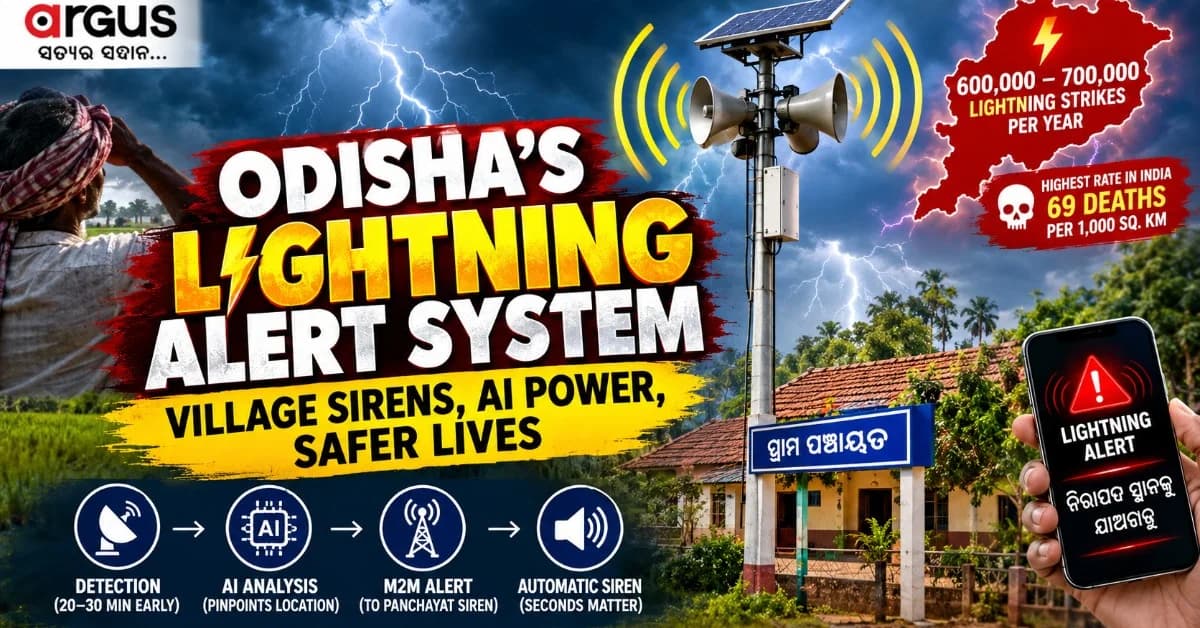
Bhubaneswar: With Odisha experiencing an average of 600,000 to 700,000 lightning strikes per year, the CROPC national density database, listed the State as the one having the highest concentrated rate of strikes in terms of geographical area, logging 69 deaths per 1,000 square kilometers over historical mapping periods.
In the above context, the State is readying up a resilient disaster warning across vulnerable districts to protect farmers, who constitute the largest fatalities owing to lightening.
Delivering the keynote address at the valedictory session of a national workshop on lightning safety, Rajesh Prabhakar Patil, Managing Director of the Odisha State Disaster Management Authority (OSDMA), emphasized moving beyond mere demonstrative pilots toward full-scale statewide execution.

📱 Get Argus News App
✨“Implementing automated siren systems at the Panchayat level alongside accessible, early alerts will play a game-changing role in saving precious human lives during lightning storms,” stated Patil.
This policy directive marks a significant shift. By placing automated early warning sirens at the Gram Panchayat (village council) level, Odisha aims to transform lightning safety from a private smartphone privilege into a public, hyper-local utility.
How It Works: Shifting from Hours to Seconds
Traditional weather models provide wide-area outlooks covering thousands of square kilometers. Lightning, however, is a localized event. A lightning strike develops and discharges within fractions of a second, though the conditions that brew it take about half an hour to assemble.
The upcoming automated system targets this crucial assembly window. The operational sequence follows a strict, human-free chain of logic to save precious minutes:
· Atmospheric Reading: Ground-based lightning detection networks and Doppler weather radars scan the atmosphere for electromagnetic changes. They track cloud-to-cloud lightning activity, which naturally occurs 20 to 30 minutes before a fatal cloud-to-ground strike hits the earth.
· AI Localization: High-speed Artificial Intelligence (AI) and Machine Learning (ML) models process this atmospheric friction, pinning down the exact trajectory of a thunderstorm down to a specific grid.
· The M2M Trigger: Instead of a meteorologist calling a district collector, who then alerts a local block officer, the data system uses Machine-to-Machine (M2M) communication. If a Panchayat is in the hazard zone, a digital packet is sent directly to the local siren tower via cellular or satellite networks.
· Audible Warning: The tower receives the command and triggers its high-decibel speakers automatically, blanketing the village with a clear audio warning well before the sky turns dark.
Managing the Psychology: Why People Will Not Panic
A sudden loud noise in a quiet village can trigger chaotic panic, driving people to run erratically, abandon vehicles unsafely, or cause stampedes. To counter this, OSDMA's roadmap relies on specialized acoustic engineering and community familiarity.
1. A Distinct, Multi-Tiered Sound Profile
The village sirens will not use the terrifying, continuous air-raid wail reserved for heavy military actions or major dam failures. Instead, the sirens emit a rhythmic, progressive pulse sequence. The sound ramps up slowly, signaling a proactive, orderly directive to seek shelter rather than a frantic call to flee.
2. Localized Voice Integration
The siren towers are dual-purpose, serving as both an alarm and a public address system. The moment the initial distinctive pulse ends, the tower broadcasts a pre-recorded, clear message in the local Odia dialect. The voice tells the community exactly what is happening: "Attention, an automated lightning alert has been triggered for this area. Please step away from open fields, electrical poles, and tall trees, and move calmly to the nearest concrete building or safety shelter." By replacing ambiguity with clear instructions, the system minimizes public panic.
3. Community Drills and Education
A major reason people panic during alarms is a lack of conditioning. Before the full-scale rollout goes live, local community bodies will conduct regular, pre-announced test chimes. This helps farmers, outdoor workers, and school children recognize the distinct sound pattern, ensuring their reaction is a practiced, calm habit rather than an emotional reflex.
Has This Tech Been Used Elsewhere in India?
Odisha is not alone in identifying lightning as a major disaster priority. Other Indian states facing severe seasonal thunder strikes have been experimenting with outdoor hooter systems and targeted sensors:
· Uttar Pradesh (UPLAMS): The Uttar Pradesh government, in collaboration with the Indian Institute of Tropical Meteorology (IITM), initiated the Uttar Pradesh Lightning Alert Management System. Utilizing Time of Arrival (ToA) sensor networks, the state integrated physical hooters and public address systems across high-risk districts to give farmers an automated 30-minute head start.
· Jharkhand: Known for high casualty rates during the monsoon, the Jharkhand Disaster Management Department has used field hooter systems linked with global tracking data to safeguard specific high-risk pockets and agricultural patches.
· National Cell Broadcasts: At the union level, the Government of India has been testing the SACHET emergency alert Framework. This system sends loud siren-style pop-ups directly to mobile phones within specific geo-targeted cells, overriding silent modes to ensure direct communication.
What sets Odisha’s new strategy apart is its planned scale. By driving the initiative directly into the Gram Panchayat framework, the state is ensuring that warning infrastructure is embedded directly into the local civic fabric. Supported by the state's upcoming comprehensive safety roadmap, these physical village sirens are poised to close the deadly last-mile gap and keep rural communities safe.
Related Topics
Explore more stories