



Eastern Ghats / El Niño 2026 Impact on Odisha: District-Wise Forecast Reveals Eastern Ghats May Be Shielding Southern Odisha from Heat and Rainfall Deficit | Exclusive
Key Points
Bhubaneswar: Dynamic climate play is on. It has undergone through a rapid shift from a neutral state in January 2026 to a full El Niño activation in May 2026, the ENSO Alert System has locked the climate dial into an active El Niño status.
For Odisha, the immediate consequences for June and the summer monsoon season are clear. The IMD and Apec Climate Centre data indicate how many districts will record extreme thermal distress and a major moisture deficit.
Here is an exclusive impact analysis across the state's geographical zones:
High Heat & Suppressed Rain (Northern Odisha)

📱 Get Argus News App
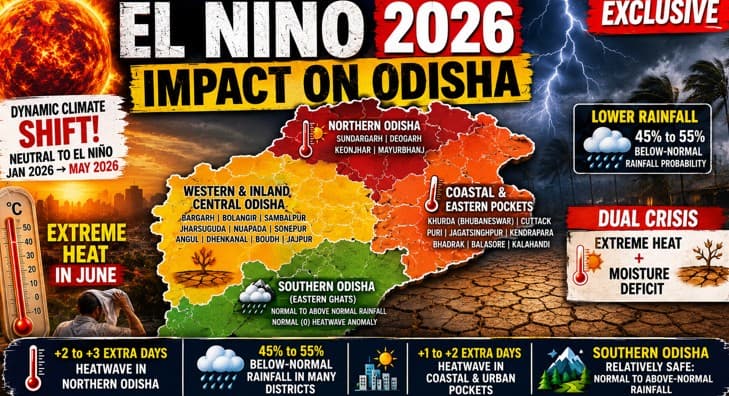
✨The Northern belt is the hardest-hit region in the state, bearing the brunt of a severe dual climate crisis.
- The Vulnerability: This zone combines the highest heatwave anomalies with a steep drop in precipitation.
- Impacted Districts: Sundargarh, Deogarh, Keonjhar, and Mayurbhanj.
- The Outlook: The maps reveal dark maroon grid boxes here, indicating an extreme anomaly of +2 to +3 extra days of heatwave duration in June. Simultaneously, the region is shaded in yellow and light orange, indicating a 45% to 55% probability of below-normal precipitation during the critical initial phases of the summer monsoon.
Low Rainfall Zone (Western & Inland Central Odisha)
Further inland, the crisis transitions from extreme atmospheric heat to a profound, prolonged agricultural moisture deficit.
- The Vulnerability: A clear, widespread deficit in seasonal rainfall, though localized heatwave anomalies remain closer to normal baseline levels.
- Impacted Districts: The Western agricultural belt-Bargarh, Bolangir, Sambalpur, Jharsuguda, Nuapada, and Sonepur (Subarnapur)-alongside inland central transition pockets including Angul, Dhenkanal, Boudh, and Jajpur.
- The Outlook: These districts sit under a solid yellow/orange footprint, locking in a 45% to 55% probability of below-normal rainfall. This threatens to trigger acute moisture stress for rain-fed crops.
High Heat Zone (Coastal & Eastern Urban Pockets like Bhubaneswar)
Along the coastal plains and eastern interior, the primary threat shifts to intense, oppressive thermal anomalies aggravated by urban environment trapping.
- The Vulnerability: Moderate to high heatwave anomalies coupled with an overall deficit in seasonal rain accumulation.
- Impacted Districts: Khurda (including Bhubaneswar), Cuttack, Puri, Jagatsinghpur, Kendrapara, Bhadrak, and Balasore, alongside interior hotspots like Kalahandi.
- The Outlook: The IMD heat Map has clearly outlined that these areas will suffer +1 to +2 extra days of heatwave conditions in June, driving up cooling demands and urban heat index levels.
The Regional Exception (Southern Odisha)
- The Vulnerability: Relative safety from the El Niño monsoon suppression.
- The Outlook: The IMD map forecast has clearly indicated that these district of Odisha sitting on the lap of Eastern Ghats stand apart with a projected tendency toward normal to above-normal precipitation and normal (0) heatwave anomalies.
The Bottomline
A deeper
glance at the IMD latest Monsoon map indicates a bigger narrative.
The apparently
big takeaway has been that an intriguing pattern emerges – districts located
along the Eastern Ghats appear less vulnerable to El Niño's drying influence
than northern and western Odisha.
Interestingly, Eastern Ghats region in the peninsular India, too, will record normal rainfall, IMD updated forecast reveals.
While the
topography may be playing a protective role, experts would need detailed
studies to confirm whether the mountain range is acting as a climatic buffer.
Also Read: El Nino Odisha Impact / Super El Nino 2026: Forget June, Odisha winter to have warmer nights but Cyclone Chances Lower| Exclusive
Related Topics
Explore more stories