



Weather Alert / El Nino Disrupts Monsoon as Odisha Faces Rain Deficit
Key Points
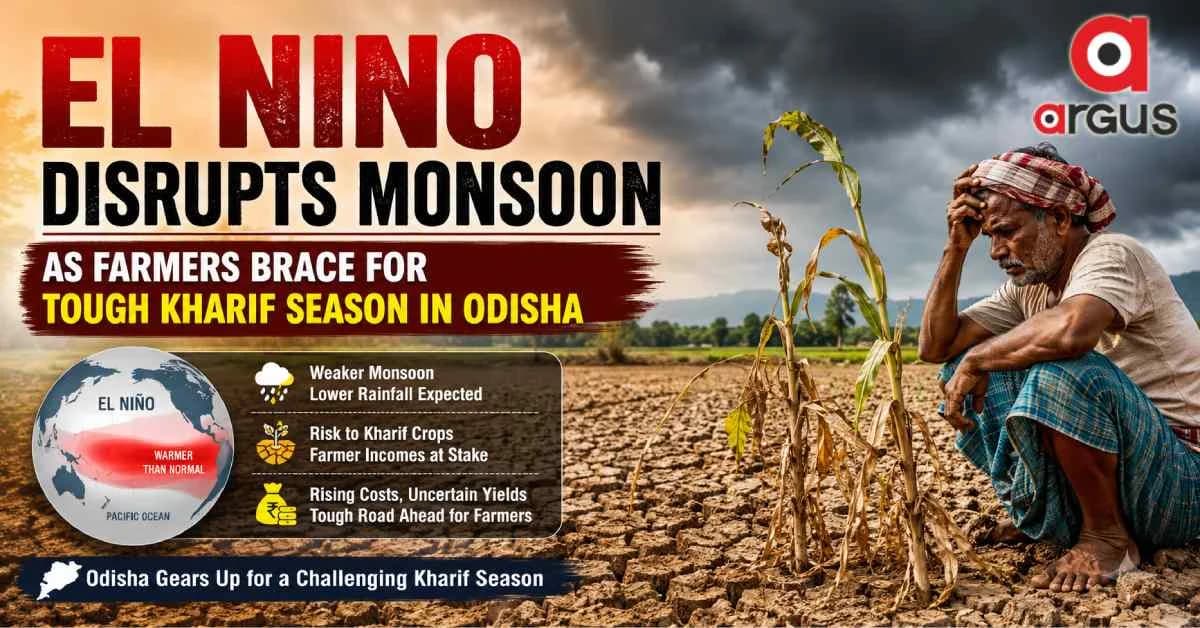
El Nino has disrupted Odisha’s monsoon, causing heatwaves and rainfall deficits. IMD warns of below-normal showers in August-September, threatening kharif crops.
Bhubaneswar, Aug 3: The monsoon season in Odisha has turned unpredictable this year, with extreme variations in rainfall and rising temperatures.
June witnessed scorching heat and below-normal showers, while July brought excessive rainfall. However, the Indian Meteorological Department (IMD) now forecasts reduced rainfall in August and September, raising concerns for farmers and the agricultural sector.
The primary cause behind this irregularity is the El Nino phenomenon developing over the Pacific Ocean. El Nino is known to disrupt global weather patterns, leading to higher temperatures and erratic rainfall.
Also read: Odisha Govt Reveals Full Flood Compensation Package

📱 Get Argus News App
✨Odisha is already feeling its impact, with weak monsoon currents leaving coastal regions hot and humid. On August 3, Balasore recorded a maximum temperature of 34.4°C, while Bhubaneswar registered 33.4°C.
IMD predicts temperatures may rise further by 2-3°C in the coming days, with limited chances of rainfall.
Historically, Odisha receives an average of 422.8 mm rainfall during August and September. Any significant reduction will directly affect kharif crops, according to IMD scientist Manorama Mohanty.
The state has already recorded 32% less rainfall between June 1 and August 1, with only 560.6 mm against the normal 739.9 mm. Districts like Malkangiri, Gajapati, and Nabarangpur have faced severe rainfall deficits, while Sundargarh, Koraput, Rayagada, Kalahandi, and Ganjam have managed near-normal showers.
The situation is not limited to Odisha. IMD warns that the entire country may experience below-normal rainfall in August and September. This could pose challenges for agriculture and water resources nationwide.
Experts suggest that if the Indian Ocean Dipole (IOD)
becomes active, it may partially offset El Nino’s impact and bring some relief.
Otherwise, August 2026 could emerge as one of the most challenging months for
India’s monsoon-dependent economy.
Related Topics
Explore more stories