



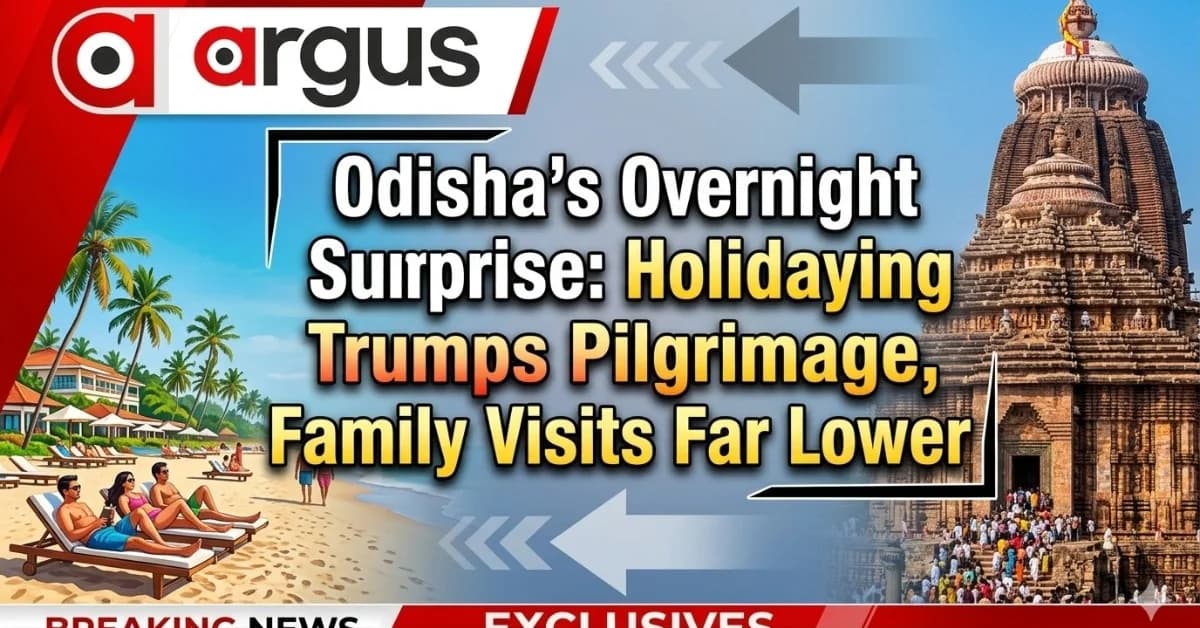
EXCLUSIVE| NSSO Report: Odisha’s Overnight Travel Map Throws Up a Surprise with Leisure Trips Outnumbering Religious, Social Visits Rank Lower
Key Points
Medical & Leisure Lead: Health and medical travel is the state's largest overnight travel driver at 15,649 trips, while leisure travel (7,631 trips) outpaces religious pilgrimage (5,271 trips).
Internal Mobility: Approximately 88% of recorded overnight trips remain within Odisha, showing residents rely heavily on internal destinations rather than interstate travel.
Rural Dominance: Roughly 80.3% of Odisha's total 365-day overnight trips originate from rural areas, linking travel patterns directly to healthcare accessibility and local connectivity.
Bhubaneswar: Odisha may be known nationally for Jagannath culture, pilgrimage and religious tourism, but the latest overnight-travel data throws up a different picture of how residents of the state actually travel.
According to the NSSO estimates, Odisha recorded 7,631 overnight trips (in 00s) for holidaying, leisure and recreation during the last 365 days, against 5,271 trips for pilgrimage and religious purposes.
The gap is not marginal: leisure travel was about 45% higher than religious travel.
But the biggest overnight-travel driver in Odisha was neither leisure nor religion. It was health and medical travel, with an estimated 15,649 trips (in 00s) during the same 365-day reference period.

📱 Get Argus News App
✨That produces an interesting three-layer picture of Odisha's travel economy: medical necessity at the top, leisure ahead of pilgrimage, and a strong preference for travelling within the state.
Odisha's overnight travel hierarchy
|
Purpose |
Odisha: estimated overnight trips (00s) |
Reading the data |
|---|---|---|
|
Health & Medical |
15,649 |
Largest 365-day purpose
Holidaying, Leisure & Recreation
7,631
Second-largest listed purpose
Pilgrimage & Religious
5,271
Below leisure
Shopping
128
Very small overnight component
Total
28,679
All listed 365-day purposes
The finding is particularly significant because it challenges a straightforward assumption that religious travel should dominate Odisha's overnight tourism because of the state's major pilgrimage centres.
It does not, however, establish that religious travel is weak in Odisha.
The NSSO measure is specifically about overnight trips. A religious visit completed and returned from on the same day would not appear in this category. Odisha's compact geography and the concentration of major religious destinations - including Puri, Bhubaneswar and Konark – make this distinction important.
In other words, the data measures overnight religious mobility, not religiosity.
Leisure beats pilgrimage – but Odisha is not a long-distance travelling state
The second important finding emerges when the travel destination is examined.
For every 1,000 overnight trips made by Odisha residents, around:
430 remain within the same district;
450 travel outside the district but remain within Odisha;
only 119 cross the state's boundary.
That means approximately 88% of the recorded overnight trips remain within Odisha.
This is perhaps the strongest behavioural signal in the dataset.
Odisha's residents appear to be highly mobile within the state but comparatively less dependent on interstate travel for overnight purposes.
|
Destination of Odisha residents |
Trips per 1,000 |
|---|---|
|
Within same district |
430 |
|
Outside district, within Odisha |
450 |
|
Outside Odisha |
119 |
The pattern is even more striking against neighbouring states.
The corresponding out-of-state share is about 561 per 1,000 in Jharkhand, 407 in Chhattisgarh and 271 in West Bengal, compared with only 119 in Odisha.
This suggests that Odisha's overnight travel demand is substantially internally oriented.
Its beaches, forests, waterfalls, temples and other destinations potentially provide residents with a large geographical range without requiring an interstate journey.
The religious-travel puzzle
Odisha's 5,271 religious overnight trips are substantially below Andhra Pradesh's 21,979 and West Bengal's 11,444.
Even Jharkhand records 10,421.
But this should not be interpreted as evidence that Odias undertake fewer religious visits overall.
The crucial word is overnight.
A resident of Cuttack travelling to Puri for darshan and returning the same day contributes nothing to the overnight-trip count. The same applies to many journeys to Bhubaneswar, Konark or other destinations that can be reached and covered without staying overnight.
Therefore, the NSSO numbers point towards a more specific conclusion:
Religious mobility in Odisha may be relatively localised and frequently completed without an overnight stay.
That is a considerably different proposition from saying that pilgrimage is unimportant to Odias.
Rural Odisha generates the bulk of overnight travel
Of Odisha's 28,679 estimated overnight trips across the listed 365-day purposes, 23,027 originated in rural areas.
That is approximately 80.3%.
The same rural dominance appears in the shorter 30-day reference period: 8,885 of 12,392 trips, or about 71.7%, originated in rural areas.
This means the state's overnight travel story cannot be read simply as an urban tourism phenomenon.
A large part of the movement originates in rural Odisha—and the largest long-period purpose is medical travel.
That combination makes the data relevant to healthcare accessibility, transport connectivity and household travel costs, not merely tourism policy.
Social travel remains important – but the numbers need careful reading
The 30-day dataset shows that social travel is by far the dominant short-term overnight purpose in Odisha, at 11,343 trips (in 00s).
That is more than 20 times the state's business travel estimate of 554 and vastly exceeds education/training travel at 249.
|
Purpose — last 30 days |
Odisha |
Andhra Pradesh |
Chhattisgarh |
Jharkhand |
West Bengal |
|---|---|---|---|---|---|
|
Business |
554 |
561 |
204 |
493 |
1,437 |
|
Social |
11,343 |
18,994 |
5,441 |
13,679 |
34,232 |
|
Education & Training |
249 |
343 |
95 |
227 |
325 |
|
Total listed |
12,392 |
20,603 |
5,956 |
14,585 |
36,517 |
Odisha's social overnight travel is below Andhra Pradesh, Jharkhand and West Bengal, but above Chhattisgarh.
It would be tempting to interpret this as evidence of weakening family or social cohesion.
The data does not support that conclusion by itself.
As per expert vew, Social-trip volumes can also reflect population size, migration patterns, household distribution, employment mobility, distance between family members, income, transport availability and the frequency with which visits require an overnight stay.
Therefore, as per experts, the safer interpretation is that Odisha records a lower volume of overnight social mobility than some neighbouring states—not necessarily weaker family relationships.
Odisha's business-travel signal is also relatively small
At 554 trips (in 00s), Odisha's business-related overnight travel is almost identical to Andhra Pradesh's 561, but substantially below West Bengal's 1,437.
It is nevertheless more than twice Chhattisgarh's 204.
This suggests that overnight business travel forms only a small component of Odisha's overall short-term travel pattern.
This suggests fewer business magnets in Odisha, and mostly concentrated in Twin Cities or in south concetrarted in Berhampur, Business transactions frequently do not require overnight stays, and the data captures travel behaviour rather than economic output.
Odisha versus its neighbours: a distinctly different travel profile
The state comparison reveals three different patterns.
West Bengal records the largest volumes across the major categories shown here, including 17,949 leisure trips, 11,444 religious trips and 32,260 medical trips.
Andhra Pradesh stands out particularly for religious travel, with 21,979 overnight pilgrimage/religious trips.
Odisha, by contrast, records a comparatively strong leisure component but a much smaller religious overnight component.
|
State |
Leisure |
Religious |
Medical |
Total |
|---|---|---|---|---|
|
Odisha |
7,631 |
5,271 |
15,649 |
28,679 |
|
Andhra Pradesh |
6,266 |
21,979 |
12,122 |
40,499 |
|
Chhattisgarh |
2,303 |
4,313 |
2,776 |
9,520 |
|
Jharkhand |
1,936 |
10,421 |
7,206 |
19,694 |
|
West Bengal |
17,949 |
11,444 |
32,260 |
61,746 |
Odisha's 7,631 leisure trips are second only to West Bengal among the neighbouring states examined.
But its 5,271 religious trips are lower than every state in the comparison except Chhattisgarh.
That creates an unusual contrast: Odisha's residents appear to undertake more overnight leisure travel than overnight pilgrimage travel, even though the state itself is one of India's most prominent religious destinations.
The inbound-outbound distinction matters
There is another important layer to the dataset.
The outbound travel behaviour of Odisha residents should not automatically be confused with the reasons why people from outside Odisha travel into the state.
The destination-purpose distribution provided for inbound visitors indicates that religious/pilgrimage and leisure travel form major components of visits to Odisha, with the figures showing 547 per 1,000 for religious/pilgrimage and 368 per 1,000 for holidaying/leisure.
This creates a potentially important tourism distinction:
Odisha residents do not need to travel far outside the state for many of their leisure or religious needs, while visitors from outside the state may travel specifically because Odisha contains destinations they cannot access at home.
What the data really tells us
Taken together, the NSSO figures point towards an Odisha with a distinctive overnight-mobility pattern.
First, leisure travel exceeds religious overnight travel by about 2,360 trips (00s).
Second, social visits dominate the shorter 30-day travel window.
Third, rural Odisha accounts for roughly four-fifths of the 365-day overnight trips.
Fourth, Odisha residents are overwhelmingly travelling within the state rather than crossing state borders.
And Fifth, Odisha's relatively low religious overnight figure should not be mistaken for low religious activity because same-day pilgrimage is outside the scope of an overnight-trip measure.
The larger Odisha story
The data therefore paints a picture that is more nuanced than the conventional image of Odisha as primarily a pilgrimage-travel state.
For its own residents, Odisha functions substantially as a self-contained travel geography.
People travel, but much of that movement happens within the state's boundaries. When an overnight stay becomes necessary, medical requirements constitute the largest long-period trigger, while leisure travel occupies a surprisingly large position ahead of pilgrimage.
For policymakers, the numbers therefore connect tourism with healthcare, rural connectivity and internal mobility.
For the tourism sector, the leisure figure suggests that the domestic Odisha market itself represents a substantial travel base.
And for any interpretation of Odisha's religious tourism, the caveat is critical: an overnight-trip survey cannot measure the full scale of pilgrimage when a large share of religious journeys may begin and end on the same day.
Bottom line
The NSSO data does not show that Odias are becoming less religious or less connected to their families. What it does show is something more precise: among overnight journeys, leisure travel has overtaken pilgrimage, and most Odisha residents' overnight movement remains within the state.
That
makes Odisha's travel story less about long-distance mobility and
more about how
leisure, family networks and the state's own geography shape where
people spend a night away from home.
Also Read:NSSO Survey Unravels Odisha Tourism Paradox: Inside Why State Lags Behind Andhra Pradesh in Interstate Pilgrimage Footprint
Related Topics
Explore more stories