



The Algorithmic Village: What Would A Fully Digital Indian Village Look Like?
·1 hour ago·10 min read
Key Points
Author and policy professional Hrudananda Prusty explores the concept of the "algorithmic village" -- a village where digital connectivity, public databases and local institutions work together to improve governance and service delivery.
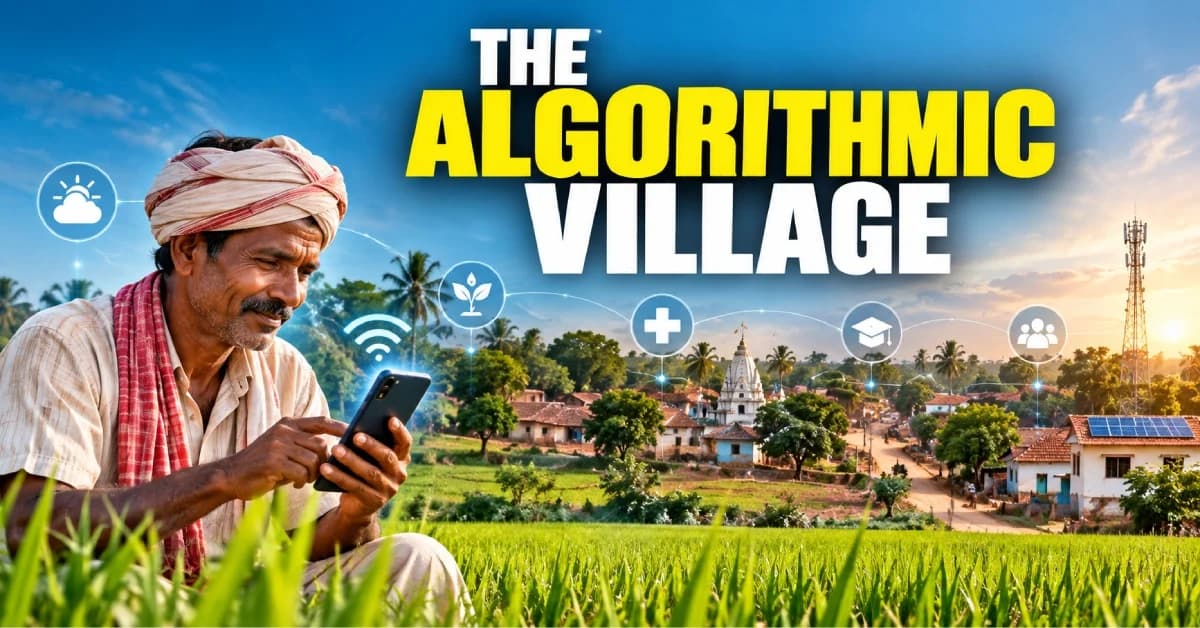
Imagine an Indian village where a farmer receives a weather-based advisory before sowing a crop, a patient consults a specialist without travelling to the district headquarters, a young person discovers a skilling opportunity through a mobile phone, and a Gram Sabha reviews the progress of development projects before making decisions.
The Panchayat no longer has to rely entirely on paper files to understand what is happening on the ground. Information is readily available, public services are connected, and decisions are informed by reliable data. This is the idea behind what may be called the algorithmic village.
The term may sound futuristic, but its foundations are already taking shape in India. An algorithmic village is not one governed by machines or artificial intelligence. It is a village where digital connectivity, public databases, technology and local institutions work together to make governance more efficient, public services more accessible and everyday life better for citizens.
The real transformation, therefore, is not about introducing more technology into rural areas. It is about using technology to address the problems people face and expand their access to opportunities.
The Panchayat no longer has to rely entirely on paper files to understand what is happening on the ground. Information is readily available, public services are connected, and decisions are informed by reliable data. This is the idea behind what may be called the algorithmic village.
The term may sound futuristic, but its foundations are already taking shape in India. An algorithmic village is not one governed by machines or artificial intelligence. It is a village where digital connectivity, public databases, technology and local institutions work together to make governance more efficient, public services more accessible and everyday life better for citizens.
The real transformation, therefore, is not about introducing more technology into rural areas. It is about using technology to address the problems people face and expand their access to opportunities.

📱 Get Argus News App
✨📰 60 Word News🎬 Argus Podcast📺 Live TV and Breaking News🔔 Free Notification Alerts
Download Free:
India has made considerable progress in extending digital connectivity to the grassroots. As of June 2026, 2.21 lakh Gram Panchayats had been made service-ready under BharatNet, while more than 80,000 Gram Panchayats had operational BharatNet Points of Presence. This infrastructure can support far more than internet access. It can facilitate education, healthcare, governance, commerce and entrepreneurship in rural areas.
The next challenge is to move beyond connecting villages to the internet and connect people to better public services, information and economic opportunities.
Agriculture: Turning Data Into Decisions
Agriculture remains central to rural India, and a farmer's decisions about what to grow and when to sow depend on several factors, including rainfall, soil conditions, irrigation availability, pest risks and market prices. Yet, this information is often scattered across different sources, making it difficult for farmers to access and interpret it at the right time.
A digitally enabled agricultural system could bring these information streams together and provide simple, local-language advisories tailored to farmers' needs. Instead of expecting farmers to interpret complex datasets, technology could translate them into practical recommendations on sowing, irrigation, pest management and marketing.
The farmer does not need to understand how an algorithm works. What matters is whether the information helps improve a decision.
Such systems must, however, account for local conditions and the uncertainties inherent in farming. Digital advisories should complement farmers' experience and agricultural extension services, not replace them. Their value will ultimately depend on the accuracy, timeliness and usefulness of the information they provide.
The next challenge is to move beyond connecting villages to the internet and connect people to better public services, information and economic opportunities.
Agriculture: Turning Data Into Decisions
Agriculture remains central to rural India, and a farmer's decisions about what to grow and when to sow depend on several factors, including rainfall, soil conditions, irrigation availability, pest risks and market prices. Yet, this information is often scattered across different sources, making it difficult for farmers to access and interpret it at the right time.
A digitally enabled agricultural system could bring these information streams together and provide simple, local-language advisories tailored to farmers' needs. Instead of expecting farmers to interpret complex datasets, technology could translate them into practical recommendations on sowing, irrigation, pest management and marketing.
The farmer does not need to understand how an algorithm works. What matters is whether the information helps improve a decision.
Such systems must, however, account for local conditions and the uncertainties inherent in farming. Digital advisories should complement farmers' experience and agricultural extension services, not replace them. Their value will ultimately depend on the accuracy, timeliness and usefulness of the information they provide.
The Panchayat As A Digital Nerve Centre
The Gram Panchayat could become the institutional centre of an algorithmic village, bringing together information about public works, budgets, assets and citizen needs.
India has already developed eGramSwaraj, a digital platform that supports Panchayat planning, budgeting, accounting, asset management and monitoring. During 2025-26, 2,55,251 Gram Panchayats and equivalent institutions uploaded their Gram Panchayat Development Plans on the platform. Meanwhile, 2,45,839 used the eGramSwaraj-PFMS interface for payments amounting to ₹57,337 crore.
These figures demonstrate the scale at which digital governance systems are being used at the Panchayat level. The next step is to make the information they generate more accessible and useful for local decision-making.
Imagine a Panchayat representative being able to identify public assets requiring maintenance, projects facing delays, expenditure against approved budgets and services most frequently requested by citizens. Such information could help local representatives identify priorities, allocate resources more effectively and monitor implementation.
Instead of preparing development plans largely on the basis of past practices or information scattered across files, Panchayats could increasingly use data to understand local needs and assess outcomes.
Technology would not replace elected representatives or the democratic process. It would give them better information to discharge their responsibilities and help citizens hold local institutions accountable.
Healthcare: Taking Expertise Closer To Villages
For rural families, access to healthcare is often shaped by distance, the availability of specialists and the cost of travel. A consultation at a district hospital can mean losing a day's wages, arranging transport and navigating an unfamiliar healthcare system.
India's Ayushman Arogya Mandirs already incorporate teleconsultation into their service architecture. With stronger digital connectivity, these services could become part of a more integrated system of early identification, follow-up and referral.
A health worker could identify patients who need follow-up consultations, help ensure that a high-risk pregnancy is referred in time, or connect patients requiring specialist advice with doctors without an unnecessary journey.
The objective should not be to replace the human healthcare system with technology. An algorithm may flag a potential health risk, but a trained health worker understands the circumstances of an individual and their family. Clinical judgement, professional accountability and human interaction remain essential.
The guiding principle for digital healthcare in villages should be straightforward: technology can help identify risks, connect patients with services and remind them about follow-ups, while trained professionals must continue to interpret, care and decide.
Education: From Digital Access To Better Learning
Digital connectivity could also transform learning opportunities in village schools. Students could gain access to high-quality educational resources, virtual laboratories, language tools and teachers beyond their immediate geographical area.
However, digital education should not be reduced to placing a screen in every classroom. The greater opportunity lies in using technology to identify individual learning needs and support teachers in addressing them.
If a student repeatedly struggles with mathematics but performs well in language, digital learning systems could help identify the gap and suggest targeted exercises. Teachers could use such information to provide additional support rather than relying solely on standardised classroom instruction.
This would shift the role of technology from simply delivering content to supporting the learning process.
The measure of success would no longer be limited to whether a school has computers or smart classrooms. The more important question would be whether students are learning better, whether teachers can identify learning gaps earlier and whether children at risk of falling behind receive the support they need.
Technology must remain accessible to students with different abilities, languages and levels of digital access. It should strengthen the teacher's role, not diminish it.
Connecting Rural Producers To Economic Opportunities
The economic possibilities of a digitally connected village are equally significant.
A rural entrepreneur could reach customers beyond the local market. A self-help group could use digital payments and online platforms to expand its customer base. Farmers and other producers could access market information before deciding where and how to sell their products. Young people could discover employment and skilling opportunities that are not restricted by geography.
Digital connectivity can help reduce one of the longstanding disadvantages of rural economies: the distance between a producer and an opportunity.
This does not mean technology will eliminate migration or turn every village into a remote-working hub. Rural development cannot be reduced to internet access alone. Roads, electricity, education, healthcare, finance and functioning markets will remain fundamental to economic progress.
However, when digital infrastructure complements these physical systems, the geography of opportunity can change. A young person should not miss an opportunity simply because information about it is unavailable in their village.
For this to happen, digital services must be affordable, easy to use and available in local languages. Access to devices, digital literacy and reliable connectivity will be just as important as the technology itself.
Strengthening Local Democracy Through Data
Perhaps the most significant transformation could occur in local democracy.
Imagine a Gram Sabha meeting where citizens can review the status of development projects, expenditure, pending works and local priorities before discussions begin. Instead of relying exclusively on verbal updates, residents could examine available information and ask more specific questions about the implementation of public works.
Platforms such as eGramSwaraj, Meri Panchayat, Panchayat NIRNAY and SabhaSaar are contributing to a broader digital ecosystem for Panchayat governance. SabhaSaar, for instance, uses artificial intelligence-enabled tools to support the documentation of Panchayat meetings.
These systems could help make local governance more transparent and evidence-based. Citizens could examine what has been completed, what remains unfinished and where public resources may be needed most.
Yet, access to data alone does not guarantee accountability. Information must be accurate, understandable and available in time for citizens to use it. Panchayats must also have the capacity to respond to questions and act on legitimate concerns.
Data cannot replace democratic debate, local knowledge or public participation. It can, however, make discussions more informed and decisions more accountable.
The Challenges Behind The Digital Promise
Building an algorithmic village will require more than installing digital platforms. It will depend on whether different systems can exchange information, whether public data are reliable, whether local institutions have the skills to use technology and whether citizens can access services without unnecessary barriers.
Digital exclusion remains a serious concern. Older people, persons with disabilities, those with limited literacy and households without reliable internet access may struggle to use digital services. If public services become available only through digital channels, technology could deepen existing inequalities rather than reduce them.
Privacy and data security must also be central to the design of digital systems. Personal information relating to health, finances and identity should be protected, with clear rules governing its collection, use and sharing. Automated recommendations must be open to scrutiny, and citizens should have a way to challenge errors or seek human intervention.
Local institutions will need training and support to interpret information, maintain systems and resolve problems. Without these foundations, digital platforms risk becoming additional layers of administration rather than tools that improve public service delivery.
India has already built important components of this digital architecture, from rural broadband under BharatNet to Panchayat-level systems such as eGramSwaraj and the wider Digital Public Infrastructure ecosystem. The next phase should prioritise interoperability, local capacity, data quality, privacy and citizen-centric design rather than simply adding more applications.
A Village Where Technology Serves People
The fully digital Indian village of the future may not look like a city filled with screens and sophisticated devices. It could look remarkably ordinary: a Panchayat office, a school, a health worker visiting families, farmers working in their fields and young people discussing their future under a tree.
What changes is the information available to them, the ease with which they can access services and the speed at which opportunities reach their doorstep.
The algorithmic village should ultimately be judged not by the number of applications it uses or dashboards it displays, but by the outcomes it delivers. Does the farmer make a better-informed decision? Does the child learn better? Does the patient reach the right doctor sooner? Does the Panchayat use public money more transparently? Does a young person gain access to an opportunity that was previously beyond reach?
These are the questions that should guide India's next phase of rural digital transformation.
The real promise of the algorithmic village is not that algorithms will govern people. It is that better data and more accessible technology will help people govern, work, learn and live better.
The algorithm should remain invisible in the background. The citizen must remain visible at the centre.
By Hrudananda Prusty, Author and Policy Professional
The Gram Panchayat could become the institutional centre of an algorithmic village, bringing together information about public works, budgets, assets and citizen needs.
India has already developed eGramSwaraj, a digital platform that supports Panchayat planning, budgeting, accounting, asset management and monitoring. During 2025-26, 2,55,251 Gram Panchayats and equivalent institutions uploaded their Gram Panchayat Development Plans on the platform. Meanwhile, 2,45,839 used the eGramSwaraj-PFMS interface for payments amounting to ₹57,337 crore.
These figures demonstrate the scale at which digital governance systems are being used at the Panchayat level. The next step is to make the information they generate more accessible and useful for local decision-making.
Imagine a Panchayat representative being able to identify public assets requiring maintenance, projects facing delays, expenditure against approved budgets and services most frequently requested by citizens. Such information could help local representatives identify priorities, allocate resources more effectively and monitor implementation.
Instead of preparing development plans largely on the basis of past practices or information scattered across files, Panchayats could increasingly use data to understand local needs and assess outcomes.
Technology would not replace elected representatives or the democratic process. It would give them better information to discharge their responsibilities and help citizens hold local institutions accountable.
Healthcare: Taking Expertise Closer To Villages
For rural families, access to healthcare is often shaped by distance, the availability of specialists and the cost of travel. A consultation at a district hospital can mean losing a day's wages, arranging transport and navigating an unfamiliar healthcare system.
India's Ayushman Arogya Mandirs already incorporate teleconsultation into their service architecture. With stronger digital connectivity, these services could become part of a more integrated system of early identification, follow-up and referral.
A health worker could identify patients who need follow-up consultations, help ensure that a high-risk pregnancy is referred in time, or connect patients requiring specialist advice with doctors without an unnecessary journey.
The objective should not be to replace the human healthcare system with technology. An algorithm may flag a potential health risk, but a trained health worker understands the circumstances of an individual and their family. Clinical judgement, professional accountability and human interaction remain essential.
The guiding principle for digital healthcare in villages should be straightforward: technology can help identify risks, connect patients with services and remind them about follow-ups, while trained professionals must continue to interpret, care and decide.
Education: From Digital Access To Better Learning
Digital connectivity could also transform learning opportunities in village schools. Students could gain access to high-quality educational resources, virtual laboratories, language tools and teachers beyond their immediate geographical area.
However, digital education should not be reduced to placing a screen in every classroom. The greater opportunity lies in using technology to identify individual learning needs and support teachers in addressing them.
If a student repeatedly struggles with mathematics but performs well in language, digital learning systems could help identify the gap and suggest targeted exercises. Teachers could use such information to provide additional support rather than relying solely on standardised classroom instruction.
This would shift the role of technology from simply delivering content to supporting the learning process.
The measure of success would no longer be limited to whether a school has computers or smart classrooms. The more important question would be whether students are learning better, whether teachers can identify learning gaps earlier and whether children at risk of falling behind receive the support they need.
Technology must remain accessible to students with different abilities, languages and levels of digital access. It should strengthen the teacher's role, not diminish it.
Connecting Rural Producers To Economic Opportunities
The economic possibilities of a digitally connected village are equally significant.
A rural entrepreneur could reach customers beyond the local market. A self-help group could use digital payments and online platforms to expand its customer base. Farmers and other producers could access market information before deciding where and how to sell their products. Young people could discover employment and skilling opportunities that are not restricted by geography.
Digital connectivity can help reduce one of the longstanding disadvantages of rural economies: the distance between a producer and an opportunity.
This does not mean technology will eliminate migration or turn every village into a remote-working hub. Rural development cannot be reduced to internet access alone. Roads, electricity, education, healthcare, finance and functioning markets will remain fundamental to economic progress.
However, when digital infrastructure complements these physical systems, the geography of opportunity can change. A young person should not miss an opportunity simply because information about it is unavailable in their village.
For this to happen, digital services must be affordable, easy to use and available in local languages. Access to devices, digital literacy and reliable connectivity will be just as important as the technology itself.
Strengthening Local Democracy Through Data
Perhaps the most significant transformation could occur in local democracy.
Imagine a Gram Sabha meeting where citizens can review the status of development projects, expenditure, pending works and local priorities before discussions begin. Instead of relying exclusively on verbal updates, residents could examine available information and ask more specific questions about the implementation of public works.
Platforms such as eGramSwaraj, Meri Panchayat, Panchayat NIRNAY and SabhaSaar are contributing to a broader digital ecosystem for Panchayat governance. SabhaSaar, for instance, uses artificial intelligence-enabled tools to support the documentation of Panchayat meetings.
These systems could help make local governance more transparent and evidence-based. Citizens could examine what has been completed, what remains unfinished and where public resources may be needed most.
Yet, access to data alone does not guarantee accountability. Information must be accurate, understandable and available in time for citizens to use it. Panchayats must also have the capacity to respond to questions and act on legitimate concerns.
Data cannot replace democratic debate, local knowledge or public participation. It can, however, make discussions more informed and decisions more accountable.
The Challenges Behind The Digital Promise
Building an algorithmic village will require more than installing digital platforms. It will depend on whether different systems can exchange information, whether public data are reliable, whether local institutions have the skills to use technology and whether citizens can access services without unnecessary barriers.
Digital exclusion remains a serious concern. Older people, persons with disabilities, those with limited literacy and households without reliable internet access may struggle to use digital services. If public services become available only through digital channels, technology could deepen existing inequalities rather than reduce them.
Privacy and data security must also be central to the design of digital systems. Personal information relating to health, finances and identity should be protected, with clear rules governing its collection, use and sharing. Automated recommendations must be open to scrutiny, and citizens should have a way to challenge errors or seek human intervention.
Local institutions will need training and support to interpret information, maintain systems and resolve problems. Without these foundations, digital platforms risk becoming additional layers of administration rather than tools that improve public service delivery.
India has already built important components of this digital architecture, from rural broadband under BharatNet to Panchayat-level systems such as eGramSwaraj and the wider Digital Public Infrastructure ecosystem. The next phase should prioritise interoperability, local capacity, data quality, privacy and citizen-centric design rather than simply adding more applications.
A Village Where Technology Serves People
The fully digital Indian village of the future may not look like a city filled with screens and sophisticated devices. It could look remarkably ordinary: a Panchayat office, a school, a health worker visiting families, farmers working in their fields and young people discussing their future under a tree.
What changes is the information available to them, the ease with which they can access services and the speed at which opportunities reach their doorstep.
The algorithmic village should ultimately be judged not by the number of applications it uses or dashboards it displays, but by the outcomes it delivers. Does the farmer make a better-informed decision? Does the child learn better? Does the patient reach the right doctor sooner? Does the Panchayat use public money more transparently? Does a young person gain access to an opportunity that was previously beyond reach?
These are the questions that should guide India's next phase of rural digital transformation.
The real promise of the algorithmic village is not that algorithms will govern people. It is that better data and more accessible technology will help people govern, work, learn and live better.
The algorithm should remain invisible in the background. The citizen must remain visible at the centre.
By Hrudananda Prusty, Author and Policy Professional
Related Topics
Explore more stories