



ISRO’s Air Drop Trial: Gaganyaan Parachute Test Soars to Success
Key Points
ISRO successfully completes first Integrated Air Drop Test (IADT-01) for Gaganyaan’s parachute-based deceleration system.
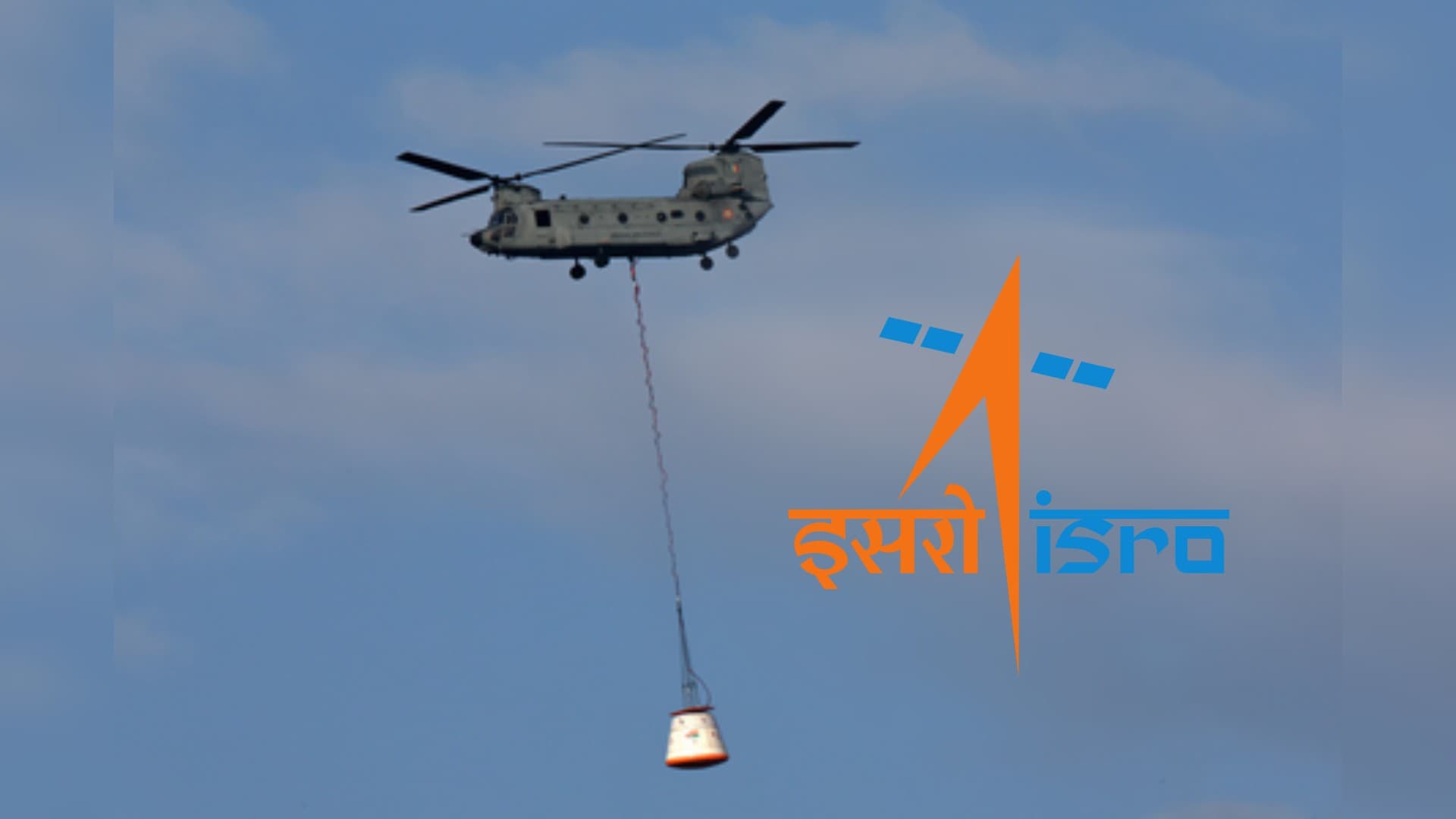
A 4.8-tonne simulated Crew Module was dropped from 3 km altitude using an IAF Chinook helicopter.
The test demonstrated a precise 10-parachute deployment sequence, reducing touchdown velocity to 8 m/s for safe sea landing.
New Delhi, Aug 25: The Indian Space Research Organisation (ISRO) has successfully completed the Air Drop Test, a key milestone for advancing the Gaganyaan human spaceflight mission.
The first Integrated Air Drop Test (IADT-01), conducted on Sunday at Satish Dhawan Space Centre (SDSC), Sriharikota, was a joint effort by the ISRO, Indian Air Force, DRDO, Indian Navy, and Indian Coast Guard.
“ISRO successfully accomplishes first Integrated Air Drop Test (IADT-01) for end-to-end demonstration of parachute-based deceleration system for Gaganyaan missions,” the Indian space agency said, in a post on social media platform X.
The test is part of "system level qualification of parachute-based deceleration system", in which a simulated Crew Module, encompassing the deceleration system, is dropped using a helicopter.
“In Gaganyaan missions, a parachute-based Deceleration system is employed during the terminal phase of Crew Module (CM) descent to reduce the touchdown velocity of the Crew Module to an acceptable limit for safe landing on sea,” ISRO said.
During IADT-01, the parachute system and its layout were kept the “same as that of Gaganyaan missions."
It comprised 10 parachutes -- two Apex Cover Separation (ACS), two Drogue, three Pilot, and three Main canopies.
The 4.8-tonne simulated Crew Module was released from about 3 km altitude using the Indian Air Force's Chinook heavy-lift helicopter.

📱 Get Argus News App
✨
"The deceleration system initiation began with firing of ACS Mortar, which deploys the Ã2.5 m ACS parachutes, which is followed by the separation of Apex cover," ISRO said.
Drogue parachutes provided the first stage of deceleration, before being released to allow the three Pilot parachutes to deploy the three Main parachutes, each with a diameter of 25 metres.
“Further, the main parachutes reduced the terminal velocity of the simulated Crew Module to about 8m/s. After touchdown, the Main parachutes were released using parachute releasers. These parachutes, totaling 10 in number, deployed in a precise sequence to gradually decrease the velocity of the Crew Module for safe touchdown,” ISRO said.
The test also “simulated a possible abort scenario on the launch pad”, with onboard avionics commanding the deceleration sequence and telemetering data to ground.
Post splashdown, the simulated Crew Module was successfully recovered and ferried back on INS Anvesha to Chennai port, ISRO said.
The space agency said that "extensive modeling of CM as well as the helicopter was carried out to address the dynamics of the underslung body". Multiple trial sorties were completed before clearance by the Test Authorisation Board (TAB).
ISRO noted that "similar tests at different deployment conditions are planned in the forthcoming days".
(IANS)