



AI Tech / Dogs to Sniff Out Cancer! Inside Bengaluru Startup Dognosis’ Bold AI Experiment
Key Points
Dognosis, a Bengaluru startup, combines trained dogs’ noses with AI to detect cancer from breath samples, achieving 91% accuracy in trials and promising affordable, non‑invasive early screening worldwide.
Bengaluru, Jul 1: Early cancer detection has long been one of medicine’s greatest challenges. Now, a Bengaluru‑based startup is attempting to change that narrative by combining two unlikely allies: the extraordinary smelling ability of dogs and the analytical power of artificial intelligence.
The company, Dognosis, is developing a breath‑based multi‑cancer early detection system that could make screening faster, cheaper, and more accessible worldwide.
Dogs and AI: A New Frontier
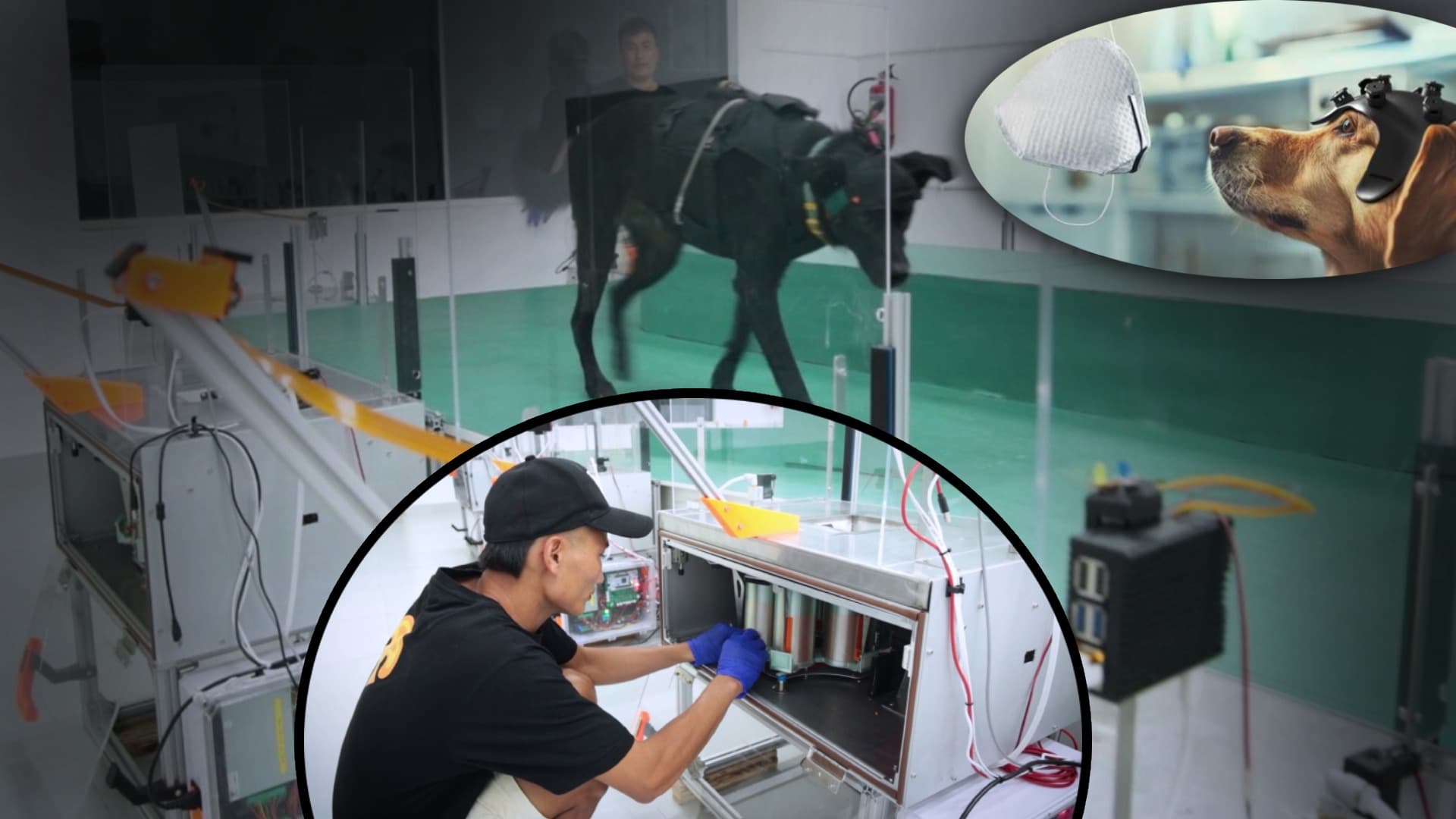
The concept is simple yet groundbreaking. Trained dogs can detect volatile organic compounds (VOCs) in human breath, which change in the presence of diseases like cancer. By pairing this natural ability with AI, Dognosis aims to transform subjective canine responses into objective, reproducible scientific data.

📱 Get Argus News App
✨Calling the initiative a “very interesting concept”, Oncologist Dr Swaratika Majumdar explained: “I have been working with diagnosis for the past year now. The concept allows for an early, easy and inexpensive way of detecting cancers.”
Also read: FSSAI Urges Food Vendors To Stop Using Newspapers For Wrapping Or Serving Food
“There is a 90 per cent sensitivity and specificity, which means that if someone has cancer, the dogs are able to identify it around 90 per cent of the time,” she added.
So, how the Test Works?
The process begins with participants breathing normally into a cotton face mask for 10 minutes. These masks capture VOCs, which are then sealed and transported to a central laboratory.
“That mask contains volatile organic compounds or VOCs, which essentially carry signals indicating whether a person has a disease or not. The masks are brought to our lab, where a team of trained dogs evaluates them and identifies these compounds with high accuracy,” explained Akash Kulgod, CEO, Dognosis.
He revealed that each sample is independently assessed by at least three dogs. Their responses are combined using advanced Bayesian statistical models that weigh each dog’s track record and participant background information. No blood draws, scans, or fasting are required.
Suba, Head of Research and Development at Dognosis, stressed the importance of uniformity. “Every sample presented here is presented in exactly the same way so that when the dog responds to it, we can record the outputs precisely. This data is then processed through AI systems trained using algorithms to convert what is usually considered subjective behaviour into objective scientific analysis."
Science behind the Sniff
Dogs are detecting VOC signatures, or “volatilomes,” that signal disease. This ability has been validated in over 40 double‑blind trials published in journals such as Nature and The Lancet.
Srishti, an office associate at Dognosis, highlighted the impact saying: “This is proof that cancer can be detected early just from breath. It is also proof that technology developed in India can contribute globally to early cancer detection.”
Phase 2 Trials: The Evidence
The company’s Phase 2 trial, published in the Journal of Clinical Oncology, was conducted across six hospitals in Karnataka in an assessor‑masked, multi‑centre case‑control format. A total of 3,275 participants were enrolled, with 1,773 used for training and 1,502 for testing.
The test cohort included 283 treatment‑naïve, biopsy‑confirmed cancer cases spanning seven major cancer groups and 1,219 controls. Results showed 91% accuracy in detecting cancer‑associated VOC breath signals across multiple cancer types, including early stages.
Reflecting on the findings, Akash Kulgod said: “We’ve known for over two decades that dogs are capable of detecting multiple types of cancers with high accuracy. The challenge has always been building a system around canine olfaction that is reproducible, scalable, and aimed at a clinical problem worth solving.”
“Multi‑cancer risk stratification from a single breath sample in countries like India is that problem, and this study shows that it can be done,” he added.
Collaboration & Training
Dognosis has partnered with Medical Detection Dogs, a UK‑based charity and leader in canine bio‑detection research, and brought in international trainers to prepare the dogs.
“I came to India because we are doing something very unique here. I think this is among the most special detection works being done with dogs anywhere in the world, and it is possible here in India,” remarked Edo, a trainer associated with the project.
Why the Concept Matters
India records lakhs of cancer cases annually, with many diagnosed only at advanced stages. Breath‑based testing offers a non‑invasive, ultra‑affordable solution — Dognosis’ system costs just $2 per test, a fraction of existing screening tools.
By democratizing early detection, Dognosis hopes to
save countless lives through timely intervention.
Related Topics
Explore more stories