



Astronomers of Indian Institute of Astrophysics Reveal Origin of Energetic Cosmic X-ray Flashes
Key Points
* Data fingerprints revealed the violent cosmic explosion happened 5 billion light-years away from Earth.
* The event unmasked a highly energetic relativistic jet unleashing an incredible $10^{51}$ ergs of kinetic energy.
Bhubaneswar: Imagine looking up at the night sky. To our eyes, it looks peaceful, dark, and mostly unchanging. But to an advanced space telescope, the universe is a frantic, roaring arena filled with sudden, violent flashes of light.
Astronomers call these cosmic blink-and-you-miss-it moments Fast X-ray Transients (FXTs). They are powerful bursts of high-energy X-ray light that suddenly ignite in the dark, flare up with brilliant luminosity, and then completely vanish within minutes or a few hours.
For decades, catching these flashes was nearly impossible. Scientists usually stumbled upon them months or even years later while combing through old satellite data, like finding a blurry photo of a shooting star long after the night had ended. Without seeing what happened immediately after the flash, the true identity of these mysterious explosions remained buried in the dark.
Everything changed with the launch of a new celestial sentinel: a cutting-edge satellite mission named the Einstein Probe (EP).
Catching a Ghost in Real-Time
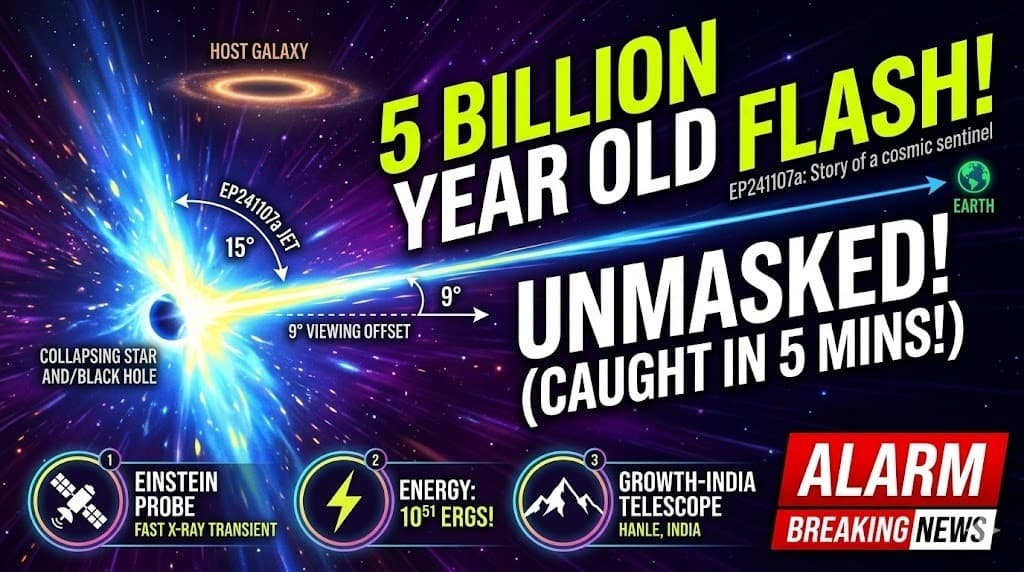
On November 7, 2024, the Wide-field X-ray Telescope aboard the Einstein Probe caught a sudden, blinding spike of energy. In the registry of space events, it was named EP241107a.
Because the Einstein Probe is built like a cosmic alarm system, it didn't just log the data; it immediately sounded the alarm to telescopes all across the globe. Within a mere five minutes, the satellite's onboard follow-up telescope pivoted to pinpoint the coordinates. Back on Earth, robotic eyes sprang into action. Just 5.5 minutes after the initial space flash, a ground telescope in China captured a newborn point of visible optical light fading at that exact spot.
Hours later, the GROWTH-India Telescope, a robotic telescope tucked away high in the Himalayas at Hanle, India, focused its gaze on the fading ember.
They successfully captured the glowing afterglow of the explosion. The next night, the massive Keck I Telescope in Hawaii spread the light out into a spectrum – the astronomical equivalent of taking a fingerprint. This fingerprint revealed the signature of a host galaxy located at a "redshift" of 0.457. In plain terms, it meant this explosion occurred in a galaxy so unimaginably far away that its light traveled for roughly 5 billion years across the expanding cosmos just to reach our sensors.
Unmasking the Culprit: A Jet in the Dark

📱 Get Argus News App
✨What could possibly unleash that much energy across the cosmos? To find out, astronomers had to look at the event through yet another lens: radio waves. Using the Karl G. Jansky Very Large Array (VLA) in New Mexico, scientists detected a glowing radio counterpart to the flash.
By combining the X-rays, the fading optical light, and the radio hum, the team of scientists – led by Deepak Eappachen and Arvind Balasubramanian, both postdoctoral fellows at the Indian Institute of Astrophysics, an autonomous institution under the Department of Science and Technology (DST)– modelled the physics.
The data pointed directly to a Gamma-Ray Burst (GRB) origin. A Gamma-Ray Burst is born when a massive star runs out of fuel and collapses into a black hole, or when two ultra-dense neutron stars collide. As the material gets sucked into the new gravity well, it coughs out a pair of incredibly tight, fiercely powerful beams of matter traveling near the speed of light – cosmic "jets".
The calculations revealed the true scale of the event:
- The Energy: The explosion unleashed a kinetic energy equivalent to $10^{51}$ ergs. To put that into perspective, that is more energy than our Sun will produce over its entire 10-billion-year lifetime, detonated in a matter of moments.
- The Angle: The jet of material wasn't pointed squarely at us. It had an opening angle of about 15 degrees, and we were viewing it slightly from the side, at an angle of about 9 degrees.
Because we were looking at the jet slightly from the edge, the initial blinding flash of gamma rays missed Earth. Instead, we caught the softer, wider "afterglow" spray of X-rays and visible light as the jet plowed into the surrounding interstellar gas. This explains why it appeared to us as a mysterious "Fast X-ray Transient" rather than a classic gamma-ray burst.
Why This Matters to the Common Man
It is easy to look at astrophysics and think it has no relevance to our daily lives on Earth. But stories like EP241107a matter for two profound reasons:
1. The Ultimate Laboratory: The universe routinely conducts physics experiments that we could never replicate on Earth. We cannot build a black hole or crush matter into a teaspoon-sized ball that weighs billions of tons. By studying these extreme jets and explosions, scientists test the very laws of nature – gravity, relativity, and nuclear physics – that ultimately govern how matter, electronics, and reality behave down here on Earth.
2. Technological Spin-offs: To catch a flash of light from 5 billion years ago in five minutes requires extreme engineering. The technology driven by astronomy – such as ultra-sensitive digital imaging sensors, automated robotic networks, and complex data-routing algorithms – constantly trickles down into daily life. The camera sensor in your smartphone, advanced medical imaging (like X-rays and PET scans), and even global communication protocols have deep roots in tools originally built to stare at the stars.
Ultimately,
missions like the Einstein Probe remind us that we live in a dynamic, deeply
connected universe. By learning to read the fleeting flashes in the dark,
humanity is mastering how to capture, analyze, and understand the most violent,
beautiful corners of existence.
Related Topics
Explore more stories