




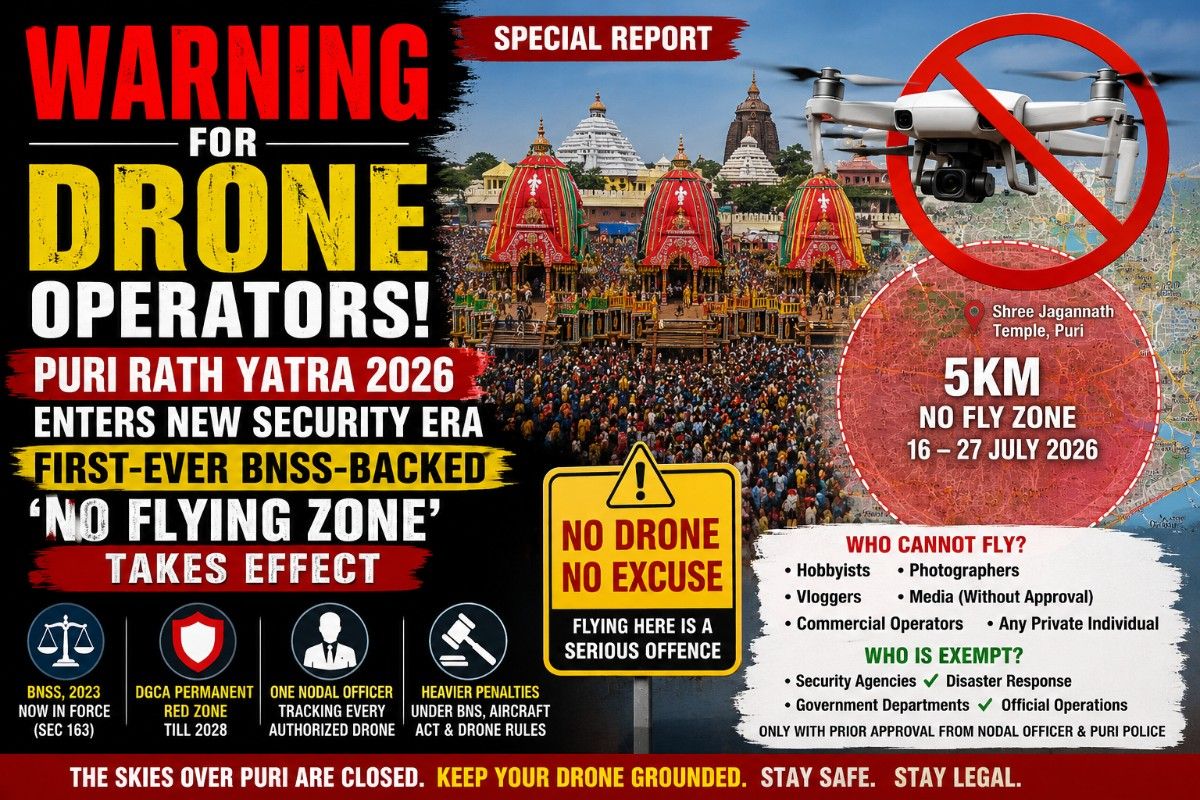
Warning for Drone Operators: Puri Rath Yatra 2026 Enters New Security Era as First-Ever BNSS-Backed 'No Flying Zone' Takes Effect | Special Report
Key Points
First BNSS Enforcement: The 2026 drone ban drops the old CrPC framework to invoke Section 163 of the new Bharatiya Nagarik Suraksha Sanhita (BNSS) for rapid legal prosecution.
Dual-Layer Security Blanket: Temporary district-level restrictions now overlay a permanent DGCA "Red Zone" classification active over Shree Jagannath Temple until 2028.
Centralized Clearance Desk: All private and media drone flights are strictly barred, with official state surveillance tightly regulated by a designated Nodal Officer (ADM Revenue).
Bhubaneswar: If you are planning to fly a drone during the upcoming Puri Rath Yatra 2026, think again.
For the first time since India's criminal justice laws were overhauled, the Puri district administration has enforced a 5-km No Flying Zone under the Bharatiya Nagarik Suraksha Sanhita (BNSS), 2023, significantly strengthening the legal consequences for unauthorized drone operations.
The order, issued by the District Magistrate of Puri on July 9, prohibits the launching, operation, or flying of any drone or Unmanned Aircraft System (UAS) within a five-kilometre radius of Puri town from July 16 to July 27, covering the entire Rath Yatra and Bahuda Yatra period.
Unlike previous years, this is no longer just a temporary administrative advisory. Officials say the 2026 order marks the beginning of a tougher enforcement regime backed by India's new criminal procedure law, permanent DGCA airspace restrictions, and centralized surveillance.
This Isn't the Same Drone Ban as Previous Years
Authorities have imposed temporary drone restrictions during Rath Yatra in the past. However, the 2026 order introduces three major changes that every drone operator – whether hobbyist, commercial photographer, YouTuber or media professional – should understand.
1. First Rath Yatra Drone Ban Under BNSS
Until 2025, prohibitory orders for festivals were issued under Section 144 of the Code of Criminal Procedure (CrPC), 1973.
The 2026 order is the first to invoke Section 163 of the Bharatiya Nagarik Suraksha Sanhita (BNSS), 2023, India's new criminal procedure code that replaced the CrPC.
The transition is more than a change in legal terminology.
BNSS has been designed around digital evidence, defined procedural timelines and faster judicial processes, giving enforcement agencies stronger legal backing to prosecute violations involving modern technologies such as drones.
2. Drone Operators Are Now Flying Into a Permanent DGCA Red Zone
The temporary district order now operates alongside an already existing central government restriction.
Following repeated drone intrusions near Shree Jagannath Temple, the Directorate General of Civil Aviation (DGCA) designated the temple airspace as a permanent "Red Zone" on the DigitalSky platform until 2028.
This means any unauthorized drone flight during Rath Yatra is no longer merely violating a temporary district notification – it may also amount to breaching national aviation security regulations under the Aircraft Act, 1934 and the Drone Rules, 2021.
Security experts say this dual-layer protection substantially increases the seriousness of any violation.
3. One Officer Will Track Every Authorized Drone
The administration has also centralized permissions.
Shri Susanta Kumar Pati, ADM (Revenue), has been designated as the sole Nodal Officer for approving any official drone deployment.
Only government agencies engaged in security surveillance, disaster response, mapping or other officially sanctioned operations may receive permission after coordination with the Superintendent of Police, Puri.
Private operators, wedding photographers, content creators, travel vloggers and commercial drone service providers are barred from operating drones inside the prohibited zone.

📱 Get Argus News App
✨What Makes BNSS Tougher?
The biggest change lies in enforcement.
Digital Evidence Gets Stronger Legal Standing
Drone telemetry, GPS coordinates, remote pilot identification, digital flight logs and electronic records now fit more seamlessly into criminal investigations under the BNSS framework.
This reduces procedural hurdles that previously delayed prosecutions involving digital evidence.
Faster Criminal Proceedings
BNSS introduces statutory timelines for investigation and judicial processes.
Instead of cases lingering for years, festival-related violations can move through the legal system much faster, increasing the deterrence against unlawful drone operations.
Modern Executive Powers
The prohibitory order issued under Section 163 BNSS allows closer coordination between district authorities, police, DGCA and airport authorities, creating a unified enforcement mechanism rather than fragmented action by multiple agencies.
Heavier Penal Consequences
Earlier, violation of prohibitory orders generally resulted in action under the colonial-era Section 188 of the IPC, often attracting relatively minor penalties.
Now, violations may invite prosecution under the Bharatiya Nyaya Sanhita (BNS), 2023, alongside provisions of the Aircraft Act and Drone Rules, enabling authorities to treat unauthorized drone activity during a high-security religious congregation as a serious public safety threat.
Who Cannot Fly?
The prohibition applies to:
- Recreational drone users
- Professional photographers
- Wedding videographers
- YouTubers and vloggers
- Commercial drone operators
- Media organizations without prior authorization
- Any private individual operating an Unmanned Aircraft System
Who Is Exempt?
Only:
- Security agencies
- Disaster response teams
- Government departments
- Official mapping and surveillance operations
and only after formal approval from the designated Nodal Officer in consultation with Puri Police.
Bottom Line
For drone enthusiasts, the message from the Puri administration is unambiguous.
The skies over Puri during Rath Yatra 2026 are effectively closed.
This year's order is not merely another seasonal restriction – it represents the first full-scale deployment of India's new BNSS enforcement architecture during one of the country's largest religious gatherings.
Combined with the DGCA's permanent Red Zone and centralized clearance system, unauthorized drone operations are now likely to invite faster investigations, stronger prosecutions and significantly higher legal risks than in previous Rath Yatras.
For anyone
planning aerial photography of the festival without official approval, the
safest option is simple: keep the drone grounded.
Also Read: Nine Days to Rath Yatra: Why CM Mohan Majhi Declared War on 'VIP Cordon Passes' Before Lord Jagannath Comes Out to Meet People| Special Report
Related Topics
Explore more stories