



Phuluri Tela Lagi: The Secret Healing of Lord Jagannath Also Reveals an Ancient Science of Wood Preservation| Special Report
Key Points
The Living Altar: Lord Jagannath breaks traditional divine invincibility by enacting biological human illness and recovery through organic Neem wood.
Centuries-Old Materials Science: The secretive Phuluri Tela Lagi functions as an advanced conditioning treatment to stop wood warping and fiber fracturing.
Nature's Polymer Armor: Underground lipid maceration extracts fat-soluble sesquiterpenes and antioxidants to create a waterproof, anti-rot shield.
Bhubaneswar: Every illness begins silently. In Ayurveda, it starts when the delicate balance of Vata, Pitta and Kapha –the three doshas governing the human body – is disturbed. Nature whispers this truth through every changing season, every fever, every aching joint, reminding mankind that health lies in harmony.
Inside the sanctum of the Shree Jagannath Temple in Puri, this eternal lesson unfolds not through sermons but through divine experience.
Today marks Anasara Panchami, the fifth day of the Lord's mysterious 15-day seclusion following Deba Snana Purnima. For lakhs of devotees separated from their beloved Lord Jagannath, it is among the most emotional days of the year. Hidden behind closed doors, away from public gaze, the Lord undergoes one of the temple's most secretive rituals –Phuluri Tela Lagi, the ceremonial application of a year-old herbal oil believed to nurse Him back to health.
To a devotee, this is the day when the Lord receives healing.
To a scholar, it is the day when Jagannath philosophy reaches its deepest expression.
To a scientist, it is an extraordinary example of centuries-old organic conservation technology embedded within a sacred ritual.
The Lord Who Falls Ill Like His Devotees
Unlike most Hindu deities portrayed as eternally invincible, Lord Jagannath chooses to live every human experience.
After the ceremonial bath with 108 pitchers of sanctified water during Deba Snana Purnima, tradition believes the Lord develops a high fever.
He withdraws from public view.
He rests.
He receives herbal medicines.
His diet changes.
He slowly recuperates before returning in renewed splendour during Nabajouban Darshan and finally emerging for the world-famous Rath Yatra.
The message is profound.
The Supreme Being voluntarily experiences sickness to teach humanity that illness is not weakness but part of life's natural rhythm. Just as imbalance in the body's tridoshas causes disease, disciplined healing restores equilibrium.
Devotees spend these fifteen days longing for the Lord, just as family members anxiously wait outside the room of a loved one recovering from illness.
Why Jagannath Is Called the Living God
This philosophy acquires even greater significance because Lord Jagannath is unlike any other major deity in India.
The idols are carved from sacred Daru (Neem wood) rather than stone.
While geology classifies stone as an inorganic material, wood is an organic biological structure that once possessed living cells. Jagannath tradition therefore reveres the deity as the "Living Lord" (Chalanti Brahma) –not because the wooden idol literally develops body temperature or biological fever, but because the Lord chooses to enact the complete cycle of human existence through His rituals.
The fever is symbolic.
The treatment is symbolic.
The compassion is real.
Yet beneath that symbolism lies another remarkable truth.
Beyond Faith Lies a Hidden Science
The same ritual that teaches mankind about health also quietly protects one of the world's oldest continuously worshipped wooden heritage structures.
Wood is fundamentally different from stone.
It breathes.
It absorbs moisture.
It expands.
It contracts.
It ages.
Without continuous preservation, even naturally durable neem wood would gradually deteriorate under centuries of humidity, ritual bathing, floral offerings and changing environmental conditions.
This is where Phuluri Tela Lagi becomes extraordinary.
What ancient temple tradition describes as the Lord's healing, modern materials science increasingly recognises as a sophisticated annual programme of organic wood conservation.
A Year in the Making
The oil applied today is not freshly prepared.
It began its journey nearly a year ago.

📱 Get Argus News App
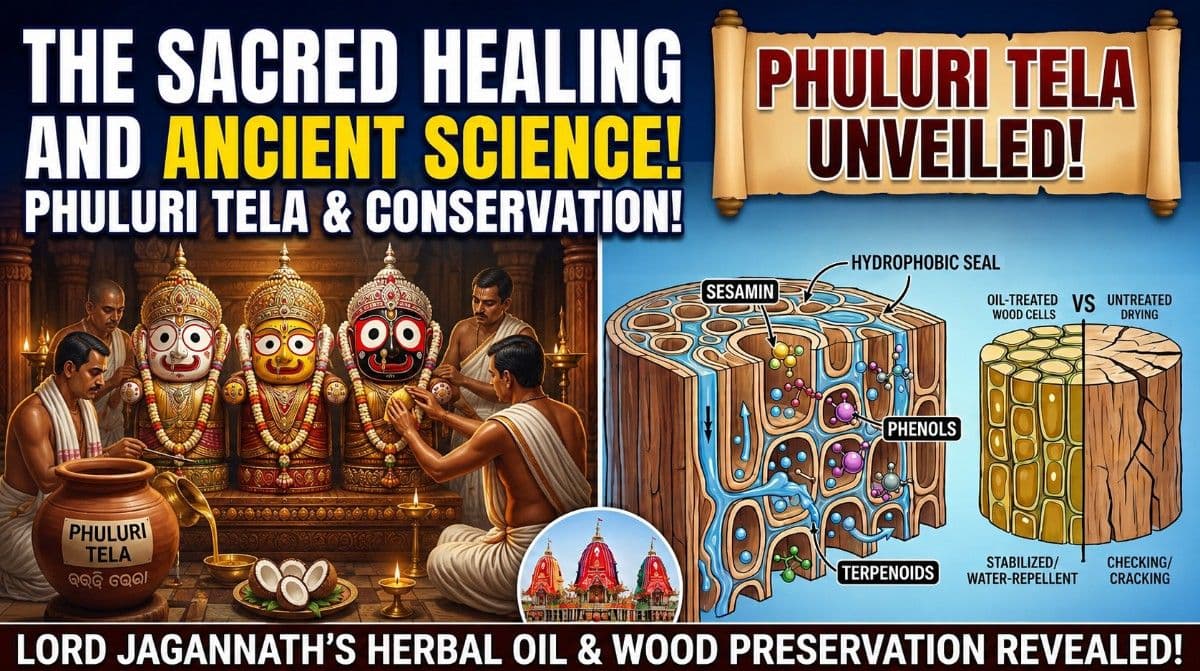
✨Cold-pressed sesame oil is infused with a carefully selected combination of 27 medicinal herbs and stored inside sealed earthen pots buried underground for an entire year.
During this prolonged underground maturation, an oxygen-free environment allows the sesame oil to slowly extract fat-soluble medicinal compounds – terpenoids, phenols, flavonoids and aromatic oils –from the herbs without exposing them to damaging heat.
Instead of ordinary herbal oil, the temple obtains a highly concentrated botanical preservation medium.
The Engineering Behind the Ritual
The significance becomes clearer when viewed through the science of wood.
During Snana Purnima, the deities are ceremonially bathed with 108 pitchers of water.
From a materials science perspective, wood is hygroscopic –it naturally absorbs moisture.
As water enters microscopic cellular spaces, the wood swells.
If this moisture leaves too rapidly during drying, uneven contraction can produce internal stress, tiny cracks and gradual structural weakening.
Phuluri Tela acts as the solution.
Its low surface tension enables the oil to penetrate deep into the microscopic channels within the seasoned neem wood.
Rather than allowing these spaces to remain empty as water evaporates, stable plant lipids occupy them.
The result is remarkable.
The oil replaces moisture with non-volatile compounds, helping reduce internal stress, minimising shrinkage and preserving structural stability.
In simple terms, what devotees witness as the Lord receiving medicine is simultaneously an annual conditioning treatment for the sacred Daru.
Nature's Own Protective Chemistry
The preservation extends even further.
Each herb contributes protective phytochemicals.
Vetiver and sandalwood contain naturally occurring sesquiterpenes recognised for their antimicrobial and antifungal properties.
Plant tannins tighten porous surfaces.
Resinous compounds strengthen the outer layers.
Sesame oil itself contains powerful antioxidant lignans such as sesamin and sesamolin, which help slow oxidative degradation.
Once absorbed into the wood, the oil creates a hydrophobic – or water-repellent – environment.
Future moisture finds it far more difficult to penetrate deeply.
Fungal growth becomes less favourable.
Wood-boring insects encounter multiple natural defensive compounds.
The conditioning also prepares the surface for the subsequent application of protective resin coatings, cloth layers and mineral-based finishes during the remaining Anasara rituals.
Thus, each stage of the ritual complements the next in preserving the sacred wooden structure.
Faith and Science Walking Together
None of this diminishes the spiritual significance of Phuluri Tela Lagi.
Instead, it enriches it.
Ancient temple architects and ritual designers never described their work in the language of polymers, capillary action, phytochemistry or hygroscopic equilibrium.
They expressed it through devotion.
Modern science merely offers another vocabulary for understanding what traditional wisdom preserved through centuries of uninterrupted practice.
The ritual speaks simultaneously to two audiences.
For the devotee, it is the Lord accepting medicine to demonstrate compassion for suffering humanity.
For conservation science, it is an elegant example of sustainable organic heritage preservation using biodegradable botanical chemistry long before the emergence of synthetic preservatives.
The Eternal Lesson
As Lord Jagannath rests inside the Anasara Ghara today, unseen by millions who wait for His return, Phuluri Tela Lagi reminds the world that India's temple traditions often carried layers of knowledge far beyond ritual alone.
One layer teaches that every human being must care for the balance of body and mind.
Another quietly demonstrates how natural materials can be preserved through ecological wisdom.
Perhaps that is the enduring genius of Jagannath culture.
It never separated spirituality from science.
It simply wrapped scientific understanding in the language of faith, allowing both to survive together across centuries.
Today, as the herbal oil touches the sacred Daru, devotees see the Lord being healed.
Science sees an ancient masterpiece of organic conservation.
Jagannath philosophy embraces both.Also Read: Anga Phita Niti: The Sacred Night When Lord Jagannath Sheds the Old to Prepare for Divine Renewal
Related Topics
Explore more stories