



When Will Jagannath Puri Rath Yatra Get UNESCO Status| Exclusive Report
Key Points
Bhubaneswar: The world-famous Jagannath Puri Rath Yatra has moved a step closer to earning one of the highest global recognitions for living traditions.
With Odisha Chief Minister Mohan Charan Majhi formally urging the Centre to nominate the annual chariot festival for UNESCO's Intangible Cultural Heritage (ICH) List, the centuries-old tradition has entered the first stage of a process.
With Chief Minister Majhi initiating the process of securing UNESCO Intangible Cultural Heritage status for the Puri Rath Yatra, the countdown has officially begun.
The crucial question now is whether the festival qualifies, how the elaborate nomination process will unfold over the next three years before UNESCO takes the final call.

📱 Get Argus News App
✨How the UNESCO Nomination Process Will Begin
The Chief Minister's letter dated August 1, 2026, to Union Culture Minister Gajendra Singh Shekhawat formally triggers the nomination process under UNESCO's Intangible Cultural Heritage framework. Since festivals and living traditions fall under the ICH Convention rather than the World Heritage Convention meant for monuments, the proposal now moves through a multi-tier institutional mechanism.
The process begins with the Shree Jagannath Temple Administration (SJTA) and the Odisha Government compiling a comprehensive UNESCO dossier.
The State must submit UNESCO Form ICH-02, documentary evidence of community participation, proof that the festival already figures in India's National Inventory of Intangible Cultural Heritage, a professionally edited 10-minute documentary, ten high-resolution photographs, and a detailed safeguarding plan explaining how the tradition will be protected for future generations.
Once received, the Ministry of Culture forwards the proposal to the Sangeet Natak Akademi – the country's apex institution for Intangible Cultural Heritage – which vets the technical dossier before the Centre decides whether to sponsor it for UNESCO.
Importantly, the proposal enjoys a significant legal and procedural advantage. The Puri Rath Yatra was officially included in India's National Inventory of Intangible Cultural Heritage on March 31, 2025, following evaluation by the Sangeet Natak Akademi.
Chief Minister Majhi had then described the inclusion as the first major milestone towards eventual UNESCO recognition. That inventory listing now forms the mandatory foundation of Odisha's 2026 nomination effort.
What UNESCO Will Examine
Unlike many international awards, UNESCO does not allocate numerical scores to Intangible Cultural Heritage nominations. Instead, every nomination undergoes a strict binary evaluation based on five mandatory criteria – R.1 to R.5. Failure to satisfy even one criterion results in the dossier being returned for revision.
|
UNESCO Criterion |
What UNESCO Examines |
|
R.1 – Definition |
Whether the element is a genuine living heritage transmitted across generations. |
|
R.2 – Visibility |
Whether inscription promotes cultural diversity, dialogue and human creativity globally. |
|
R.3 – Safeguarding |
Whether adequate long-term protection measures exist. |
|
R.4 – Community Consent |
Whether the practicing community has voluntarily endorsed the nomination. |
|
R.5 – National Inventory |
Whether the element already figures in the country's official cultural inventory. |
How Odisha Intends to Satisfy Every UNESCO Criterion
Odisha enters the nomination process with substantial documentary strength against each of UNESCO's five evaluation benchmarks.
|
UNESCO Requirement |
Odisha's Evidence |
|
R.1 – Living Heritage |
The State will demonstrate that Rath Yatra is a living tradition sustained by hereditary Maharana artisans, Chitrakara painters and hundreds of Sevayats whose knowledge has been transmitted across generations. The annual construction of three massive wooden chariots entirely without engineering blueprints remains one of its strongest heritage credentials. |
|
R.2 – Global Visibility |
Odisha will argue that Rath Yatra embodies universal values of equality, inclusion and social harmony. Millions irrespective of caste, creed or nationality participate in pulling the chariots, making it one of the world's largest inclusive public festivals. |
|
R.3 – Safeguarding Measures |
The dossier will outline crowd-management systems, eco-friendly festival management, heritage conservation measures and welfare initiatives for artisans and servitor communities to ensure continuity of traditional practices. |
|
R.4 – Community Participation |
The State must submit signed declarations, resolutions and video testimonies from Nijogs, Sevayats, temple servitors, chariot builders and community representatives establishing their free, prior and informed consent. |
|
R.5 – National Inventory |
Odisha already fulfils this mandatory condition after the Puri Rath Yatra was officially entered into India's National Inventory of Intangible Cultural Heritage on March 31, 2025. |
Why the Puri Rath Yatra Is Considered Strongly Eligible
The Rath Yatra naturally aligns with UNESCO's definition of Intangible Cultural Heritage. It is not merely a religious procession but a living civilisational tradition encompassing ritual practices, oral traditions, traditional craftsmanship, music, community participation and knowledge systems preserved over centuries.
In his letter, Chief Minister Majhi argued that the festival transcends religion and represents India's timeless spirituality, craftsmanship and civilisational ethos. He highlighted its message of equality before Lord Jagannath, the preservation of hereditary artisan traditions and its role in projecting India's living cultural heritage globally.
When Could UNESCO Finally Confer the Tag?
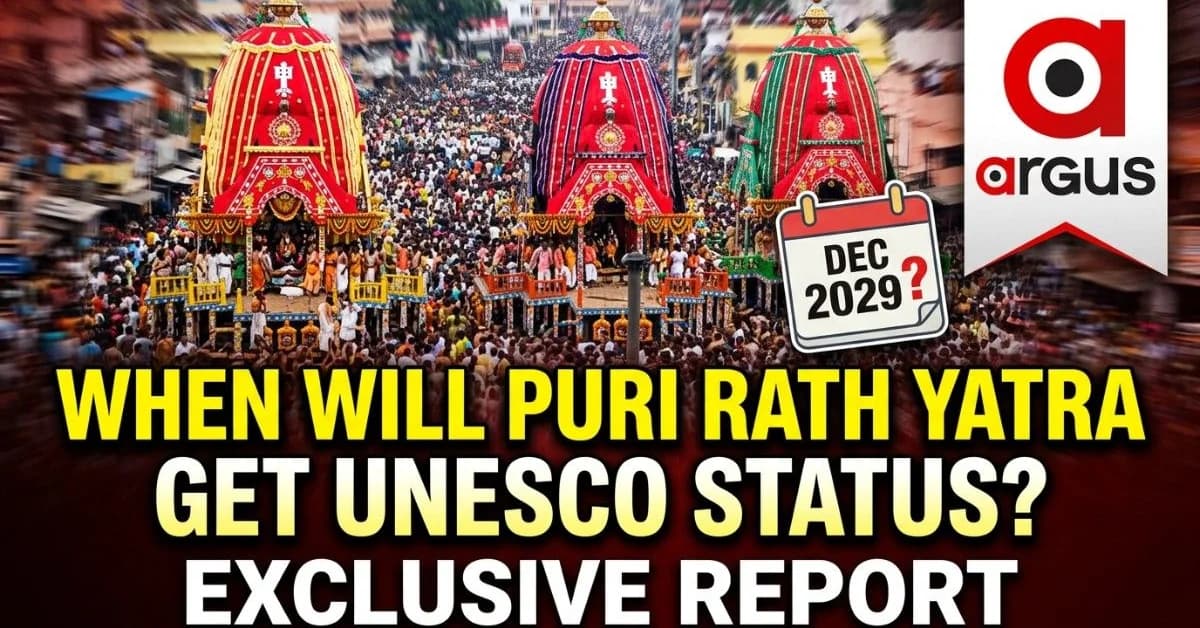
Despite the proposal beginning now, UNESCO procedures make December 2029 the earliest realistic timeline for inscription.
The first reason is UNESCO's lengthy evaluation cycle. Once a dossier reaches UNESCO headquarters in Paris, it undergoes nearly two years of independent technical scrutiny, documentation review, expert assessment and community verification before being placed before the Intergovernmental Committee for voting.
The second reason is India's existing nomination pipeline. UNESCO presently permits member countries to advance only one nomination during each submission cycle. India has already secured Deepavali's inscription in 2025, while Chhath Mahaparv occupies the ongoing 2026–2027 cycle. Consequently, the Rath Yatra can only be forwarded in the subsequent 2028–2029 window.
The Roadmap to UNESCO Recognition
|
Timeline |
Expected Milestone |
|
August 2026 |
CM Majhi's letter initiates the national nomination process. |
|
2026–2027 |
Sangeet Natak Akademi and the Ministry of Culture finalise documentation, collect community consent, prepare translations and edit UNESCO documentary material. |
|
March 31, 2028 |
India is expected to submit the final ICH nomination dossier to UNESCO in Paris under the earliest available cycle. |
|
April 2028 – October 2029 |
UNESCO's independent Evaluation Body examines compliance with all five mandatory criteria and may seek clarifications if required. |
|
November–December 2029 |
The UNESCO Intergovernmental Committee takes the final decision on inscription. If approved, the Puri Rath Yatra would officially become a UNESCO Intangible Cultural Heritage of Humanity. |
If the
process proceeds without procedural delays and the nomination successfully
clears all five mandatory evaluation criteria, the world-famous Jagannath Puri
Rath Yatra could join the ranks of India's globally recognised living
traditions such as Kumbh Mela, Durga Puja, Garba and Deepavali by the end of
2029. Such an inscription would not merely be a global cultural honour for
Odisha but would elevate one of India's oldest living traditions onto the
world's foremost heritage platform.
Also Read: Global Recognition / CM Majhi Writes to Centre, Seeks UNESCO Tag for Rath Yatra