



When Voters Decide to Punish: Lessons from West Bengal’s Political Shift
·5 months ago·5 min read
Key Points
West Bengal election results saw TMC's ouster due to anti-incumbency, corruption allegations, deteriorating law and order, and centralisation of power around Mamata Banerjee.
Bhubaneswar, May 6: In a democracy, electoral verdicts are rarely impulsive. Voters may take time to assess, observe, and endure, but when they decide to act, their judgment can be decisive and unforgiving. The recent West Bengal Assembly election results, which saw the ousting of the Trinamool Congress (TMC) led by Mamata Banerjee, reflect this enduring democratic principle. The outcome signals a convergence of anti-incumbency, governance concerns, and a desire for political change—factors that have echoed in other states, including Odisha.
The reasons for Mamata's downfall are completely identical to the reasons for the fall of Naveen Patnaik government in 2024. Mamata, instead of reading the writing on the wall, could not mend her style of functioning and paid the price for her careless attitude. In West Bengal, the Congress was ousted from power in 1977, it could not revive ever since. Similarly, the Communists fell in 2011 and they still struggle to stand up and put up a spirited fight. After Congress' fall, its cadres moved to the Communists. And, in similar fashion, the Communist cadres shifted their loyalty to the TMC. Now it is to be seen if Mamata manages to overcome this peculiar pattern.
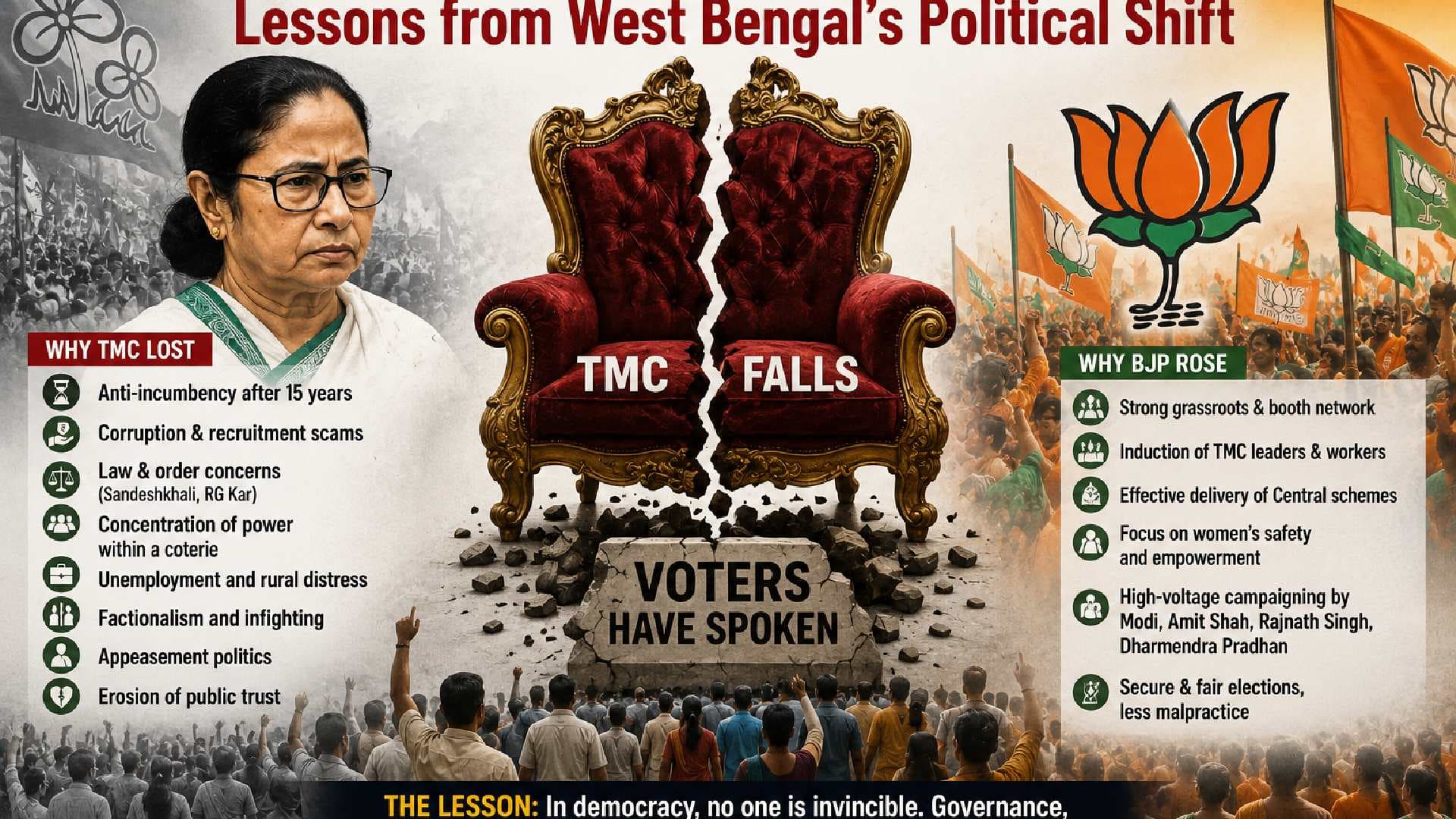
One of the primary reasons behind TMC’s decline appears to be the fatigue associated with prolonged incumbency. After more than a decade in power, any government risks administrative stagnation and a narrowing of vision. Over time, this often breeds dissatisfaction among citizens who begin to seek alternatives. In West Bengal, this anti-incumbency sentiment gradually intensified, creating fertile ground for political upheaval.
Corruption allegations significantly dented the image of the ruling party. Issues such as recruitment scams, coal-related irregularities, and allegations of forced collections became major talking points. As corruption seeps into everyday governance, it directly impacts public trust. Reports of irregularities in government offices further aggravated public anger, leading many to feel disillusioned with the system.
The reasons for Mamata's downfall are completely identical to the reasons for the fall of Naveen Patnaik government in 2024. Mamata, instead of reading the writing on the wall, could not mend her style of functioning and paid the price for her careless attitude. In West Bengal, the Congress was ousted from power in 1977, it could not revive ever since. Similarly, the Communists fell in 2011 and they still struggle to stand up and put up a spirited fight. After Congress' fall, its cadres moved to the Communists. And, in similar fashion, the Communist cadres shifted their loyalty to the TMC. Now it is to be seen if Mamata manages to overcome this peculiar pattern.
One of the primary reasons behind TMC’s decline appears to be the fatigue associated with prolonged incumbency. After more than a decade in power, any government risks administrative stagnation and a narrowing of vision. Over time, this often breeds dissatisfaction among citizens who begin to seek alternatives. In West Bengal, this anti-incumbency sentiment gradually intensified, creating fertile ground for political upheaval.
Corruption allegations significantly dented the image of the ruling party. Issues such as recruitment scams, coal-related irregularities, and allegations of forced collections became major talking points. As corruption seeps into everyday governance, it directly impacts public trust. Reports of irregularities in government offices further aggravated public anger, leading many to feel disillusioned with the system.

📱 Get Argus News App
✨📰 60 Word News🎬 Argus Podcast📺 Live TV and Breaking News🔔 Free Notification Alerts
Download Free:
Equally damaging was the perception of deteriorating law and order. Incidents like those reported from Sandeshkhali and controversies surrounding institutions such as RG Kar Medical College contributed to a narrative that governance was faltering. The government’s handling of these situations was closely scrutinised, and for many voters, it did not inspire confidence. Concerns over safety and justice are powerful electoral issues, often influencing voting behaviour more than development claims.
Another critical factor was the concentration of power within a limited circle. The growing perception that decision-making was centralised around Mamata Banerjee and her nephew created unease within the party ranks as well as among the electorate. When political organisations begin to appear insular or family-driven, they risk alienating both senior leaders and grassroots workers. This internal friction weakens organisational cohesion, ultimately affecting electoral performance.
Socio-economic issues also played a role. Despite various welfare initiatives, concerns persisted regarding employment opportunities, especially for the youth. Rural distress and the lack of visible progress in agriculture further contributed to voter dissatisfaction. Aspirational voters, particularly young people, often demand tangible economic growth and job creation—areas where expectations seemed unmet.
Factionalism within the party compounded these challenges. As seen in other long-standing regimes, the proliferation of groups and competing interests at the grassroots level led to disunity. Ticket distribution disputes and internal rivalries weakened the party’s electoral machinery, giving an advantage to opponents.
On the other side, the rise of the Bharatiya Janata Party (BJP) was neither sudden nor accidental. Since the previous election, the party had systematically strengthened its organisational structure in West Bengal. By building a robust booth-level network and expanding its grassroots presence, it laid a strong foundation for electoral success.
The BJP also benefited from the induction of disgruntled leaders and workers from the TMC. These entrants brought with them established local networks, effectively providing the BJP with a ready-made organisational base in several constituencies.
Another critical factor was the concentration of power within a limited circle. The growing perception that decision-making was centralised around Mamata Banerjee and her nephew created unease within the party ranks as well as among the electorate. When political organisations begin to appear insular or family-driven, they risk alienating both senior leaders and grassroots workers. This internal friction weakens organisational cohesion, ultimately affecting electoral performance.
Socio-economic issues also played a role. Despite various welfare initiatives, concerns persisted regarding employment opportunities, especially for the youth. Rural distress and the lack of visible progress in agriculture further contributed to voter dissatisfaction. Aspirational voters, particularly young people, often demand tangible economic growth and job creation—areas where expectations seemed unmet.
Factionalism within the party compounded these challenges. As seen in other long-standing regimes, the proliferation of groups and competing interests at the grassroots level led to disunity. Ticket distribution disputes and internal rivalries weakened the party’s electoral machinery, giving an advantage to opponents.
On the other side, the rise of the Bharatiya Janata Party (BJP) was neither sudden nor accidental. Since the previous election, the party had systematically strengthened its organisational structure in West Bengal. By building a robust booth-level network and expanding its grassroots presence, it laid a strong foundation for electoral success.
The BJP also benefited from the induction of disgruntled leaders and workers from the TMC. These entrants brought with them established local networks, effectively providing the BJP with a ready-made organisational base in several constituencies.
Central welfare schemes such as housing initiatives, LPG distribution, and direct benefit transfers helped the BJP connect with voters, particularly in rural and economically weaker sections. The party’s emphasis on women’s safety and empowerment further broadened its appeal.
High-voltage campaigning by national leaders, including Narendra Modi, Amit Shah, Rajnath Singh, Dharmendra Pradhan, created a strong political momentum. Frequent visits and targeted messaging contributed to a perception of seriousness and commitment, energising the party’s cadre and supporters.
Finally, the conduct of elections in a more secure and monitored environment also played a role. Reduced instances of alleged electoral malpractices ensured that voter preferences were more accurately reflected in the results.
The West Bengal verdict serves as a reminder that in a democracy, no political party is invincible. When governance falters, corruption allegations mount, and internal cohesion weakens, voters are willing to deliver a strong message. The parallels with political developments in other states highlight a broader truth: democratic accountability, though sometimes delayed, is ultimately inevitable.
High-voltage campaigning by national leaders, including Narendra Modi, Amit Shah, Rajnath Singh, Dharmendra Pradhan, created a strong political momentum. Frequent visits and targeted messaging contributed to a perception of seriousness and commitment, energising the party’s cadre and supporters.
Finally, the conduct of elections in a more secure and monitored environment also played a role. Reduced instances of alleged electoral malpractices ensured that voter preferences were more accurately reflected in the results.
The West Bengal verdict serves as a reminder that in a democracy, no political party is invincible. When governance falters, corruption allegations mount, and internal cohesion weakens, voters are willing to deliver a strong message. The parallels with political developments in other states highlight a broader truth: democratic accountability, though sometimes delayed, is ultimately inevitable.
Related Topics
Explore more stories