



Odisha Politics / Weak Opposition in Odisha Gives BJP Early Advantage ahead of Panchayat Polls
·4 months ago·4 min read
Key Points
BJP has begun early groundwork for upcoming panchayat elections in Odisha, viewing rural polls as stepping stone towards 2029 Assembly and Lok Sabha elections.
Bhubaneswar, May 25: As Odisha gradually moves towards the next round of panchayat elections, expected to begin early next year, the political atmosphere in the state is beginning to reveal a striking contrast. While the ruling Bharatiya Janata Party appears to have started its groundwork well in advance, the opposition space looks fragmented, hesitant and unusually inactive.
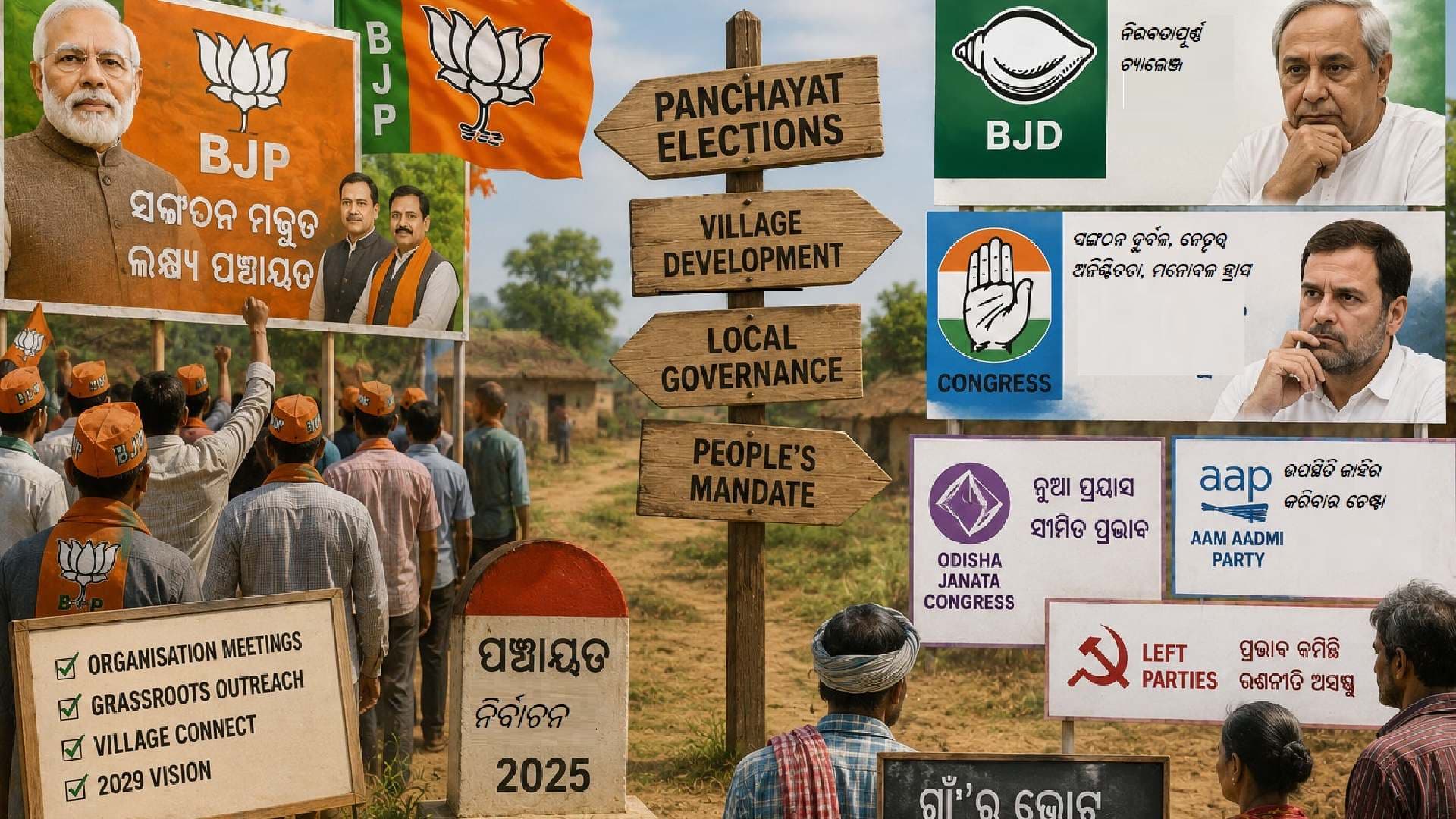
The early political mobilisation by the BJP indicates that the party is keen to consolidate the gains it achieved in the 2024 Assembly elections. Senior party strategists have already begun holding organisational meetings in Odisha, signalling that the party views the upcoming rural polls not merely as local body elections, but as a crucial stepping stone towards the 2029 Assembly and Lok Sabha elections.
Recent visits by BJP national leaders and strategy sessions with state-level functionaries underline the party’s intention to remain electorally dominant. The BJP leadership appears fully aware that victories in panchayat elections often shape the political narrative for future state elections. Rural Odisha remains politically decisive, and strengthening organisational control at the grassroots level has clearly become a priority for the ruling party.
In contrast, the opposition camp appears to be struggling with both direction and momentum.
The early political mobilisation by the BJP indicates that the party is keen to consolidate the gains it achieved in the 2024 Assembly elections. Senior party strategists have already begun holding organisational meetings in Odisha, signalling that the party views the upcoming rural polls not merely as local body elections, but as a crucial stepping stone towards the 2029 Assembly and Lok Sabha elections.
Recent visits by BJP national leaders and strategy sessions with state-level functionaries underline the party’s intention to remain electorally dominant. The BJP leadership appears fully aware that victories in panchayat elections often shape the political narrative for future state elections. Rural Odisha remains politically decisive, and strengthening organisational control at the grassroots level has clearly become a priority for the ruling party.
In contrast, the opposition camp appears to be struggling with both direction and momentum.

📱 Get Argus News App
✨📰 60 Word News🎬 Argus Podcast📺 Live TV and Breaking News🔔 Free Notification Alerts
Download Free:
The Biju Janata Dal, led by Naveen Patnaik, has so far not demonstrated any major visible organisational preparation for the panchayat polls. Despite remaining Odisha’s principal regional force for over two decades, the party presently appears subdued after its electoral setback in 2024. Beyond occasional statements from Naveen Patnaik himself, most senior leaders of the party have largely maintained political silence.
This silence has triggered speculation regarding the BJD’s internal transition phase. The party, which once functioned through a highly disciplined and centralised structure, now faces the challenge of redefining its role as an opposition force after years in power. Whether the party can successfully energise its cadre at the grassroots level remains one of the key political questions in Odisha today.
The situation of the Indian National Congress appears even more uncertain. The Congress has yet to launch any sustained statewide movement or organisational drive capable of reviving its weakening presence in Odisha. Apart from a few isolated programmes led by the state unit leadership, the party has struggled to project itself as an effective opposition force.
More importantly, the apparent lack of attention from the Congress high command towards Odisha has further weakened cadre morale. Since the 2024 elections, no major national Congress leader has made a significant political intervention in the state. This organisational vacuum has left many Congress workers and younger leaders politically restless.
It is within this vacuum that smaller and emerging political outfits are beginning to sense opportunity.
The newly floated Odisha Janata Congress has shown signs of early political activity, particularly through public meetings and outreach programmes in western Odisha. Though still organisationally limited, the party appears to be attracting a section of younger Congress-minded leaders searching for a more active political platform.
This silence has triggered speculation regarding the BJD’s internal transition phase. The party, which once functioned through a highly disciplined and centralised structure, now faces the challenge of redefining its role as an opposition force after years in power. Whether the party can successfully energise its cadre at the grassroots level remains one of the key political questions in Odisha today.
The situation of the Indian National Congress appears even more uncertain. The Congress has yet to launch any sustained statewide movement or organisational drive capable of reviving its weakening presence in Odisha. Apart from a few isolated programmes led by the state unit leadership, the party has struggled to project itself as an effective opposition force.
More importantly, the apparent lack of attention from the Congress high command towards Odisha has further weakened cadre morale. Since the 2024 elections, no major national Congress leader has made a significant political intervention in the state. This organisational vacuum has left many Congress workers and younger leaders politically restless.
It is within this vacuum that smaller and emerging political outfits are beginning to sense opportunity.
The newly floated Odisha Janata Congress has shown signs of early political activity, particularly through public meetings and outreach programmes in western Odisha. Though still organisationally limited, the party appears to be attracting a section of younger Congress-minded leaders searching for a more active political platform.
Similarly, the Aam Aadmi Party is also attempting to expand its relevance in Odisha. Recent organisational meetings and visits by senior leaders suggest that the party is trying to position itself within the opposition space created by the relative inactivity of both the BJD and Congress. Whether AAP can convert visibility into electoral influence, however, remains uncertain.
Another interesting aspect of Odisha’s political landscape is the near invisibility of Left parties. Once influential in labour belts, tribal regions and ideological politics, the Left has yet to clearly outline its electoral strategy for the upcoming panchayat elections. Their future role — whether independent or alliance-based — remains unclear.
At its core, Odisha politics today reflects a larger truth about democratic competition: political relevance depends on continuous public engagement. Electoral victories from the past do not automatically guarantee future success. Voters increasingly expect visibility, activism and sustained communication from political parties between elections as well.
For the BJP, the challenge will be to convert governmental authority into durable grassroots acceptance. For the BJD, the immediate task is organisational revival and ideological repositioning as a regional opposition force. For Congress, the battle is existential — rebuilding structure, morale and credibility before its support base further erodes.
The road to 2029 may still appear distant, but the political groundwork has already begun. Panchayat elections in Odisha are unlikely to remain confined to village-level governance alone. Instead, they may emerge as the first major test of which party truly possesses organisational depth, public energy and political direction in the post-2024 era.
Another interesting aspect of Odisha’s political landscape is the near invisibility of Left parties. Once influential in labour belts, tribal regions and ideological politics, the Left has yet to clearly outline its electoral strategy for the upcoming panchayat elections. Their future role — whether independent or alliance-based — remains unclear.
At its core, Odisha politics today reflects a larger truth about democratic competition: political relevance depends on continuous public engagement. Electoral victories from the past do not automatically guarantee future success. Voters increasingly expect visibility, activism and sustained communication from political parties between elections as well.
For the BJP, the challenge will be to convert governmental authority into durable grassroots acceptance. For the BJD, the immediate task is organisational revival and ideological repositioning as a regional opposition force. For Congress, the battle is existential — rebuilding structure, morale and credibility before its support base further erodes.
The road to 2029 may still appear distant, but the political groundwork has already begun. Panchayat elections in Odisha are unlikely to remain confined to village-level governance alone. Instead, they may emerge as the first major test of which party truly possesses organisational depth, public energy and political direction in the post-2024 era.
Related Topics
Explore more stories