



Odisha Politics / Rajya Sabha Poll Row: Is BJD Attempting to Cast Doubt on the Election Commission’s Credibility?
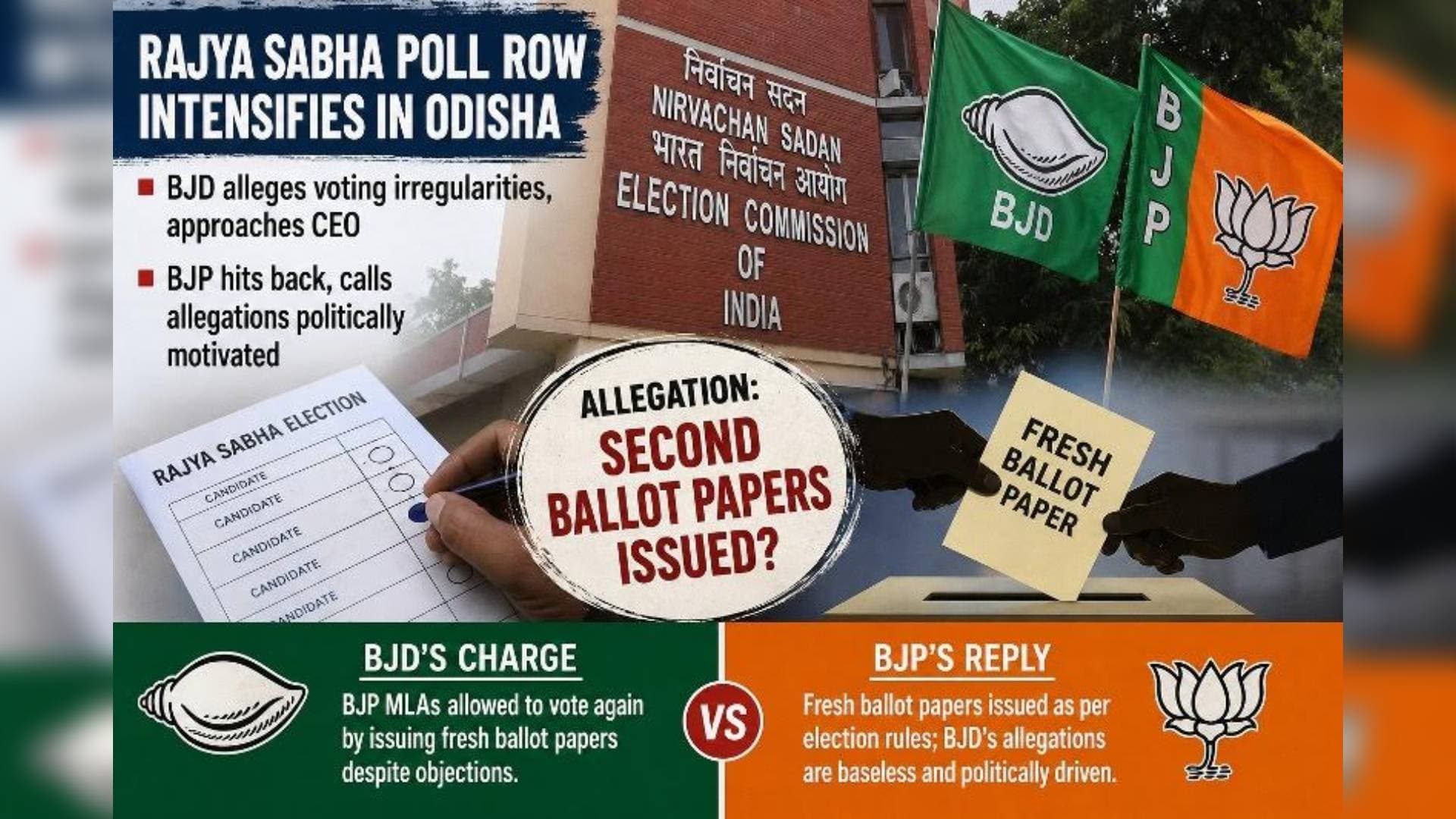
Key Points
Odisha’s Rajya Sabha election row intensifies as BJD challenges
ballot procedures, sparking a political battle with BJP.
Bhubaneswar, May 11: The controversy triggered by the Odisha Rajya Sabha elections has now moved beyond a procedural disagreement and entered the realm of political messaging and institutional perception. By aggressively questioning the conduct of polling officials and approaching the Chief Electoral Officer over the issuance of fresh ballot papers to two BJP MLAs, the opposition Biju Janata Dal (BJD) led by former Chief Minister Naveen Patnaik appears to be walking a politically sensitive line - one that critics say risks undermining public faith in the sanctity and neutrality of the Election Commission system itself.
At the heart of the dispute is the allegation that BJP legislators were improperly allowed to cast fresh votes after allegedly marking their ballot papers incorrectly. However, election experts point out that provisions exist within the Rajya Sabha electoral framework for issuance of another ballot paper if a voter inadvertently spoils the original before formally casting it. The Returning Officer’s powers in such situations are defined under established electoral procedures.
This is precisely where the political significance of the BJD’s protest becomes important.
By insisting that the process was “undemocratic” despite procedural
explanations already being offered by election authorities and the ruling BJP,
the BJD risks creating an impression that the Election Commission machinery
acted in a partisan manner. Political observers believe such a narrative could
have wider implications because the Election Commission of India has
traditionally been viewed as one of the country’s most sacrosanct
constitutional institutions.
Also Read: Odisha’s 2027 Panchayat Polls Set to Reflect Political Direction Ahead of 2029

📱 Get Argus News App
✨For decades, Indian democracy has functioned on the strength of public confidence in the electoral process. Even when political parties lose elections, the broader legitimacy of the Election Commission’s conduct has largely remained intact. In that context, critics argue that repeatedly alleging irregularities without conclusive evidence may gradually erode institutional trust among the public.
The BJP has seized upon this argument aggressively. Odisha Law Minister Prithviraj Harichandan accused the BJD of manufacturing controversy despite clarification of the rules. The ruling party’s counterattack is politically calculated - to portray the opposition as unwilling to accept either electoral defeat or established constitutional procedures.
The episode also reflects the BJD’s changing political position after losing power in Odisha. Under Naveen Patnaik, the BJD enjoyed political dominance for nearly 24 years, during which the party rarely found itself questioning institutional processes from the opposition benches. Today, however, with the BJP government led by Mohan Charan Majhi consolidating power, the BJD appears determined to challenge the ruling establishment through procedural and constitutional battles.
Yet, in doing so, the opposition party faces a delicate balancing act.
A robust opposition has every democratic right to question procedural lapses and seek clarifications from constitutional authorities. But there is also a thin line between raising legitimate objections and creating public suspicion about the integrity of electoral institutions themselves. Once political parties begin routinely projecting election authorities as compromised, the long-term casualty can be public confidence in democracy’s foundational mechanisms.
This is particularly sensitive in Odisha, a state that historically witnessed relatively stable and less confrontational politics compared to several other Indian states. The Rajya Sabha poll controversy suggests that Odisha is now entering a more combative political phase where institutions themselves may increasingly become arenas of political contestation.
Political analysts believe the BJD’s aggressive posture is also linked to the upcoming rural and urban local body electoral battles. By projecting itself as a watchdog against alleged procedural impropriety, the party may be trying to energise its cadre base and retain political relevance after its electoral setback. However, the risk lies in the possibility that constant institutional confrontation could be interpreted as an attempt to delegitimise constitutional authorities whenever outcomes become politically inconvenient.
The BJP, on the other hand, is attempting to use the controversy to strengthen its narrative that the opposition is suffering from “political frustration” after losing power. The ruling party wants to project itself as both procedurally correct and institutionally respectful, while painting the BJD as increasingly confrontational toward democratic systems.
Related Topics
Explore more stories