



Nitin Nabin Team Eyes 2027 to 2029: Why Ram Madhav, Smriti Irani Comebacks Matter More Than Social Engineering| Special Report
Key Points
Bhubaneswar: The first headline from BJP president Nitin Nabin's new team may be about caste equations, regional representation and the party's renewed social engineering. But the more consequential story lies elsewhere.
Look closely at the appointments and the BJP appears to be preparing not merely for the next round of assembly elections, but for the larger 2028-29 electoral cycle.
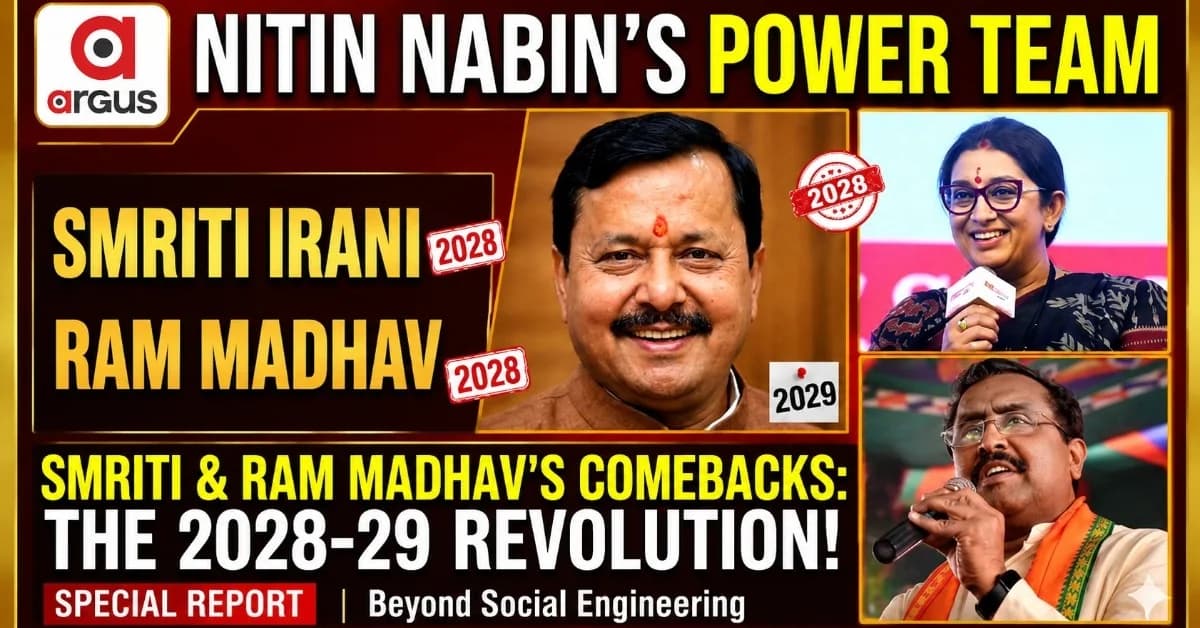
The return of Ram Madhav to the national core and the elevation of Smriti Irani as a national general secretary are particularly telling.
One represents the party's ideological and strategic bridge to the RSS and its wider intellectual ecosystem; the other brings back one of the BJP's most recognisable national campaigners.

📱 Get Argus News App
✨Together with the retention of organisational operators such as Sunil Bansal and experienced political hands, the architecture suggests a two-layer strategy: younger leadership for long-term political ownership, backed by seasoned troubleshooters for the battles ahead.
The new team therefore should not be read simply as another exercise in caste arithmetic. The social engineering is certainly there. But underneath it is a broader attempt to build an electoral machine capable of moving from the immediate 2027 assembly contests to the 2028 state elections and eventually the 2029 Lok Sabha battle.
The comparison with the previous structure reinforces that reading. The new organisation has pushed the frontline executive towards a younger profile while retaining several experienced hands. A comparative glance puts the earlier frontline working executive average above 62, against a sub-55 bracket under Nabin.
1. Ram Madhav comeback: the RSS bridge is back in the room
Among all the appointments, Ram Madhav's return may carry the greatest institutional significance.
The former national general secretary has been brought back as a national vice president, with the new structure assigning him a role around ideological strategy, foreign-policy outreach and complex regional alliances. The leadership comparison specifically describes his induction as a return to the core for foreign-policy and alliance grids.
That makes his appointment different from a conventional state-specific electoral posting.
Madhav has occupied an unusual space in the BJP ecosystem: part political organiser, part ideological interlocutor and part strategic troubleshooter. His presence can potentially strengthen the operational bridge between the BJP and the RSS at a time when coordination between the organisation and the political establishment becomes critical before a long election calendar.
That is why his comeback matters for 2028 and 2029.
The BJP will need more than campaign speeches and caste mobilisation as it approaches another national election. It will need organisational synchronisation, alliance management, ideological messaging and the ability to interpret political shifts across states.
Madhav's return puts an experienced hand back into precisely that space.
2. Smriti Irani comeback: from electoral face to national campaign asset
If Madhav represents the strategic brain, Smriti Irani represents the political face.
Her elevation as national general secretary is one of the most visible changes in the new structure. Political observers describe her as a "massive comeback", with the task of strengthening the BJP's Hindi-belt traction.
That is significant because Irani is not merely another organisational appointment.
She is a national-level communicator with an established political identity, an aggressive public style and a particularly strong connect with women and middle-class voters. Women voters and urban middle-class populations are key elements of her electoral base, while highlighting her strength in rallies and high-stakes media environments.
Her return therefore gives Nabin's team something a purely organisational reshuffle cannot provide: a ready-made national campaigner who can carry the party's political narrative beyond individual states.
And that matters for 2029.
3. The social engineering is deliberate but it is not the whole story
The new BJP team certainly has a heavy social-engineering component.
Amarpal Maurya has been positioned to consolidate non-Yadav OBCs in Uttar Pradesh. Roop Kumari Choudhary brings a tribal and rural-women focus. Other appointments target SC communities, Pasmanda outreach, Jat voters, women beneficiaries and regional agrarian constituencies.
The UP structure is particularly revealing: Smriti Irani, Amarpal Maurya, Rekha Verma and Prof. Tariq Mansoor collectively represent an attempt to address women, non-Yadav OBCs and Pasmanda Muslims in the state's complex electoral matrix.
But reducing the entire exercise to caste arithmetic would miss the larger design.
The appointments suggest that the BJP is trying to build multiple voter channels simultaneously – caste, gender, welfare beneficiaries, youth, professionals, minorities and regional identities.
In other words, social engineering is becoming one layer of a much larger electoral architecture.
4. Nabin's age reset is really a 2029 bet
At 45, Nitin Nabin himself embodies the generational change.
But the significance of his age is not symbolic alone. A younger president requires an organisation that can work on a longer political horizon.
The new structure moves the organisational centre towards a sub-55 bracket, compared with a frontline executive average above 62 in the earlier arrangement (under JP Nadda)
That creates a potentially important distinction.
The BJP is not simply replacing old faces with young faces. It is placing younger political operators alongside leaders with long institutional experience.
That combination can give Nabin two things at once: continuity in organisational know-how and a longer runway for the new leadership generation.
That is why 2029 is arguably as important to this team as 2027.
5. The experienced hands have not disappeared
The generational shift does not mean the BJP has abandoned its veterans.
Vasundhara
Raje remains in the
vice-presidential structure. D. Purandeshwari, Rekha Verma, Lal Singh Arya and
Tariq Mansoor also continue. On the organisational side, Vinod Tawde, Sunil
Bansal and Tarun Chugh remain in place.
This is perhaps the most important feature of the new arrangement.
Nabin is not starting with a clean slate.
He is effectively creating a young command layer over an experienced institutional foundation.
Sunil Bansal's retention is especially important because the comparison identifies him as a core backroom data and state-election strategist.
That gives the new president experienced election-management capacity while allowing him to project a younger political generation.
6. 2027 is the first test; 2028 is the consolidation round
The election calendar explains the urgency.
The new organisation has an immediate operational focus on Uttar Pradesh, Punjab, Uttarakhand and Gujarat, with these turning as the first major electoral battlegrounds.
UP, in particular, gets a dense concentration of appointments.
That is not surprising. The state remains indispensable to any serious 2029 Lok Sabha strategy.
But the architecture extends beyond UP.
Rajasthan
and Madhya Pradesh receive combinations aimed at agrarian, tribal and SC
constituencies; Chhattisgarh gets a rural women and tribal outreach focus;
Karnataka gets an academic-intellectual face through Prof. M. Nagaraja.
The message is clear: win the immediate battles, consolidate the
organisational gains, and enter 2029 with a wider electoral footprint.
7. The BJP is broadening the definition of its voter
The appointments also show an attempt to move beyond the party's traditional electoral categories.
There are dedicated faces for women, youth, OBCs and SCs. There is Pasmanda outreach. There are professionals and academics. There are regional leaders for Punjab, Bengal, Karnataka and the South.
That makes the new structure less about finding one dominant social bloc and more about building a coalition of multiple smaller constituencies.
The new team announcement also indicates this as a deliberate move towards OBCs, STs and rural women beneficiaries, rather than relying solely on traditional upper-caste equations.
This could become critical by 2029, when the BJP will have to defend its national coalition rather than simply expand it.
8. The intellectual turn is as important as the caste turn
Perhaps the least discussed feature of the reshuffle is the emergence of professionals and intellectuals alongside conventional political organisers.
Prof. M. Nagaraja, Dr. Bharti Pravin Pawar and Ram Madhav represent different versions of this approach. The leadership matrix explicitly identifies their induction as part of an intellectual shift towards data-driven and issue-based politics.
That could become increasingly important as the BJP enters its next national campaign.
The political environment of 2029 may demand arguments on jobs, technology, national security, foreign policy, welfare delivery and India's global positioning alongside identity politics.
Ram Madhav's return, in that sense, fits into a larger organisational experiment: can the BJP combine ideological depth, electoral engineering and professional campaign management in a single structure?
9. The real message: Nabin is building an election machine, not just a new team
The temptation will be to read every appointment through the lens of caste.
That would be only half the story.
The deeper message of the Nabin team is about institutional capacity.
Ram Madhav brings strategic and ideological experience.
Smriti Irani brings national political communication.
Sunil Bansal brings election-management experience.
Regional veterans provide state-level continuity.
Younger leaders are being pushed into positions where they can build their own political capital before 2029.
And the morcha appointments are being used to deepen connections with specific demographic groups.
It is therefore less a choice between old BJP and new BJP than an attempt to fuse the two.
10. Why 2029 sits behind the entire exercise
The 2027 elections will provide the first report card. The 2028 assembly contests will test whether the new organisational machinery can sustain itself. But the ultimate examination is likely to be the 2029 Lok Sabha election.
That explains why two kinds of faces have returned or been elevated.
Ram Madhav is useful when the BJP needs a strategist who can operate across ideology, institutions, alliances and the international space.
Smriti Irani is useful when the BJP needs a recognisable national political voice capable of converting policy and organisational narratives into mass mobilisation.
Around them, Nabin has retained experienced operators and installed a younger generation.
So, beneath the headline of social engineering, the bigger story is this:
Nitin Nabin's BJP is not merely rearranging its caste equations for the next election. It is trying to build the organisational and political architecture of the 2028-29 cycle – with Ram Madhav and Smriti Irani symbolising two of its most consequential bets.
The new
team, in that sense, is less about who gets which caste vote today and more
about who will run the BJP's next national campaign tomorrow.
Also Read: NitinNabin Team Eyes 2028, 2029: Why Ram Madhav, Smriti Irani Comebacks Matter MoreThan Social Engineering| Special Report
Related Topics
Explore more stories