



SIR Politics / How the SC Dusted Away the SIR Storm and Left the Opposition Gen Z Movement Grounded| Analysis
Key Points
- * Supreme Court puts a definitive 'constitutionally valid' stamp on the Gyanesh Kumar-led Election Commission’s Special Intensive Revision, affirming its absolute power to clean voter lists.
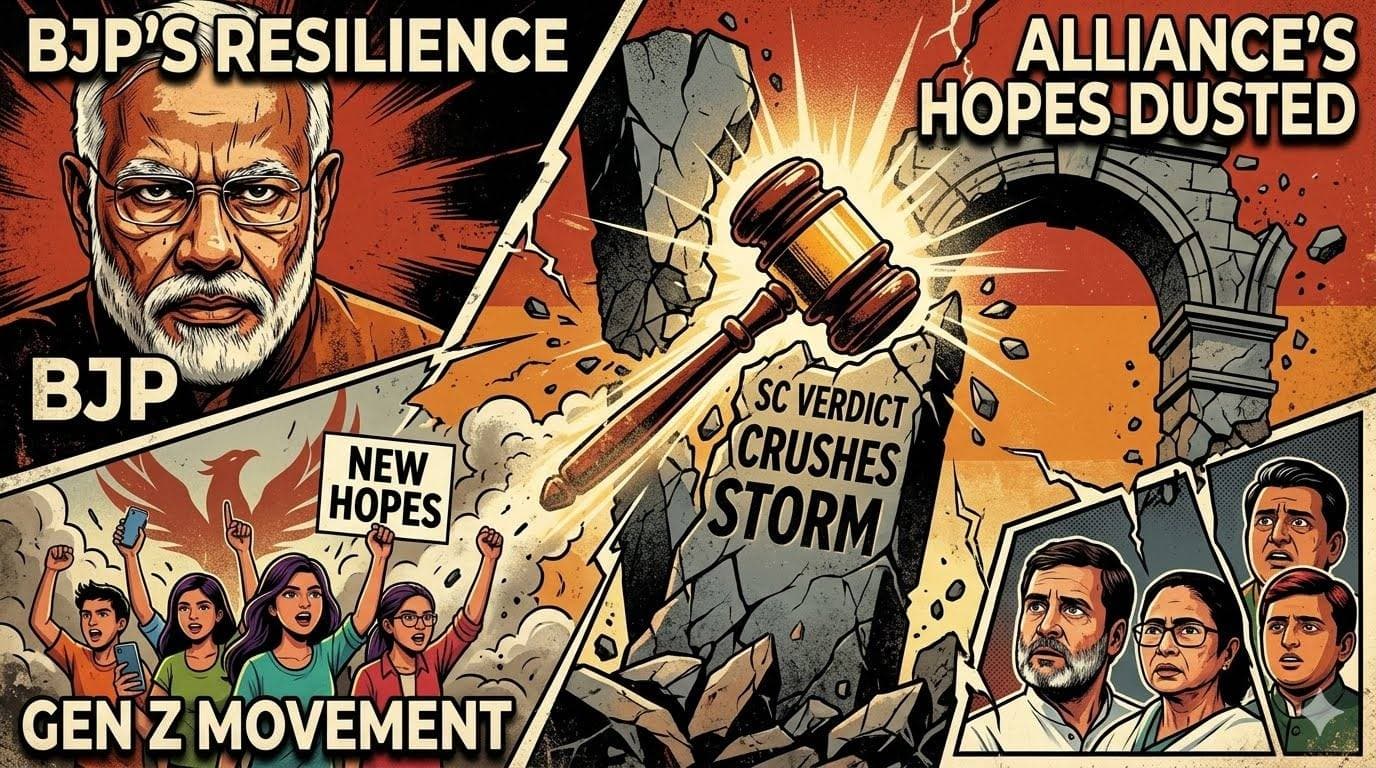
- * The landmark verdict completely blunts the INDI Alliance's high-stakes legal offensive, neutralising their core political weapon against the BJP ahead of upcoming elections.
- * The judicial clearance derails the opposition's grand blueprint to ignite a nationwide Gen Z-led movement built on the alarmist narrative of 'Democracy in Danger.'
Bhubaneswar: Special Intensive Revision (SIR) Brouhaha put to rest. Election Commission of India’s SIR has passed the judicial test. The Supreme Court of India has put the ‘constitutionally valid’ stamp on SIR exercise undertaken by Gyanesh Kumar led ECI.
With the Apex court’s stamp of approval, the storm over SIR blown away. The Opposition Indi Alliance’s sharp political weapon against BJP stands neutralised.
The SC judgement on SIR will have a far-reaching impact on Indian political landscape, and the Opposition plan to organise Gen Z movement against Modi govt holding the high cardinal card of ‘Democracy in threat’.
This verdict will reshape India’s electoral and political discourse far beyond Bihar. Though the ruling is seen legally as an endorsement of the Election Commission’s powers under Article 324 of the Constitution, it is the political implications that could prove far more consequential.

📱 Get Argus News App
✨Indi Alliance Lost its ‘Silver Bullet’
For months, SIR has been the crown jewel of Indi alliance narrative. From Congress to TMC, DMK et al had mounted an aggressive campaign against the SIR exercise, portraying it as a “backdoor NRC”, a “voter purge mechanism” and a potential tool for disenfranchisement of migrants, minorities, backwards and economically weaker sections.
Even as Supreme Court’s upholding of the constitutional validity of SIR of electoral rolls has effectively strengthening the ECI’s power to scrutinise voter eligibility and maintain, what SC termed, the sanctity of electoral democracy, the SC observations, however, appear to have substantially weakened the constitutional line of Opposition attack – “Democracy in Threat.”
The significant reaffirmation of the Court has been that it recognised that accurate electoral rolls are indispensable to free and fair elections, which themselves form part of the Constitution’s basic democratic structure.
By doing so, the apex court effectively elevated electoral roll purification from a mere bureaucratic exercise to a constitutional necessity.
BJP Gains Momentum as Indi Narrative Collapses
For the BJP and the Modi government, this verdict acts as a major political vindication. The ruling party has long maintained that electoral rolls across key states are plagued by duplications, deceased voters, and illegal cross-border influxes. By upholding the ECI’s choice of the 2003 intensive revision as the authoritative baseline, the Supreme Court justified the absolute necessity of rigorous verification
Politically, the narrative fallback for the opposition is severe.
The INDI Alliance had pinned its hopes on the judiciary to stall the electoral roll cleanup and provide fuel for a larger national protest. For the Opposition bloc, the SIR controversy was not merely an administrative dispute but a broader political narrative aimed at framing the BJP-led establishment as using state institutions to influence electoral outcomes.
The “democracy under threat” narrative became central to several Opposition campaigns, especially after concerns were raised over documentation requirements and fears of exclusion among vulnerable populations.
Instead, the final data released by the ECI made the narrative fell flat on their face.
While 3.66 lakh duplicate or deceased names were successfully purged, over 21.53 lakh valid, verified electors were added.
The subsequent successful execution of the elections using this verified roll completely blunted the opposition's narrative of targeted manipulation and democratic backsliding.
The BJP's organizational machinery adjusted seamlessly to the house-to-house enumeration process, using Booth Level Agents (BLAs) to proactively assist voters while the opposition spent its energy on litigation.
Moreover, by packaging the SIR exercise as a systemic purge of marginalized and young voters, the opposition intended to weaponize the narrative of a "Democracy in Danger." They hoped to ignite a passionate, youth-led Gen Z movement against the Modi government. However, that sharp political weapon has now been completely blunted.
How SC Dusted SIR Storm
Backed by senior legal minds, since the INDI Alliance moved the Supreme Court under Article 32 of the Constitution, alleging that the exercise was an unconstitutional, exclusionary, and partisan attempt to disenfranchise lakhs of vulnerable voters, the Court accepted that the Election Commission possesses the authority to examine citizenship-related aspects for the limited purpose of determining voter eligibility.
This observation could have far-reaching implications in future electoral disputes across politically sensitive states where questions around migration, demographic changes and duplicate voter entries have increasingly entered mainstream political debate.
1. The ruling is particularly significant because Opposition parties had consistently argued that citizenship determination falls exclusively within the domain of the Union Home Ministry, Foreigners Tribunals or designated citizenship authorities – not the Election Commission. The Supreme Court’s endorsement of the ECI’s limited scrutiny powers now considerably alters that legal terrain.
2. Historically, ECI has been granted wide operational autonomy under Article 324. Over decades, Indian courts have repeatedly expanded the ECI’s authority in matters involving election management, conduct and supervision. By upholding the SIR framework, the Supreme Court appears to have added another important layer to that jurisprudence.
3. Another politically sensitive aspect of the verdict concerns the debate around Aadhaar and voter eligibility. During the hearings, the Court had already indicated that Aadhaar serves as proof of identity, not proof of citizenship. That distinction now assumes greater significance because many critics of SIR had argued that possession of Aadhaar or other welfare-linked documents should suffice for inclusion in electoral rolls.
4. The court said, while an Aadhaar card is not proof of citizenship, it directed the ECI to treat it as a valid 12th document of identity to aid voter inclusion and prevent arbitrary disenfranchisement.
5. The verdict effectively separates identity verification from citizenship verification – a distinction that could shape future electoral policies nationwide.
6. Writing for the Court, the judgment explicitly stated that parliamentary laws under Article 327 cannot be weaponized to paralyze or extinguish the core functions of the ECI
7. The Court recognized the ECI's power to conduct a statewide Special Intensive Revision under Section 21(3) of the Representation of the People Act, 1950. The ECI gave valid grounds for the 2025 Bihar SIR, including large-scale migration, duplication, and rapid urbanization over two decades, the order said.
8. The ECI's inquiry during an SIR is a legitimate verification of eligibility for enrolment under Articles 325 and 326, which is distinct from a formal termination of citizenship under the Ministry of Home Affairs
SC Judgement Far Reaching Impact
The clear judgement ECI has the power revise electoral rolls alone could trigger major political recalibrations.
States with complex migration histories, border sensitivities or high levels of population mobility may now witness intensified debates. In such regions, SIR-type exercises could emerge as major electoral and ideological flashpoints in the coming years.
In many ways, the judgment may have done more than merely settle a legal dispute over electoral rolls. It may have fundamentally strengthened the constitutional foundation of voter verification exercises in India while simultaneously weakening one of the Opposition’s most aggressive institutional narratives against the Centre and the Election Commission.
Gen Z Disconnect and the Road Ahead
The most significant casualty of this judgment is the opposition’s planned Gen Z mobilization strategy.
By attempting to frame a routine, albeit intensive, data-cleaning exercise by an independent constitutional body as an authoritarian assault on voting rights, the INDI Alliance overreached.
Today's youth, highly reliant on digital verification and institutional transparency, found little substance in the opposition's alarmist claims once the Supreme Court introduced functional safeguards.
The one liner here is: In one swift stroke, the Supreme Court dusted away the SIR storm that the opposition had spent months brewing.
Related Topics
Explore more stories