



How PK Wins BJP Bastion in Bankipur: Read the Exclusive Details Inside| Election Analysis
Key Points
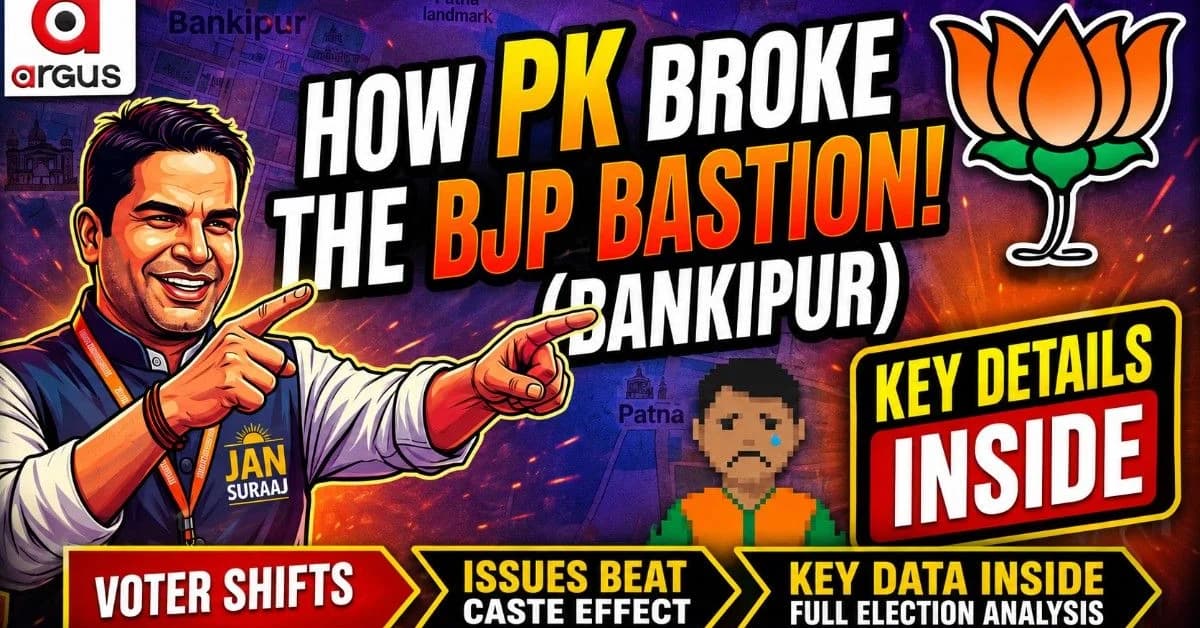
Bhubaneswar: Prashant Kishor's victory in the Bankipur Assembly by-election marks the end of the BJP's uninterrupted dominance in one of Bihar's most urban constituencies. The verdict assumes significance because Bankipur has long been regarded as a politically stable urban seat where the BJP consistently enjoyed overwhelming support.
This time, however, a combination of demographic shifts, candidate appeal and issue-based voting altered the electoral arithmetic, enabling the Jan Suraaj Party chief to secure nearly half of the votes.
BJP's Long Hold Broken Despite Decade-Long Dominance
Bankipur had remained a BJP fortress for over 15 years under four-time MLA Nitin Nabin. Between 2010 and 2025, the party consistently polled around 59-72 per cent vote share in successive Assembly elections.

📱 Get Argus News App
✨However, with Nabin moving to the Rajya Sabha and the BJP fielding a new face, the party's vote share fell sharply, while Prashant Kishor transformed Jan Suraaj from a marginal player in the 2025 Assembly polls into the winning force with a vote share of about 49.19 per cent. The outcome reflects both the loss of an entrenched incumbent advantage and the emergence of a credible challenger.
Urban Demography Played Decisive Role
Unlike most Bihar constituencies, Bankipur is an entirely urban Assembly segment with a high concentration of upper-caste and business-class voters.
Traditionally, the BJP's electoral strength rested on upper-caste communities, particularly Kayasthas, along with Vaishya traders.
The constituency also has a sizeable Yadav-Muslim electorate, which historically supported the RJD.
The by-election, however, witnessed noticeable shifts within these established voting blocs, while the relatively low turnout suggested that a section of traditional BJP supporters did not participate in the election.
Voter Shift: How Traditional Voting Patterns Changed
|
Community |
Approx. Electorate |
Traditional Preference |
Observed Shift in Bypoll |
|
Kayastha |
14-15% |
BJP |
Younger voters showed greater support for Prashant Kishor, while older voters largely stayed with BJP. |
|
Vaishya (OBC) |
8% |
BJP |
Despite the RJD fielding a Vaishya candidate, a sizeable section reportedly moved towards Jan Suraaj. |
|
Yadav & Muslim |
Around 20% |
RJD |
Vote consolidation behind Prashant Kishor appeared to reduce the RJD's vote share significantly. |
|
Other Upper Castes (Bhumihar, Rajput, Brahmin) |
Around 20% |
BJP |
Lower participation among sections of these voters coincided with the overall turnout of about 34%. |
Beyond Demography: Local Issues and Candidate Strength Made the Difference
Apart from the demographic realignment, several constituency-specific factors appear to have influenced the result.
The BJP's transition from veteran leader Nitin Nabin to a relatively less-established candidate reduced the personal connect that had helped the party dominate the constituency for years.
On the other hand, Prashant Kishor's decision to contest personally transformed the by-election into a high-profile contest, giving Jan Suraaj a recognisable face with strong recall among urban voters.
Campaign themes also differed sharply.
While the BJP largely emphasised continuity and broader governance issues, Jan Suraaj focused extensively on unemployment, career opportunities, migration of educated youth, municipal concerns and alleged examination irregularities. The campaign's outreach among students, particularly around the Patna University area, helped reinforce this message among younger urban voters.
The verdict also reflected the changing behaviour of urban voters.
Rather than remaining tied to long-standing party loyalties, sections of the electorate appeared willing to back a candidate perceived as a stronger local alternative.
Simultaneously, the sharp decline in the RJD's vote share suggested consolidation among voters seeking a viable challenger in the constituency.
Coupled
with lower turnout among sections of the BJP's traditional support base, these
factors reshaped the electoral outcome and ended one of Bihar's most enduring
urban strongholds.
Also Read: Bengal polls / West Bengal Elections 2026: Mamata Vs BJP: Who Will win?
Related Topics
Explore more stories