



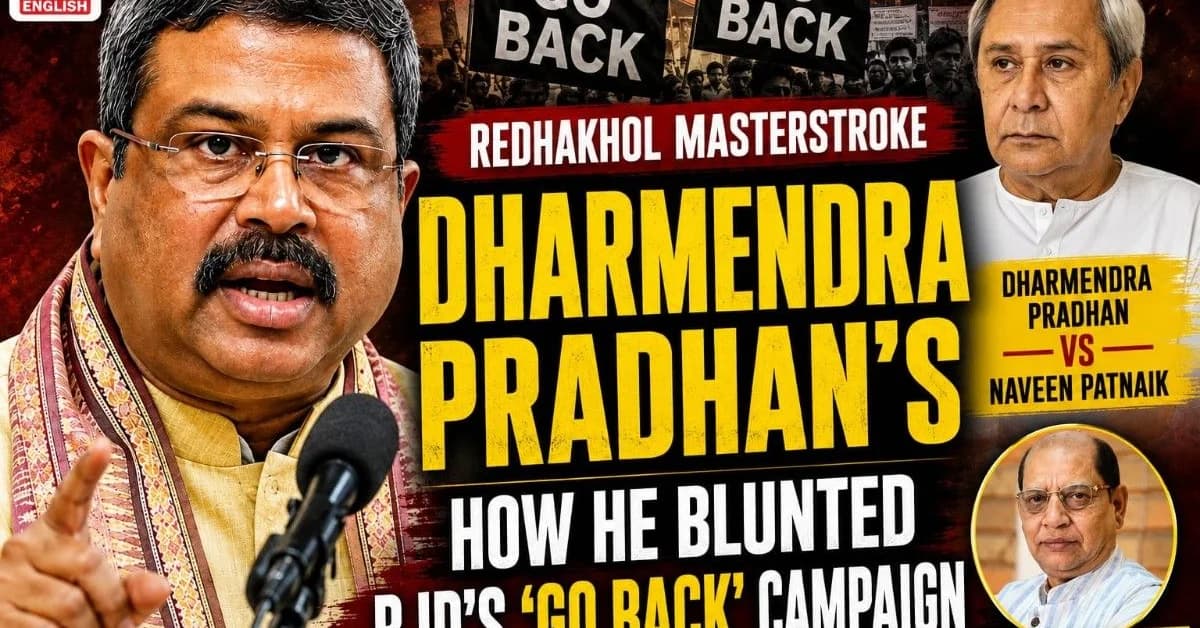
Dharmendra Pradhan’s Redhakhol Masterstroke: How He Blunted BJD’s ‘Go Back’ Campaign Beside Prasanna Acharya| Political Analysis
Key Points
* The resignation over the NEET controversy was reframed from a liability into a question of accountability and political record.
* Sharing the stage with veteran BJD leader Prasanna Acharya created a striking counter-optic to the party’s street campaign.
Bhubaneswar: When western Odisha stirred the political pot for Naveen Patnaik led BJD, and when his bête noir set foot on the soil of the very landscape that proved a Waterloo for Patnaik in 2024 election, the erstwhile ruling party and the main opposition party in the State tried to seize the opportunity and stir the political pot for BJP’S key poll architect and Sambalpur MP Dharmendra Pradhan.
But the BJP veteran in a classic way turned the tables on BJD. By doing so, Dharmendra Pradhan shows why he is a master political leader in the State.
He did so without a dint of aggression, without spewing venom against his arch-rival and former Odisha CM Naveen Patnaik.
For which, political observers call it a masterstroke.

📱 Get Argus News App
✨THE BJD POLITICAL STRATEGY
BJD planners assumed they had seemingly found a potent political weapon to target the political capital of former Union Education Minister Dharmendra Pradhan.
They tried to weaponise his resignation following the NEET examination paper leak.
In order to paint a narrative against a top BJP leader, the party strategists framed a “Go Back” campaign, and sought to convert that resignation into a political indictment –an argument that a senior minister from Odisha had failed the state’s students and therefore had no moral or political claim to continue representing Odisha.
But in Redhakhol, on the home turf of veteran BJD leader Prasanna Acharya, Pradhan demonstrated why political battles are often won not by avoiding an opponent’s weapon, but by taking control of it.
What Pradhan attempted was more than a conventional rebuttal.
He effectively turned the BJD’s proposed referendum on his resignation into his own referendum on his political record.
Instead of allowing the opposition to ask voters whether he had failed Odisha, he asked the voters to decide whether his long stint in the Union government had compromised – or strengthened = his claim to represent Odia interests. That was the central political pivot.
The BJD’s New Weapon: From ‘External Control’ to Accountability
The BJD’s political narrative has always been Odia Swabhiman. When it ruled the State, it had then painted Union Ministers from Odisha in Modi Cabinet as Delhi’s ‘Yes Men’.
However, under Dharmendra Pradhan’s leadership in 2024 elections, the BJP had flipped the Swabhiman narrative by taking the Odia Asmita mantle, putting finger on BJD’s raw nerve – the role of former IAS VK Pandian. The rest has been history.
However, smelling an opportunity, the BJD strategists tried to sharpen their tried and tested political missile, when local elections are looming large.
The opposition therefore needed a fresh line of attack.
The resignation of Pradhan after the NEET controversy offered precisely such an opening, and the BJD decided now to personalise the attack: Was Odisha’s most prominent BJP leader accountable for what happened to students?
That is where the “Go Back” campaign acquired political significance.
The objective was not merely to protest against Pradhan. It was to redefine him in the public imagination – from a powerful Odia leader at the Centre to a minister who had to resign.
Pradhan’s Redhakhol take off was designed to shot down the BJD missile.
The First Masterstroke: Taking away The Opposition’s Surprise
The most effective political attacks often depend on controlling the first frame through which voters encounter an issue.
Pradhan appears to have understood that.
Rather than allowing the BJD’s “Go Back” campaign to dominate the narrative before or during his interaction with voters, he himself brought the controversy into the conversation.
This is essentially an inoculation strategy: expose the audience to the opponent’s attack before the opponent can deploy it effectively, then provide your own take on it.
The BJD wanted the resignation to remain an accusation.
Pradhan sought to make it a subject of debate.
That distinction matters.
Once a politician voluntarily acknowledges an opponent’s most damaging allegation, the allegation loses some of its ability to create surprise.
The political conversation moves from “Look what happened to Pradhan” to “What does Pradhan say about what happened?”
In Redhakhol, therefore, the resignation stopped being solely a BJD weapon. It became contested political territory.
The Bigger Pivot: From Resignation to Sacrifice
The second and more consequential manoeuvre was moral reframing.
The BJD’s preferred interpretation was straightforward: resignation equals failure.
Pradhan's counter-interpretation was equally straightforward: resignation equals accountability and principle.
That distinction allowed him to move the debate away from the mechanics of BJD political campaign towards his larger political identity.
By invoking Lord Jagannath and his long record in national politics, Pradhan attempted to establish a hierarchy of political values: office is temporary, but Odia identity and dignity are permanent.
That was a masterstroke move.
Had he concentrated only on defending his administrative record, he would have remained trapped inside the BJD’s frame. He would effectively have been answering the opposition’s question on its terms.
Instead, he sought to change the question itself.
The BJD's question was:
“Odisha’s prominent leader failed the State and hurt Odia Swabhiman?”
Pradhan's counter-question was:
“After 12 years at the Centre, did I ever compromise Odisha’s pride?”
The second question is politically much harder to attack because it moves the debate from a single institutional controversy to an accumulated political record.
Why Redhakhol Mattered
The venue was almost as important as the message.
The argument was being made not in a television studio or a social-media ecosystem, but before a physical audience or voters in Redhakhol, within Pradhan’s Sambalpur Lok Sabha constituency.
This created a classic ground-versus-studio divide.
A resignation is an abstract institutional event. Its political meaning is often amplified through television debates, social media posts and party statements.
But once the same issue reaches a local political gathering, it has to compete with the voter’s accumulated perception of the individual politician.
That is where Pradhan's intervention became strategically important.
When he directly asked the gathering to respond to the BJD's allegation, the loud response of ‘NO’ from the crowd became political theatre as well as political communication.
It created social proof.
The message was no longer merely Pradhan saying that the “Go Back” campaign had failed. The crowd itself became part of the counter-narrative.
The optics was simple: the opposition was asking for rejection; the local audience was being presented as unwilling to endorse that rejection.
For a political campaign, that is a far more powerful image than a counter-statement issued from a party office.
The Prasanna Acharya Factor: The Opposition’s Own Stage Complication
The most interesting part of the Redhakhol episode, however, was arguably the presence of veteran BJD leader Prasanna Acharya.
This created an unusual political juxtaposition.
On the street, the BJD's cadre-level message was confrontation: “Go Back”.
On the stage, however, Pradhan was sharing space with a senior regional leader of the very party leading that campaign.
Pradhan's decision to seek Acharya's permission before addressing the question to the electorate was therefore politically significant.
It was not simply courtesy.
It created a chivalry trap.
If Acharya objected, he risked appearing excessively partisan in a public setting.
If he allowed Pradhan to speak, the latter received the legitimacy of addressing the same audience while standing beside a senior BJD leader.
The result was an optical contradiction for the opposition.
The BJD's street campaign sought to portray Pradhan as politically unacceptable.
The stage presented a very different picture: Pradhan was not an isolated leader. He was a political heavyweight capable of sharing the platform with one of the BJD's most experienced leaders.
That contrast matters enormously in electoral politics, where visuals can sometimes communicate more powerfully than speeches.
Pradhan’s 12-Year Record Became the Counterweight
The resignation campaign also contained another vulnerability: it risked compressing Pradhan's entire political career into one controversy.
Pradhan's counter-strategy was to reverse that compression.
Instead of allowing the debate to become exclusively about the NEET episode, he invoked his 12-year political record at the Centre.
This is classic record-based political defence.
A politician facing an immediate controversy has two choices: defend the incident or enlarge the frame.
Pradhan chose the second.
The political calculation was that voters should judge the resignation against the accumulated record of a leader who had spent years in national politics, rather than judge the entire political career through one administrative controversy.
That does not necessarily eliminate the accountability question. But it prevents the opposition from monopolising its interpretation.
And that, strategically, was the objective.
The Battle Was Over Meaning, Not Just Votes
The Redhakhol episode therefore reveals a deeper feature of contemporary political warfare.
The BJD was trying to weaponise an event.
Pradhan was trying to weaponise its interpretation.
The difference is crucial.
BJD's political frame Pradhan's counter-frame
Resignation = failure Resignation = accountability
NEET controversy = administrative liability Resignation = acceptance of responsibility
“Go Back” = public rejection Crowd response = political endorsement
Pradhan failed Pradhan as long-serving Odia leader
Delhi minister disconnected from Odisha National leader claiming an Odia identity
Street confrontation Public-stage engagement
The BJD's objective was to make Pradhan defensive.
Pradhan's objective was to expose the BJD game plan.
That is a substantially different battlefield.
The Political Lesson: Never Fight Your Opponent’s Question
The most important takeaway from the Redhakhol episode is perhaps this: Pradhan did not attempt to win the BJD's argument; he turned the tables completely on BJD
The BJD wanted the resignation to be the starting point and the conclusion.
Pradhan made it the starting point and then moved the conversation towards accountability, identity, political record and voter endorsement.
That is a classic narrative pivot.
The “Go Back” campaign required voters to accept the BJD's interpretation of Pradhan's resignation before the campaign could acquire political momentum.
By putting the issue directly before the voters himself, Pradhan sought to deny the opposition make gain in their strategy.
The result was a political inversion.
A campaign designed to force Pradhan to answer the electorate instead gave Pradhan an opportunity to ask the electorate a question of his own.
And in politics, controlling the question can often be more important than winning the answer.
The Bottom Line
The Redhakhol episode should therefore not be read merely as another confrontation between the BJP and BJD. Its real significance lies in the tactical response to an emerging opposition strategy.
The BJD had tried to weaponise the politics of accountability.
Pradhan played a masterstroke swiftly to deny the opposition ownership of the new narrative.
He brought the resignation into the open, reframed it as accountability rather than defeat, expanded the discussion to his 12-year record, invoked Odia identity, and then placed the entire proposition before a local audience.
Most importantly, he did it in the presence of a veteran BJD leader.
That was the masterstroke.
The BJD wanted “Go Back” to become a verdict on Pradhan.
Pradhan turned it into a question for the voters. And in democracy, voters are Supreme.
Related Topics
Explore more stories