



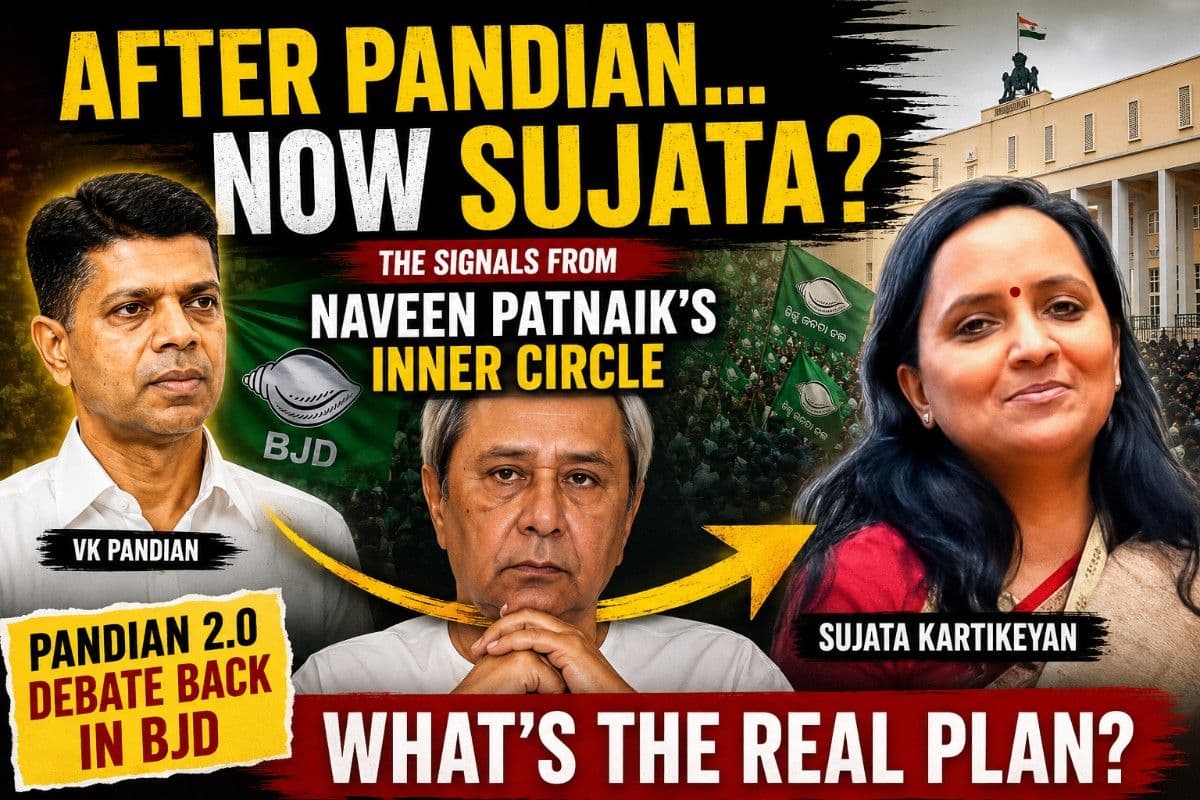
After Pandian, Now Sujata? The Signals Emerging from Naveen Patnaik's Inner Circle| Analysis
Key Points
* The narrative surrounding Sujata's induction bears striking similarities to the rise of VK Pandian before the 2024 Odisha elections.
* Political observers are debating whether her entry reflects grassroots demand or a top-down leadership transition strategy within the BJD.
Bhubaneswar: Politics is often about what is said. But sometimes it is shaped more by what is repeatedly hinted at.
That is precisely why former IAS officer Sujata R. Karthikeyan's possible entry into the Biju Janata Dal (BJD) has become the biggest political conversation in Odisha.
The latest trigger came from BJD leader Manmath Routray, who virtually declared Sujata's political arrival as a settled matter rather than a possibility.
"Sujata is joining the BJD; there is no doubt about it," Routray told reporters, adding that the party was ready to accord her a grand welcome.

📱 Get Argus News App
✨More than a Welcome: What BJD leaders Signalling?
The significance of the statement lies not merely in welcoming a retired bureaucrat into politics. It lies in the carefully crafted assurances that accompanied it.
Routray repeatedly stressed that Sujata would not hold any organisational position. He said she would not be projected as anyone's successor. Yet in the same breath, he claimed that her entry would strengthen the party, challenge the BJP government, boost cadre morale and energise the organisation.
Another senior BJD leader echoed similar sentiments, arguing that Sujata's guidance would strengthen the party structure and benefit the organisation.
Taken together, the statements reveal several political signals:
• Her entry into BJD is being treated as a certainty rather than speculation.
• The leadership appears keen to expedite the process.
• There is unusual eagerness among sections of the party to publicly endorse her arrival.
• Her administrative experience is being projected as a political asset.
• She is being portrayed as someone capable of strengthening the opposition's attack on the BJP government.
• Most importantly, she is being projected as a morale booster for BJD workers.
And that last claim is where the political story becomes intriguing.
The Pandian Parallel
For many observers, the language surrounding Sujata's proposed induction sounds strikingly familiar.
Only two years ago, a similar narrative surrounded her husband, former IAS officer V.K. Pandian.
Pandian never formally occupied a major organisational position within the BJD. Officially, he remained the private secretary to then Chief Minister Naveen Patnaik for much of his rise.
Yet politics is often conducted through symbolism.
During the run-up to the 2024 Assembly elections, Pandian was projected across Odisha in a manner unprecedented for a bureaucrat. He undertook extensive public outreach programmes, addressed gatherings, reviewed projects and emerged as the most visible face after Naveen Patnaik himself.
No formal declaration was made regarding succession.
No official document proclaimed him heir apparent.
But the political message perceived by many voters was unmistakable: Naveen Patnaik remained the mascot, while Pandian had emerged as the most powerful figure within the system and the likely inheritor of the political mantle.
The BJP and Congress seized on that perception.
They framed the election as a battle against the transfer of Odisha's political leadership to a former bureaucrat from outside Odisha's political mainstream. The campaign resonated sufficiently to alter political equations and contributed to the BJP's historic victory in the state.
The 2024 verdict therefore represented not merely a defeat for BJD but a rejection of a succession narrative that many voters believed was being scripted behind the scenes.
Why Sujata Raises Similar Questions
It is against this backdrop that Sujata Karthikeyan's possible political debut is attracting extraordinary attention.
The central argument being advanced by her supporters is that her administrative experience would strengthen the BJD.
Few dispute her bureaucratic credentials.
Born on May 9, 1975, Sujata Karthikeyan belongs to the 2000 batch of the Odisha cadre of the Indian Administrative Service. Holding a Master's degree in International Politics, she has served in a range of positions including district administration, social sector governance and senior policy-making roles.
Her most prominent public recognition came during her tenure in the Women and Child Development ecosystem, where she became associated with Odisha's extensive Self-Help Group (SHG) mobilisation efforts.
Supporters credit her with helping expand and strengthen the SHG network that transformed women's economic participation across large parts of the state.
However, the political question remains fundamentally different.
The Legacy of SHGs: Achievement or Political Capital
SHGs are not political organisations.
They are socio-economic institutions supported through government frameworks involving agencies such as NABARD, the Union Government and the State Government.
Mobilising women for SHG participation, implementing welfare programmes and building administrative delivery mechanisms require governance skills.
Running a political organisation demands a different set of capabilities: electoral management, cadre building, ideological messaging, coalition management, faction handling and political negotiation.
As of today, Sujata Karthikeyan possesses a distinguished administrative record but no demonstrated experience as a career politician.
That raises a legitimate question.
If she has never contested elections, managed party structures or built a political base, how exactly does her entry become a source of organisational morale for party workers?
The answer may lie less in grassroots demand and more in leadership signalling.
Bottom-Up Demand or Top-Down Design?
Political parties usually elevate leaders through visible organisational journeys.
Workers first rally behind an emerging figure. The leadership then formalises that rise.
In the present case, the sequence appears reversed.
Before Sujata has formally entered politics, senior leaders are already arguing that she will strengthen the organisation, challenge the government and inspire cadres.
That suggests a top-down political process rather than a bottom-up organisational movement.
The comparison with Pandian therefore becomes difficult to ignore.
Just as Pandian was presented as an administrative problem-solver capable of energising the party, Sujata is now being introduced through a similar framework of competence, governance experience and leadership potential.
The repeated insistence that she will neither hold organisational office nor be projected as successor may itself reflect an awareness of the political backlash that accompanied similar perceptions in 2024.
Yet political messaging often operates beyond formal declarations.
The real question is not whether BJD leaders publicly deny succession plans.
The real question is whether party workers, political opponents and voters begin interpreting the signals differently.
The Leadership Question
There is another aspect that fuels speculation.
Those who know Sujata's career trajectory point to a long-standing personal ambition.
After completing Class X, she reportedly chose the arts stream with a clear objective of entering the civil services. She eventually realised that goal and rose through the administrative hierarchy.
Such a journey demonstrates focus, determination and leadership instincts.
These qualities are valuable in politics.
But they also make political observers wonder whether Odisha may be witnessing the early stages of another carefully managed leadership transition experiment.
At present, there is no official indication from BJD president Naveen Patnaik regarding Sujata Karthikeyan's political future.
Nor has the party formally announced any role for her.
However, the unusually enthusiastic endorsements from party leaders have ensured that her possible entry is no longer being discussed merely as a routine induction.
Instead, it has become a debate about the future direction of the BJD itself.
Whether Sujata Karthikeyan eventually emerges as a grassroots political leader, an influential strategist, or simply another respected party member remains to be seen.
But one thing is already evident.
The moment senior leaders began describing a former bureaucrat as a morale booster, organisational asset and future challenger to the government, Odisha's political memory inevitably travelled back to 2024.
And that is why the conversation today is no longer only about Sujata Karthikeyan.
It is about whether Naveen Patnaik is preparing a sequel to the Pandian experiment – or attempting to write a very different ending, especially when the political buzz gets amplified a day after Patnaik’s return from 6-day stay in Delhi.
Related Topics
Explore more stories