



Odisha Politics / Will Sujata Live up to Naveen’s Expectations?
Key Points
Bhubaneswar, Oct 28: Sujata Karthikeyan Pandian, wife of controversial bureaucrat-turned-politician V. Karthikeyan Pandian, has embarked on what could prove to be a defining political assignment: reviving the fortunes of the beleaguered Biju Janata Dal (BJD) and preparing the party for the electoral battle of 2029.
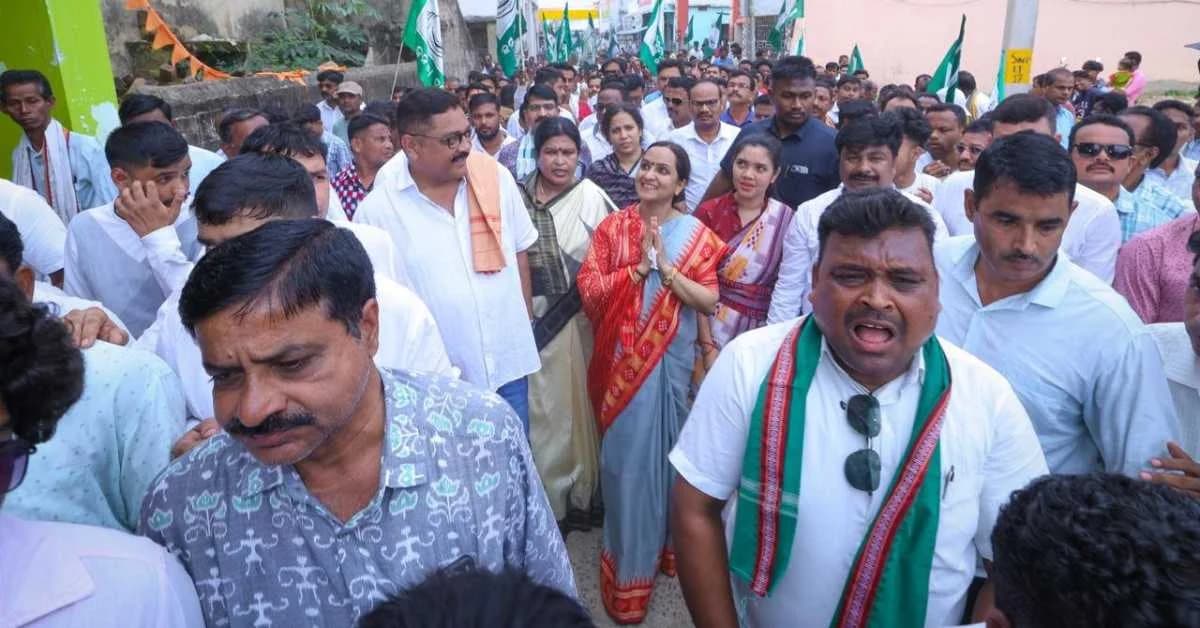
Her district tours have begun, signalling that she is ready to move beyond the status of an ordinary party member and assume a more active role in rebuilding the regional outfit. Her first major political outing at Sonepur on October 27, where she participated in a mega padyatra and addressed party workers before interacting with local journalists, offered an early glimpse of the political strategy she intends to pursue.
The programme was attended by several prominent BJD leaders, including former finance minister Niranjan Pujari, former minister Snehangini Chhuria, former MLA Debesh Acharya and MLA Barsha Singh Bariha. Their presence lent political weight to the event and underlined the party's attempt to project a united front as it prepares for a difficult road ahead.
Addressing party workers, Sujata launched a sharp attack on the Mohan Charan Majhi government, accusing it of failing to deliver on welfare commitments. She alleged delays in the disbursement of old-age pensions, inadequate support for weavers and farmers, and a deterioration in the law-and-order situation. She also accused the BJP government of making false promises and failing to live up to public expectations.

📱 Get Argus News App
✨Her speech was not merely an exercise in political criticism. It was also an attempt to remind the electorate of the BJD's 24-year tenure and the welfare architecture that the Naveen Patnaik government had built around tribal development, women's empowerment and rural livelihoods.
Sujata invoked the BJD government's initiatives for tribal communities, including the establishment of Special Development Councils in 23 districts with substantial tribal populations. She referred to the Anwesha and Akankshya schemes for tribal students, the role of Mission Shakti in empowering women, and initiatives aimed at training rural youth, including the proposed establishment of a World Trade Centre.
The thrust of her argument was unmistakable: the BJD had pursued empowerment-oriented governance and service-based politics, while the present government, she alleged, was abandoning that legacy. By presenting the party's past record as a model for welfare and inclusive development, she sought to reconnect with constituencies that had been central to its political dominance.
But the larger significance of the Sonepur programme lies beyond the familiar rhetoric of opposition politics. It was Sujata's first major public mobilisation since she formally joined the BJD on June 25, 2026. Her induction had generated considerable speculation about the party's succession question and the role she might eventually play in its organisational hierarchy.
At the time of her induction, BJD president Naveen Patnaik had described her as an ordinary member. The formulation appeared designed to avoid unsettling senior leaders who might have viewed her entry into active politics as a signal of an impending leadership transition. Yet the political optics of the induction ceremony conveyed a message that went well beyond the formal description of her position. For many observers, it appeared to be an indication that Naveen was preparing to entrust her with a significant role in the party's future.
Her Sonepur appearance has strengthened that perception.
Sujata appeared energetic and well-prepared, deploying statistics, references to welfare schemes and pointed political rhetoric to connect with the audience. The padyatra and public meetings attracted a sizeable gathering, giving her an opportunity to test her appeal among party workers and local supporters. While crowd mobilisation at a single event cannot be treated as a reliable measure of electoral popularity, it provided an initial indication that she could command attention within the party's organisational network.
The crucial question, however, is whether this early momentum can be translated into a sustained political revival.
The challenge of rebuilding the BJD
The BJD is confronting a challenge fundamentally different from the one it faced during its long years in power. After governing Odisha for 24 years, the party lost power to the BJP in 2024. The defeat exposed not only electoral vulnerabilities but also questions about organisational renewal, grassroots engagement and the concentration of authority around a small circle of trusted aides.
The party's revival will require more than criticism of the ruling government or reminders of Naveen Patnaik's administrative legacy. It will need to rebuild its district-level organisation, restore the confidence of disgruntled workers, develop a credible second line of leadership and articulate a political vision that addresses the aspirations of a changing electorate.
Sujata's district tours could become an important instrument in this exercise. They may help her identify organisational weaknesses, reconnect with local leaders and energise cadres who have struggled to adjust to the party's loss of power. But the task will also require her to navigate competing interests within an organisation where several senior leaders have their own political ambitions and established constituencies.
Her ability to win the confidence of these leaders, rather than merely occupy the political space created by Naveen's endorsement, will be a decisive test.
The BJD's future also depends on how it handles the legacy of V. Karthikeyan Pandian, whose rise within the party had become a major political controversy. The perception that an unelected former bureaucrat exercised disproportionate influence over the party and the government became a persistent point of attack for the opposition. The BJD's electoral defeat intensified the debate over whether excessive centralisation and the marginalisation of established political leaders had contributed to its decline.
Sujata will inevitably face questions about whether her emergence represents a genuine organisational reset or the continuation of the same centralised style of functioning under a different face. Her challenge is to demonstrate that she can build relationships with grassroots workers and senior leaders on the strength of her own political judgement, rather than rely solely on the authority conferred by Naveen Patnaik.
Naveen's old political playbook
There is also a broader question about Naveen's own approach to managing the party.
From the comfort of Naveen Niwas, the former chief minister
appears once again to be relying on a familiar political arrangement:
delegating organisational responsibilities to trusted associates while
reserving his own energies for the larger electoral battle. The strategy
recalls the roles played by the late Pyarimohan Mohapatra and, more recently,
V. Karthikeyan Pandian, both of whom occupied influential positions in the
BJD's political and organisational affairs.
Also Read: CM Mohan Majhi Writes to Naveen Patnaik, Reaffirms Odisha's Claim Over Kotia Villages
The underlying calculation is straightforward. Naveen remains the party's most recognisable political face, and his personal appeal could continue to be an important electoral asset. By allowing a trusted lieutenant to manage organisational affairs, he can concentrate on preserving his own political authority and leading the campaign when elections approach.
Related Topics
Explore more stories