



Why Fertiliser Sales Have Fallen in Odisha This Kharif Despite Record Stocks: The Real Crisis Lies Beyond El Niño
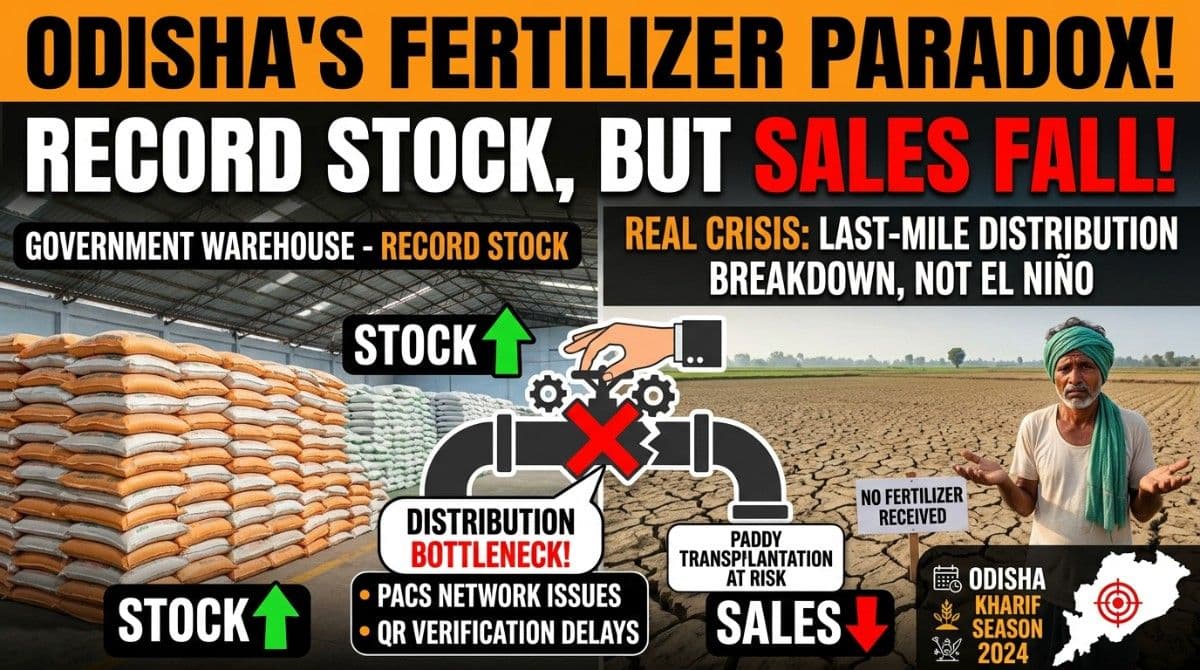
Key Points
- Odisha's fertiliser sales fell 12.1% despite higher stocks and increased demand.
- PACS distribution bottlenecks and QR-code verification are slowing last-mile delivery.
- Western Odisha's paddy belt faces nutrient delays during the crucial transplantation stage.
Bhubaneswar: Odisha is witnessing a paradox this Kharif season. Fertiliser warehouses are better stocked than last year, demand projections have increased across every major nutrient category, yet actual fertiliser sales have fallen by more than 12%.
Unlike the national narrative, where weather uncertainties and El Niño-related concerns have moderated consumption, Odisha's slowdown is being driven by an entirely different problem: a breakdown in the last-mile distribution network.
Data comparing April 1 to July 21 shows that total fertiliser consumption through the Direct Benefit Transfer (DBT) system declined from 3.97 lakh metric tonnes (LMT) last year to 3.49 LMT this year, a fall of 12.1%, despite higher availability and higher projected demand.
The figures indicate that fertiliser is reaching Odisha but not reaching farmers on time.

📱 Get Argus News App
✨Stocks Are Higher, Yet Sales Are Lower
The numbers reveal that supply is not the constraint.
The state's projected Kharif fertiliser requirement increased from 4.94 LMT to 5.08 LMT this year. To support this demand, the Centre also increased allocations, pushing overall availability from 8.13 LMT to 8.58 LMT.
Every major fertiliser category shows the same trend:
|
Fertiliser |
Requirement 2025 |
Requirement 2026
Availability 2025
Availability 2026
DBT Sales 2025
DBT Sales 2026
Urea
2.62
2.73
3.95
4.17
1.84
1.67
DAP
1.18
1.22
1.48
1.53
0.91
0.80
MOP
0.52
0.55
0.71
0.76
0.28
0.21
NPKS
1.62
1.68
1.99
2.12
0.94
0.81
The pattern is unmistakable. Demand has risen. Stocks have risen. Sales have fallen.
That disconnect points squarely towards the distribution chain.
The PACS Bottleneck
The biggest choke point has emerged at the level of Primary Agricultural Cooperative Societies (PACS), which serve as the primary retail interface for thousands of farmers.
Although fertiliser has reached central warehouses, only about 1.14 lakh metric tonnes has reportedly moved through the PACS network to grassroots farmers –roughly 10% of the seasonal requirement.
The result is a growing mismatch between fertiliser lying inside warehouses and fertiliser actually reaching paddy fields during the narrow transplantation window.
In effect, Odisha is facing a distribution crisis rather than a supply crisis.
Peak Transplantation Window Under Stress
The timing could hardly be worse.
Kharif paddy transplantation requires immediate application of basal nutrients, particularly Urea and Diammonium Phosphate (DAP), to stimulate root establishment and early vegetative growth.
Any delay during this critical stage affects tillering, weakens root systems and increases crop vulnerability to weeds.
Agronomically, nutrients applied weeks late cannot fully compensate for losses incurred during the initial establishment stage.
Thus, the slowdown is not merely reducing fertiliser sales – it carries the potential to lower crop productivity even if fertilisers eventually reach farmers.
Digital Verification Slowing Rural Distribution
Reports suggest a significant factor behind the slowdown is the implementation of QR-code based digital verification at cooperative outlets.
Instead of handling large farmer volumes quickly, many PACS are reportedly processing only 30 to 70 farmers per day because every transaction requires digital authentication.
The system has also created practical barriers for sharecroppers, elderly farmers and cultivators without smartphones or properly linked digital identities.
While designed to improve transparency and prevent diversion, the verification process has substantially slowed physical distribution during the busiest agricultural season.
Western Odisha Feeling the Greatest Pressure
The impact is most visible in Odisha's early-sowing western districts, particularly Bargarh and Sundargarh, where paddy transplantation begins earlier than many coastal regions.
Farmers in these intensive cultivation belts have reportedly been waiting outside cooperative societies for extended periods in hopes of securing fertiliser before their transplanted saplings suffer nutrient stress.
Because these districts contribute significantly to Odisha's paddy production, prolonged delays could have wider implications for state foodgrain output.
Policy Shift Towards Alternative Nutrients
Another reason behind the decline in traditional fertiliser sales is the government's strategy of encouraging complex fertilisers and ammonium sulphate instead of excessive dependence on conventional Urea and DAP.
The move comes amid continuing international supply uncertainties affecting phosphate-based fertilisers.
As MARKFED shifts part of its distribution towards alternative nutrient combinations, recorded sales of conventional fertilisers have naturally moderated.
However, this transition appears to have coincided with distribution bottlenecks, amplifying the slowdown visible in DBT sales data.
Odisha's Story Differs From the National Trend
India as a whole has also recorded a decline in DBT fertiliser sales despite maintaining large strategic stocks.
Nationally, however, the moderation has largely been linked to weather variability, revised consumption estimates and policy efforts encouraging balanced nutrient use.
Odisha's case stands apart.
The state's own demand estimates have increased, central allocations have increased, and stock availability has improved.
Yet sales have contracted primarily because fertilisers are moving slowly through the cooperative distribution pipeline rather than because farmers need less fertiliser.
A Logistics Challenge That Could Influence Harvests
The current numbers suggest Odisha's fertiliser challenge is administrative rather than production-related.
If fertilisers continue to remain inside warehouses while paddy transplantation progresses in the fields, the state risks converting an avoidable logistics problem into a crop productivity issue.
For now, the
data presents an unusual agricultural paradox: more fertiliser than ever
before is available in Odisha, but less is reaching farmers when it matters
most.
Also Read: Amid Global Fertilizer Crisis, Odisha’s Push for Urea Alternatives to Trigger Soil Health Revolution Across 20 Odisha Districts| Special Report
Related Topics
Explore more stories