



When Poverty Breaths Poison and Progress Bypasses The Poor
·3 months ago·4 min read
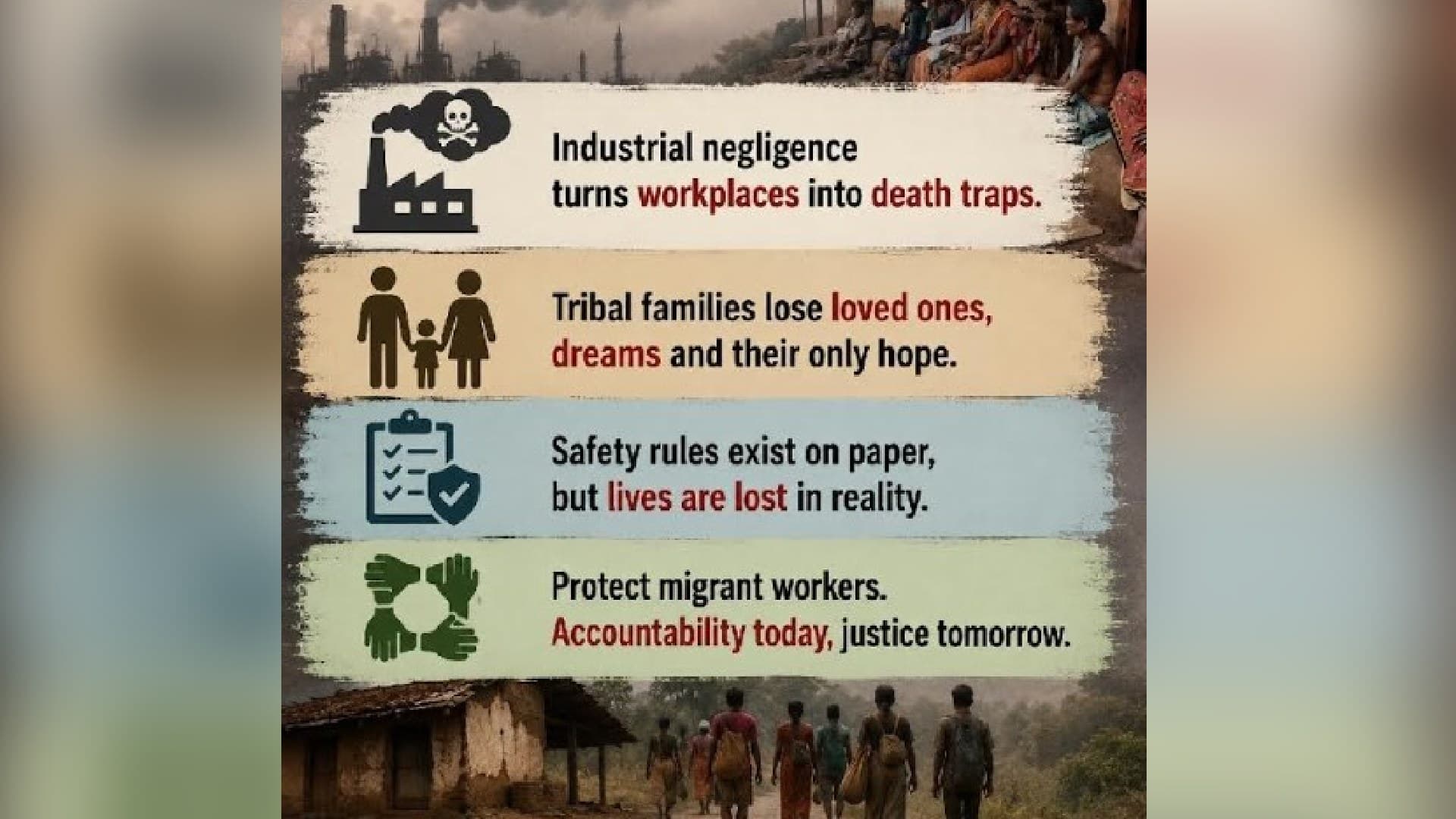
Key Points
The ammonia gas leak at a Tamil Nadu seafood plant, which killed several Odia workers from the Juang tribal community, highlights how migrant workers from vulnerable tribal groups continue to bear the cost of industrial growth.
Bhubaneswar, Jun 24: The ammonia gas leak at a seafood processing unit in Tamil Nadu's Tiruvallur district is not merely another industrial accident. It is a heartbreaking reminder of how India’s economic growth continues to rest on the fragile shoulders of its poorest workers. The tragedy has already claimed the lives of several Odia workers, most of them young women from the Juang tribal community of Keonjhar district, while dozens of others continue to battle for survival in hospitals.
For the nation, it is a factory accident. For Odisha, it is a story of shattered homes, grieving parents and dreams extinguished before they could bloom.
The faces behind the statistics belong to some of the most marginalised citizens of the country. The Juangs, classified among Odisha's Particularly Vulnerable Tribal Groups (PVTGs), have historically lived in remote pockets of Keonjhar. Their lives have been shaped by poverty, inadequate livelihood opportunities and limited access to education and healthcare. In recent years, migration has become a survival strategy rather than a choice. Young men and women leave their villages, forests and familiar landscapes to work hundreds of kilometres away in factories they know little about.
Reports indicate that many of the workers affected in the Tamil Nadu tragedy had migrated from villages in Keonjhar seeking modest wages that could support their families back home. Some earned barely enough to send a few thousand rupees every month to ageing parents and younger siblings.
For the nation, it is a factory accident. For Odisha, it is a story of shattered homes, grieving parents and dreams extinguished before they could bloom.
The faces behind the statistics belong to some of the most marginalised citizens of the country. The Juangs, classified among Odisha's Particularly Vulnerable Tribal Groups (PVTGs), have historically lived in remote pockets of Keonjhar. Their lives have been shaped by poverty, inadequate livelihood opportunities and limited access to education and healthcare. In recent years, migration has become a survival strategy rather than a choice. Young men and women leave their villages, forests and familiar landscapes to work hundreds of kilometres away in factories they know little about.
Reports indicate that many of the workers affected in the Tamil Nadu tragedy had migrated from villages in Keonjhar seeking modest wages that could support their families back home. Some earned barely enough to send a few thousand rupees every month to ageing parents and younger siblings.

📱 Get Argus News App
✨📰 60 Word News🎬 Argus Podcast📺 Live TV and Breaking News🔔 Free Notification Alerts
Download Free:
One cannot help but imagine the scenes unfolding today in the villages of Keonjhar. Mothers waiting for daughters who will never return. Elderly parents staring at silent mobile phones. Children asking when their sisters will come home. In these villages, every migrant worker carries not only personal aspirations but also the economic hopes of an entire family.
What makes this tragedy even more painful is that it appears to have been avoidable. Preliminary reports point to an ammonia leak in an industrial facility where workers lived in accommodation located dangerously close to the source of the toxic gas. Investigations have been ordered, and factory owners have been questioned. Yet such official responses have become painfully predictable after every industrial disaster.
The larger question remains unanswered: Why do industrial accidents continue to claim the lives of workers despite advances in technology, safety engineering and regulatory frameworks?
Across India, whether in mines, steel plants, chemical factories or seafood processing units, investigations often reveal a familiar pattern—poor maintenance, inadequate risk assessment, weak enforcement of safety norms and a culture that prioritises production over human life. Safety audits become paperwork exercises. Workers receive little training. Warning signs go unnoticed until tragedy strikes.
But for migrant workers, the risks are even greater.
Far from home, unfamiliar with local languages and dependent on contractors, they often lack the power to question unsafe conditions. Their vulnerability begins long before they enter a factory gate. The Tamil Nadu incident has also exposed another troubling reality—the absence of reliable records on migrant workers from Odisha. Officials reportedly struggled to identify victims and trace affected families because migration from several tribal areas remained undocumented.
What makes this tragedy even more painful is that it appears to have been avoidable. Preliminary reports point to an ammonia leak in an industrial facility where workers lived in accommodation located dangerously close to the source of the toxic gas. Investigations have been ordered, and factory owners have been questioned. Yet such official responses have become painfully predictable after every industrial disaster.
The larger question remains unanswered: Why do industrial accidents continue to claim the lives of workers despite advances in technology, safety engineering and regulatory frameworks?
Across India, whether in mines, steel plants, chemical factories or seafood processing units, investigations often reveal a familiar pattern—poor maintenance, inadequate risk assessment, weak enforcement of safety norms and a culture that prioritises production over human life. Safety audits become paperwork exercises. Workers receive little training. Warning signs go unnoticed until tragedy strikes.
But for migrant workers, the risks are even greater.
Far from home, unfamiliar with local languages and dependent on contractors, they often lack the power to question unsafe conditions. Their vulnerability begins long before they enter a factory gate. The Tamil Nadu incident has also exposed another troubling reality—the absence of reliable records on migrant workers from Odisha. Officials reportedly struggled to identify victims and trace affected families because migration from several tribal areas remained undocumented.
This should serve as a wake-up call for Odisha.
The state has made notable progress in infrastructure, industry and welfare. Yet the continued migration of tribal youth from districts such as Keonjhar, Mayurbhanj, Rayagada, Ganjam, Gajapati, and Nabarangpur reveals a deeper challenge. Development cannot be measured solely by highways, investment summits or industrial projects. True development means creating dignified employment close to home so that young tribal women are not compelled to travel across the country to perform hazardous work for meagre wages.
The Tamil Nadu tragedy therefore demands more than compensation packages and inquiries. It calls for a comprehensive national framework to protect migrant workers. Registration of migrants must be mandatory. Employers must be held strictly accountable for workplace safety and living conditions. States that send workers and states that receive them must coordinate continuously. Most importantly, industrial safety violations must invite criminal liability, not merely administrative penalties.
Every time a poor worker dies in an industrial accident, India loses more than a life. It loses a dream.
The young women from Keonjhar did not travel to Tamil Nadu seeking fortune. They travelled seeking dignity, opportunity and a better future for their families. Instead, they encountered a system that failed to protect them.
As their mortal remains return to Odisha and funeral pyres light up remote tribal villages, the nation must ask itself a difficult question: How many more poor workers must die before safety becomes non-negotiable?
For the grieving families of Keonjhar, there can be no adequate answer. But the least India can do is ensure that their daughters did not die in vain.
The state has made notable progress in infrastructure, industry and welfare. Yet the continued migration of tribal youth from districts such as Keonjhar, Mayurbhanj, Rayagada, Ganjam, Gajapati, and Nabarangpur reveals a deeper challenge. Development cannot be measured solely by highways, investment summits or industrial projects. True development means creating dignified employment close to home so that young tribal women are not compelled to travel across the country to perform hazardous work for meagre wages.
The Tamil Nadu tragedy therefore demands more than compensation packages and inquiries. It calls for a comprehensive national framework to protect migrant workers. Registration of migrants must be mandatory. Employers must be held strictly accountable for workplace safety and living conditions. States that send workers and states that receive them must coordinate continuously. Most importantly, industrial safety violations must invite criminal liability, not merely administrative penalties.
Every time a poor worker dies in an industrial accident, India loses more than a life. It loses a dream.
The young women from Keonjhar did not travel to Tamil Nadu seeking fortune. They travelled seeking dignity, opportunity and a better future for their families. Instead, they encountered a system that failed to protect them.
As their mortal remains return to Odisha and funeral pyres light up remote tribal villages, the nation must ask itself a difficult question: How many more poor workers must die before safety becomes non-negotiable?
For the grieving families of Keonjhar, there can be no adequate answer. But the least India can do is ensure that their daughters did not die in vain.
Related Topics
Explore more stories