



When Odisha Leads India in Human-Elephant Deaths, Coimbatore's New Centre of Excellence Could Become Its Biggest Lifeline | Special Report
Key Points
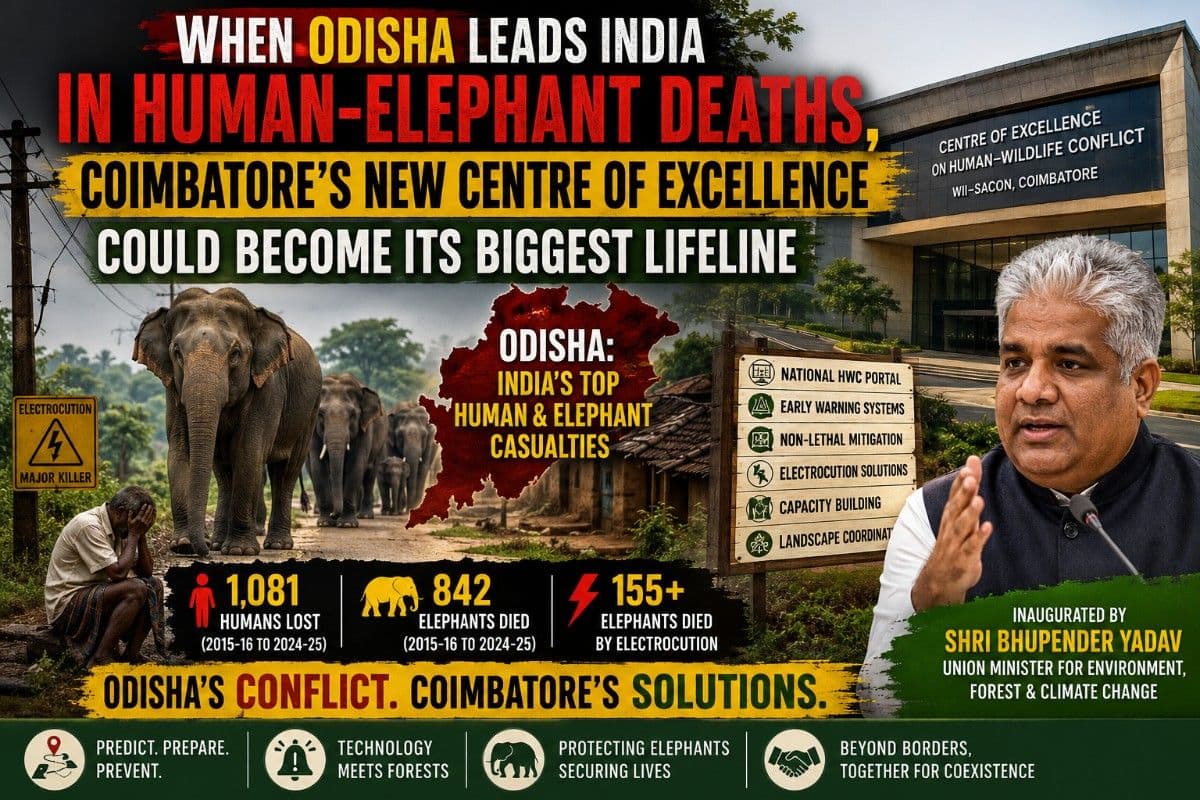
Odisha leads India in human-elephant conflict casualties, recording 1,081 human deaths and 842 elephant mortalities over the last ten years.
The state’s crisis is worsened by structural barriers like mining fragmentation and the concrete Rengali Canal system trapping herds in localized pockets.
Coimbatore's new Centre of Excellence (CoE) offers a predictive approach using a live National HWC Portal and AI-enabled early warning systems.
Bhubaneswar: When Odisha has recorded the country's highest human and elephant casualties arising out of human-elephant conflict in recent years, the launch of the Centre of Excellence (CoE) on Human-Wildlife Conflict by Union Minister for Environment, Forest and Climate Change Bhupender Yadav at Coimbatore may prove to be a game changer for the state.
The Centre, inaugurated alongside a National Workshop on Human-Wildlife Conflict, comes at a time when Odisha's conflict has evolved into India's most complex elephant conservation challenge – where rising elephant populations, shrinking habitats, mining expansion and infrastructure barriers have pushed both humans and wildlife into an increasingly dangerous confrontation.
The numbers illustrate the gravity of the crisis.
Over the last decade (2015-16 to 2024-25), Odisha lost 1,081 people to elephant attacks while 842 elephants died from natural and unnatural causes.

📱 Get Argus News App
✨Human fatalities climbed from 68 in 2015-16 to 153 in 2024-25, while elephant deaths touched a record 106 in the latest financial year.
Electrocution has emerged as the single biggest unnatural killer of elephants, accounting for more than 155 deaths over the decade, with deliberate electrocution, sagging power lines, train collisions, retaliatory killings and poaching continuing to plague conservation efforts.
Significantly, fatalities involving tigers and leopards have remained negligible, underscoring that Odisha's human-wildlife conflict is overwhelmingly an elephant crisis.
Odisha Tops India's Human-Elephant Conflict Map
Among India's major conflict-prone states, Odisha continues to record the highest annual human fatalities caused by elephants, averaging 110-140 deaths every year, considerably higher than Assam (75-95), Jharkhand (75-85), West Bengal (50-70) and Tamil Nadu (50-65).
While Assam remains one of the country's most severe human-wildlife conflict landscapes because of extensive forest encroachments and high elephant mortality, Odisha stands out for another reason – it simultaneously records one of the country's highest human and elephant casualty burdens.
Unlike West Bengal, where tiger conflicts in the Sundarbans significantly contribute to wildlife-related deaths, or Tamil Nadu where elephant encounters are concentrated around the Western Ghats, Odisha's conflict is almost entirely driven by elephants.
The state's human-to-elephant mortality ratio remains among the highest in the country, reflecting the intensity of interactions between expanding elephant populations and rapidly changing landscapes.
Why Odisha Suffers More Than Its Neighbours
The paradox becomes sharper because Odisha shares the East-Central Elephant Landscape with Jharkhand, West Bengal and Chhattisgarh, yet experiences significantly higher casualties than all three.
The foremost reason is elephant density.
According to the latest All India Elephant Population Estimation, Odisha supports nearly 2,100 wild elephants, compared with around 451 in Chhattisgarh, 217 in Jharkhand and barely 31 in South Bengal, making it the ecological anchor of eastern India's elephant population. More elephants naturally translate into greater opportunities for conflict.
However, numbers alone do not explain Odisha's crisis.
The state's principal elephant habitats overlap with some of India's busiest mining and industrial belts, particularly Keonjhar, Sundargarh, Angul and Jharsuguda. Continuous mining, quarrying, blasting and heavy vehicular movement have fragmented traditional habitats, compelling elephants to move into villages and agricultural fields in search of food.
Another Odisha-specific faultline is the Rengali Left and Right Bank Canal system cutting across Dhenkanal and Angul forests. These deep concrete canals act as formidable physical barriers, trapping elephant herds in isolated forest pockets and preventing movement along age-old migratory routes. Unable to follow ancestral corridors, elephants remain stranded near villages throughout the year, intensifying crop raids and fatal encounters.
Habitat degradation has also forced herds into non-traditional districts such as Ganjam, Cuttack, Puri and Nayagarh, regions where local communities historically had little experience living alongside elephants. The absence of traditional coexistence practices has increased panic-driven responses, accidental confrontations and retaliatory actions.
Adding to the complexity is the disruption of interstate migration. Herds moving from Jharkhand's Dalma landscape increasingly spill into northern Odisha and remain there for prolonged periods because of abundant paddy cultivation, shifting the conflict burden onto Odisha's forest divisions.
Within the state, conflict is heavily concentrated in Dhenkanal, Angul, Keonjhar and Sundargarh, where breached corridors, mining expansion and infrastructure barriers have created persistent hotspots.
Why Coimbatore Centre Could Change the Equation
The newly inaugurated Centre of Excellence marks a shift in India's approach – from reactive conflict management to predictive, science-based mitigation.
For Odisha, this could fundamentally alter how the state manages its escalating elephant crisis.
The biggest immediate benefit will come through the National Human-Wildlife Conflict Portal, which standardises real-time conflict reporting across states.
Instead of relying on fragmented field reports after incidents occur, Odisha's Forest Department can feed live geospatial information on elephant movement into a national platform. Scientists at the CoE will analyse these datasets to generate predictive movement patterns, enabling forest officials to anticipate herd movement before elephants enter villages or croplands.
Equally significant is the CoE's emphasis on managing wildlife outside protected areas – a reality that defines Odisha's elephant landscape today.
The Centre will develop standard operating procedures (SOP) for fragmented forest landscapes, including deployment of AI-enabled early warning systems, automated SMS alerts, thermal cameras, acoustic sensors and scientifically trained elephant response teams. Such systems could substantially reduce surprise encounters that often result in fatalities.
The CoE also promises to address Odisha's biggest conservation challenge – electrocution.
By bringing together technology experts, infrastructure agencies and wildlife scientists, it will develop standard engineering solutions for insulating low-hanging power lines, improving railway safety and promoting non-lethal crop protection systems.
Considering that electrocution remains Odisha's leading unnatural cause of elephant mortality, even modest improvements could save dozens of elephants annually.
Capacity building represents another major gain. Odisha's frontline forest personnel, veterinary officers and community volunteers such as Gaja Sathis will be able to receive specialised training in scientific herd management, non-lethal driving techniques and crowd control, replacing many ad hoc practices that sometimes aggravate conflict.
Perhaps most importantly, the Centre is expected to facilitate landscape-level coordination among Odisha, Jharkhand, West Bengal and Chhattisgarh. Since elephants routinely cross administrative boundaries, synchronised monitoring, shared databases and common regional action plans could ensure that conservation strategies no longer stop at state borders.
For Odisha, therefore, the significance of the Coimbatore Centre extends far beyond another national institution.
It offers
the possibility of replacing fragmented, district-level firefighting with
integrated, technology-driven, landscape-scale management. For a state that has
become India's epicentre of human-elephant conflict, that transition could make
the difference between continuing to record the country's highest casualty
figures and finally beginning to reverse them.
Also Read: NTCA's 6th Tiger Reserve Audit May Turn Heat on Odisha Simlipal, Satkosia| Special Report
Related Topics
Explore more stories