



UPI Turns 10: Odisha’s ₹33,890-Crore Monthly Digital Economy and the New Challenge Ahead| Special Report
Key Points
Bhubaneswar: When the Unified Payments Interface (UPI) entered India’s payment system in 2016, it was a digital experiment built around instant bank-to-bank transfers. A decade later, it has become the country’s most powerful payment infrastructure, transforming everything from a Rs10 tea purchase to a high-value utility payment.
As UPI enters its second decade today, Odisha stands as a significant, though relatively under-whelming, player in India’s digital payment revolution. But away from the technology hubs of Bengaluru and Mumbai, the state has quietly built a substantial digital payment footprint, emerging as a middle-tier but increasingly important UPI economy.
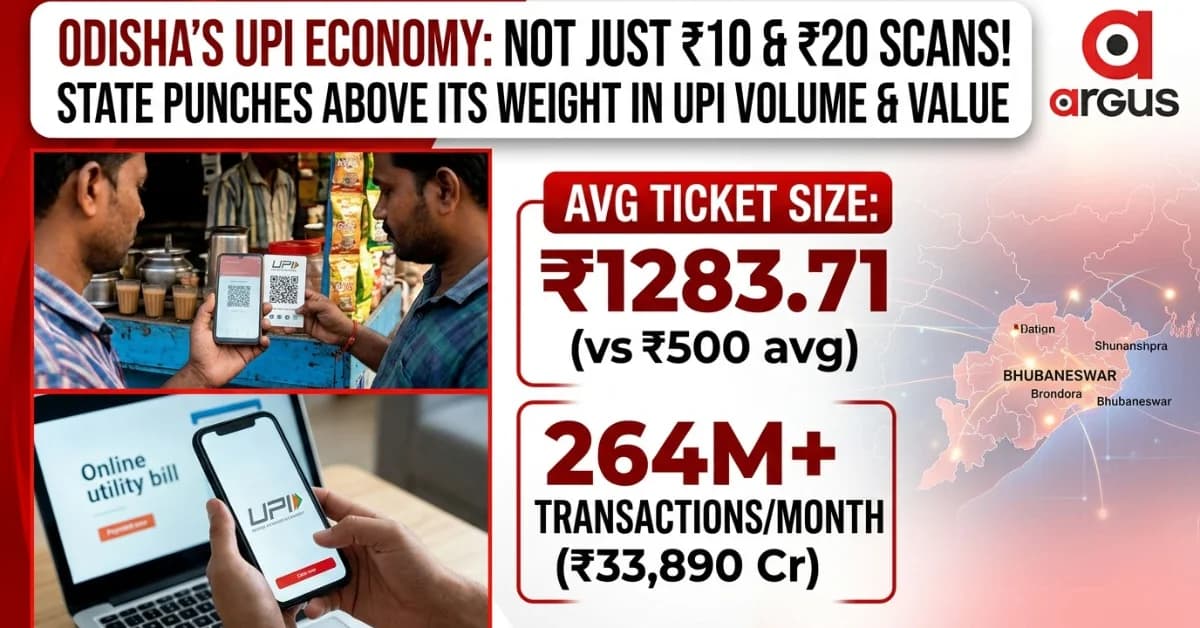
The numbers underline the scale. As per NPCI, SBI Reasearch Report, Odisha records around 264 million UPI transactions a month in 2025, with a monthly transaction value of about Rs33,890 crore, giving it a 1.4% share of the country’s classified digital payment volume and value.
Odisha Leads Its Immediate Eastern Neighbours
The state’s UPI footprint places it ahead of several neighbouring states in transaction volume and value.

📱 Get Argus News App
✨While West Bengal records around 426 million monthly transactions worth Rs62,144 crore, Odisha is ahead of Jharkhand, which records 168 million transactions worth Rs21,496 crore, and Chhattisgarh, with 129 million transactions valued at Rs16,475 crore.
The ranking shows that Odisha has already moved far beyond the early stage of digital payment adoption. The state is now a major payment market in eastern India, although its transaction scale still leaves significant room for growth compared with larger economies.
The Real Story: Odisha’s Payments Not Just About ₹10 and ₹20 QR Scans
What makes Odisha particularly interesting is the nature of its transactions.
Across India, 86% of merchant UPI transactions are below Rs500, reflecting the explosive growth of small-value QR payments at grocery shops, eateries and neighbourhood businesses.
Odisha, however, has an average ticket size of Rs1,283.71 per transaction.
This suggests that UPI usage in the state is not restricted to the traditional low-value digital payment economy. The platform is increasingly being used for relatively higher-value transactions such as utility bills, clothing purchases, consumer goods and formal loan repayments.
In other words, Odisha appears to be moving from simply using UPI as a cash substitute to using it as an integrated part of its wider financial activity.
ecting digital borrowing, repayment and banking through the same QR-based infrastructure.
The Grocery Economy Still Drives the Volume
Groceries and supermarkets account for 24.5% of merchant transaction volume, but their average ticket size is only around Rs214. Fast-food restaurants and eateries account for another 19.2% of transaction volume, with average transaction sizes ranging between Rs113 and Rs158.
This is the dual character of Odisha’s UPI economy: millions of small everyday payments create the volume, while utilities, apparel, consumer goods and debt repayments contribute disproportionately to transaction value.
How Big Could Odisha’s UPI Economy Be Now?
The available Odisha-specific data captures a verified structural share of around 1.4% of the national payment market. But UPI itself has expanded at extraordinary speed.
India recorded 24,162 crore UPI transactions worth Rs314 lakh crore in FY 2025-26. In July 2026, UPI touched a record 2,366 crore transactions worth Rs29.88 lakh crore.
If Odisha has maintained its 1.4% structural share during this expansion, the state’s present monthly payment activity could now be running at more than 330 million transactions worth over Rs41,800 crore. However, this is a projection based on Odisha maintaining its earlier verified market share, not an independently reported current state-level figure.
Odisha’s Actual Digital Economy Bigger Than the Official Numbers?
There is another reason why the visible numbers may understate Odisha’s real UPI activity.
According to the available payment classification data of SBI, 43.3% of total UPI transaction volume and 39.3% of transaction value remain classified as “unclassified”. Interstate migration, centralised e-commerce clearing systems and payment processing nodes often make it difficult to geographically attribute transactions accurately.
That means Odisha’s actual cash replacement and digital payment footprint could be substantially larger than what conventional state-level payment logs indicate.
A Decade That Changed India’s Payment Habit
The scale of UPI’s national transformation explains Odisha’s own rapid shift.
Annual UPI transactions have surged from just 1.78 crore in FY 2016-17 to 24,162 crore in FY 2025-26, while annual transaction value has grown from Rs0.07 lakh crore to about Rs314 lakh crore.
Today, the network processes an average of around 66 crore transactions every day. UPI, which began with 21 pilot banks, has expanded to 741 interconnected banks and now accounts for nearly 49% of global real-time payment volume, according to the data cited in the inputs.
The transformation has also altered India’s retail payment mix. The data indicates that UPI’s share in retail payment demand rose from around 40% in late 2019 to 91%, while its rapid expansion has also reduced the role of debit-card payments.
The Second Decade Challenge for Odisha
The bigger challenge is whether the next phase of expansion can take digital payments deeper into the state’s rural and remote economy.
Two concerns stand out. As per the report, first is the high concentration of UPI traffic among a small number of third-party payment applications. The data points to a market in which more than 79% of the ecosystem is controlled by just two major apps, raising questions about concentration and the scope for region-specific innovation.
For Odisha, that opens up the possibility of more regional-language, voice-assisted and locally adapted payment interfaces, particularly for users in rural areas and those less comfortable with English-language digital platforms.
The second challenge is banking infrastructure. With UPI volumes continuing to rise, banks – particularly those with a strong rural footprint – will need greater server capacity and resilience to prevent transaction failures. SBI’s position as the country’s largest remitter bank and its extensive reach in rural Odisha make this issue particularly relevant to the state.
The Odisha Paradox
A fascinating paradox emerges at checkout counters across Odisha's semi-urban corridors.
While verified commercial retail networks structurally facilitate single transactions up to Rs1 Lakh, thousands of everyday consumers using indigenous Public Sector bank applications frequently encounter strict, risk-driven barriers of Rs2,000 per scan.
As a result, are forced to split a single Rs10,000 consumer-goods bill into five consecutive transactions, this behavioral friction not only creates a severe, invisible burden on public-sector infrastructure but also make the payee pass through a cimbersome procedure.
Instead of logging one single transaction, the banking core processing engine is slammed with five separate server pings, compounding traffic on public sector bank pipelines.
Experts point out that this artificial fragmentation highlights the exact warning issued in the SBI Research Report: until nationalized lenders optimize risk management profiles to differentiate safe commercial billing hubs from peer transfers, server congestion will continue to lock regional consumers out of the full velocity of the digital economy
The next decade, therefore, may not be about convincing more people to scan a QR code. For Odisha, the bigger task will be to turn that enormous payment network into deeper financial inclusion, rural banking access, stronger digital infrastructure and a more resilient local fintech ecosystem.
One decade after UPI began as an experiment, Odisha is no longer standing outside India’s digital payment revolution. The numbers show that it has become part of the mainstream. The challenge now is to ensure that the next 10 years take the digital economy beyond the cities – and into every corner of the state.
Related Topics
Explore more stories