



Tier-2-3 Cities Now corner 50% of India's Startups: Why Bhubaneswar Must Become first Odisha, not Bengaluru |Special Story
Key Points
* Chandigarh's 168.9% startup surge offers Odisha a blueprint built on niche sectors, university incubation and fast-track approvals.
* Odisha can carve a unique startup identity through agritech, maritime innovation and metallurgical cleantech instead of copying Bengaluru's model.
Bhubaneswar: When Union Minister Dr. Jitendra Singh declared that more than 50% of India's startups are now emerging from Tier-2 and Tier-3 cities, it signalled a historic shift in the country's innovation landscape. Entrepreneurship is no longer the exclusive domain of Bengaluru, Delhi, or Mumbai. India's next generation of innovators is increasingly coming from smaller cities and regional hubs.
Yet, amid this national success story, Odisha faces an uncomfortable question: why has one of eastern India's most promising capitals failed to translate startup growth into large-scale jobs and national influence?
The answer lies not in a lack of potential, but in the gap between growth and ecosystem maturity.
India's Startup Engine Running Full Speed

📱 Get Argus News App
✨The numbers are staggering.
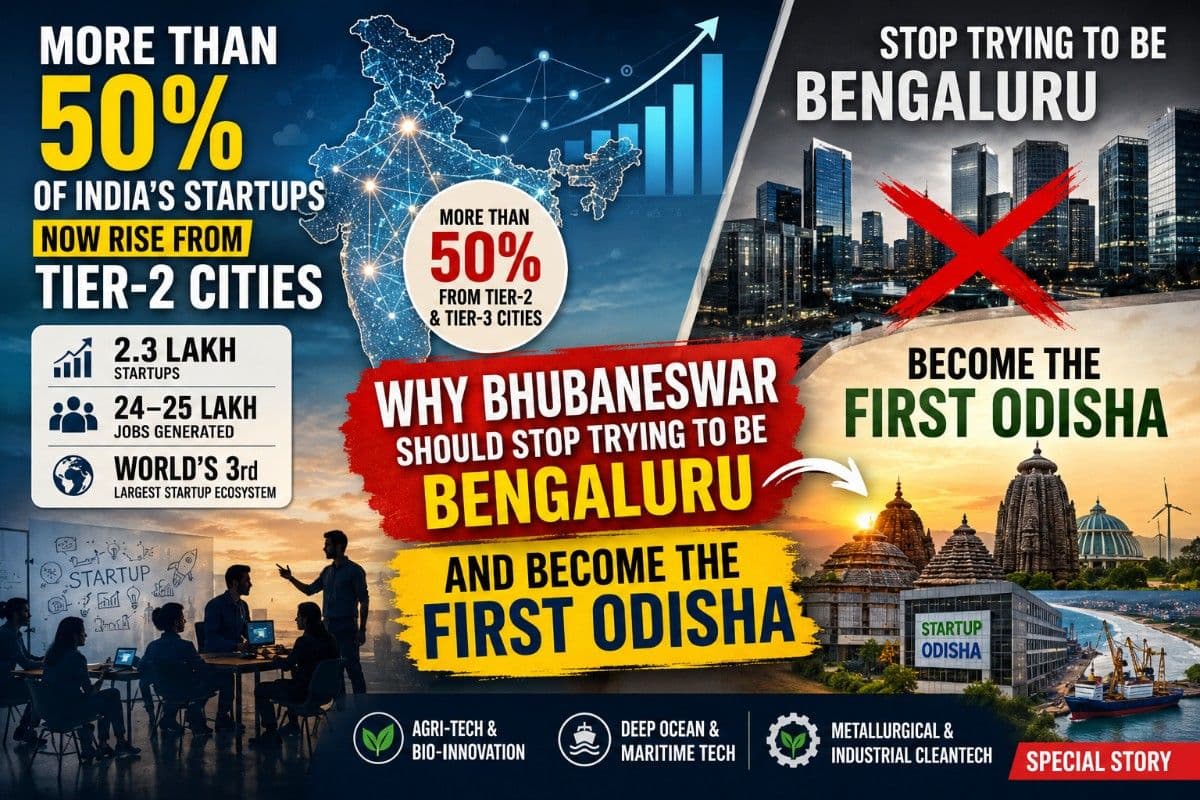
A decade ago, India had only a few hundred startups. Today, the country hosts nearly 2.3 lakh recognized startups, generating around 24-25 lakh jobs, making it the world's third-largest startup ecosystem.
What is even more significant is where this growth is occurring.
According to Dr. Jitendra Singh, more than half of these startups are now coming from Tier-2 and Tier-3 cities, proving innovation is spreading far beyond traditional metropolitan centres.
Cities such as Chandigarh, Ahmedabad and Jaipur have emerged as unexpected winners of this transformation.
Bhubaneswar's Paradox: High Growth, Low Scale
On paper, Bhubaneswar appears to be participating in the startup boom.
The city recorded an impressive 135.2% annual ecosystem growth rate in 2025, one of the fastest among emerging startup hubs.
But the underlying numbers reveal a different reality.
Bhubaneswar remains home to only about 139 startups, representing roughly 1% of India's startup ecosystem. Startup density remains low compared to India's leading innovation centres.
More importantly, job creation has lagged behind growth.
While states like Maharashtra, Karnataka and Gujarat have built large-scale startup ecosystems generating hundreds of thousands of jobs, Odisha's startup sector has created only around 50,000 direct jobs, reflecting a weaker employment multiplier despite years of policy support.
The result is a startup ecosystem that is growing in numbers but not yet in economic impact.
Chandigarh Shows What Odisha Could Become
Perhaps the most important lesson for Odisha comes from Chandigarh.
The Union Territory recorded a remarkable 168.9% annual ecosystem growth, jumping 94 places globally and entering India's Top-10 startup cities, as per Global Start Up Index 2026.
This was not accidental.
Instead of attempting to compete across every sector, Chandigarh focused on targeted strengths:
- Industry-specific clusters
- Dedicated Centres of Excellence
- Operational subsidies for startups
- University-driven incubation networks
- Fast regulatory approvals
The strategy transformed Chandigarh from a regional player into one of India's fastest-growing startup destinations.
For Odisha, the lesson is straightforward:
Stop trying to be the next Bengaluru. Become the first Odisha.
Three Sectors Where Odisha Can Win
1. Agri-Tech and Bio-Innovation
With agriculture supporting millions of livelihoods, Odisha can become a national laboratory for climate-resilient farming technologies, AI-driven crop management, smart cold chains and agri-logistics.
The national focus on Agri-Food Innovation makes this a natural fit.
2. Deep Ocean and Maritime Technology
Few states possess Odisha's strategic advantage.
With a 480-km coastline and major ports like Paradip and Dhamra, Odisha can build startups focused on:
- Marine robotics
- Coastal surveillance
- Ocean mapping
- Smart logistics
- Port automation
The Centre's push into deep-ocean exploration creates a rare first-mover opportunity.
3. Metallurgical and Industrial Cleantech
This may be Odisha's biggest untapped advantage.
As one of India's largest mineral-producing states, Odisha could become a global testing ground for:
- Green steel technologies
- Mining automation
- Industrial decarbonisation
- Carbon accounting platforms
- Waste-to-value innovations
Few states can match Odisha's industrial ecosystem in this area.
The Kolkata Factor: Opportunity and Threat
Another major development is occurring just across Odisha's border.
Kolkata has emerged as one of India's fastest-growing startup ecosystems, recording 92.7% annual growth and entering the national Top-10.
For Odisha, this presents both opportunity and risk.
On one hand, Kolkata's growing investor network gives Odisha startups access to venture capital closer to home.
On the other hand, it could intensify talent migration from institutions such as IIT Bhubaneswar and NIT Rourkela.
If Odisha fails to create attractive startup opportunities locally, the state's brightest innovators may simply build their companies elsewhere.
Real Test Is Jobs, Not Startups
India's startup success story has already been written.
The next chapter will be about which states can convert entrepreneurship into employment, innovation into industry, and ideas into wealth creation.
For Odisha, the challenge is no longer encouraging startups.
The challenge is ensuring that every startup creates meaningful jobs, attracts investment, and remains rooted in the state.
Bhubaneswar's rapid growth shows the potential exists.
The question
now is whether Odisha can build the ecosystem needed to transform that
potential into the next great Tier-2 startup success story.
Also Read: Beyond Housing: Why Odisha’s First BJP Govt Brought a New Rental Law Five Years After the Modi Govt’s Model Tenancy Act? | Special Story
Related Topics
Explore more stories