



The Debrigarh Blueprint: Maithili Bhue’s Answer to India’s Human-Animal Conflict and Why PM Modi Wants the Nation to Hear It
Key Points
Bhubaneswar: As human-animal conflict increasingly haunts India’s wildlife corridors, a quiet revolution in a fringe village of Odisha’s Debrigarh Wildlife Sanctuary has provided the country with a powerful masterclass in coexistence.
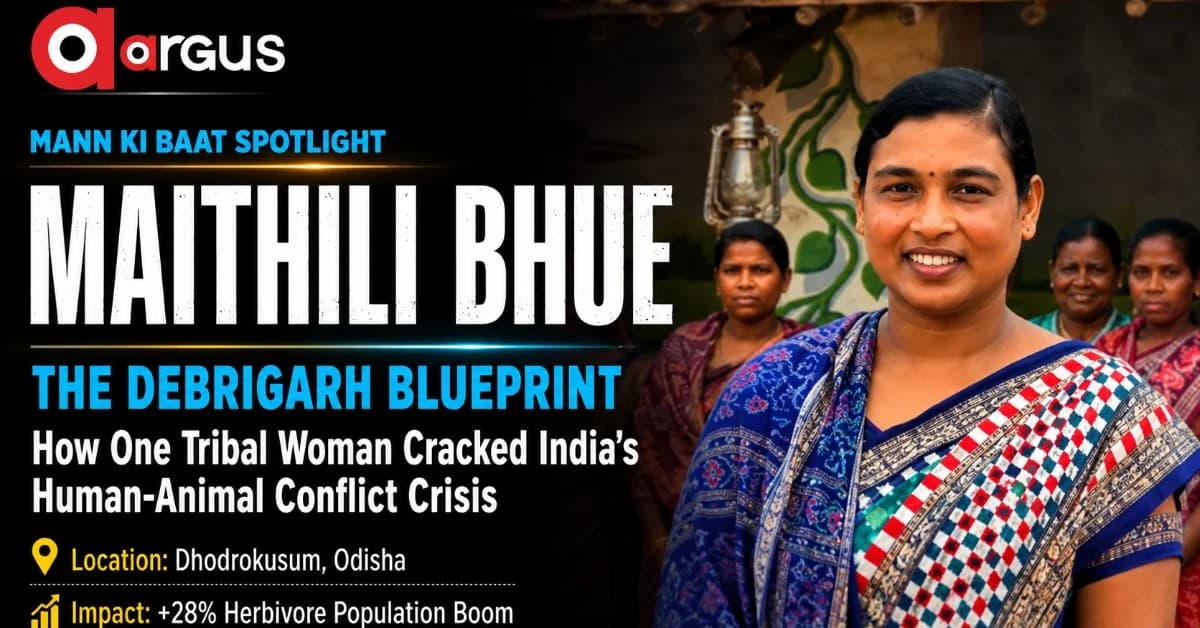
Led by 40-year-old tribal woman Maithili Bhue, Dhodrokusum village has attempted a remarkable transformation – from depending on the forest as a daily source of extraction to becoming one of its active guardians.
That transformation was what brought Bhue into the national spotlight on Sunday, when Prime Minister Narendra Modi mentioned and lauded her work during the 137th episode of Mann Ki Baat.
But the bigger story is not merely that an Odisha tribal woman was named by the Prime Minister. The bigger question is: what did Maithili Bhue do that made her work nationally relevant?

📱 Get Argus News App
✨The answer lies in what may now be called the “Debrigarh Blueprint” –a conservation model that does not ask poor forest-fringe communities to simply stop entering forests. Instead, it gives them an economic reason to become stakeholders in protecting wildlife.
At its heart is a simple proposition: replace forest extraction with conservation-linked income, and turn those living closest to wildlife into its first line of protection.
From forest extractor to forest guardian
Maithili Bhue’s own life represents the transformation.
A native of Dhodrokusum village on the fringe of Debrigarh Wildlife Sanctuary in Bargarh district, Bhue studied up to Class X. For years, like many women in the forest-fringe economy, her livelihood depended on the forest.
She collected firewood, gathered Mahua flowers and Kendu leaves and harvested minor forest produce. Tender bamboo shoots were also among the resources traditionally collected from the forest.
It was a survival economy – but one that also meant constant human presence in sensitive wildlife habitat.
Then came the institutional intervention.
In 2023, the Hirakud Wildlife Division brought Bhue into the sanctuary’s community-based ecotourism and conservation framework. She moved from an informal forest-dependent livelihood into formal conservation-linked employment.
Today, she earns a fixed monthly income of around Rs9,500 through the ecotourism and Eco-Development Committee framework.
The financial shift was crucial.
A woman who once depended on extracting resources from the forest could now earn by helping protect the ecosystem that supported her village. The same forest that once provided firewood and minor forest produce was now becoming the economic foundation of a new livelihood through tourism, hospitality and conservation.
Bhue went on to become the President of the Eco-Development Committee (EDC) in her village. She is also associated with community ecotourism facilities, including the Zero Point Restaurant and tribal homestays at Dhodrokusum.
More importantly, her influence has expanded beyond her own household. A network of over 60 tribal women has become part of the broader community conservation effort.
That is the first pillar of the Debrigarh Blueprint: conservation has to pay.
The flashpoint: Why Debrigarh needed a new model
The Debrigarh landscape was historically a difficult interface between human livelihoods and wildlife.
Forest-fringe communities depended heavily on forest resources, while elephants, gaurs, leopards and other wildlife moved through the same larger ecological landscape.
For villagers, the forest was a source of daily livelihood. For wildlife, it was habitat.
That overlap created conflict.
Human entry into forests increased the possibility of accidental encounters with large animals. Elephants moving towards agricultural areas could trigger crop protection measures and retaliation. Fear of crop loss often created a dangerous cycle in which crude live-wire traps and other aggressive deterrents were used.
The danger was not confined to a single species.
The same retaliatory practices could kill or injure protected wildlife, including leopards and other large mammals. Human-wildlife conflict, therefore, was not merely a question of elephants raiding crops. It was also about how the pressure of poverty could push people into dangerous interactions with wildlife.
The Debrigarh solution began by addressing the economic root of the problem.
Instead of treating local communities as a threat to wildlife, the forest management strategy began treating them as potential conservation partners.
The anatomy of the Debrigarh Blueprint
The transformation was built around a major economic shift.
Maithili Bhue’s journey illustrates how the model works.
The objective was not to tell a poor woman: do not enter the forest anymore.
The question was: what alternative income will replace the forest?
The answer came through community ecotourism and conservation employment.
Women who earlier depended on collecting resources could instead earn through homestays, restaurants, tourism facilities, wildlife-linked services and conservation activities. Local communities were also involved in grassland and meadow development, patrolling support and habitat management.
This changed the economic incentive.
Earlier, an intact forest may have had limited direct financial value for a poor household except as a source of firewood, bamboo or minor forest produce.
Now, living wildlife and a healthy forest ecosystem could generate recurring income.
A dead forest could not attract tourists. A poached animal could not generate a tourism livelihood.
This turned conservation from an external government order into a community economic interest.
Bhue’s women-led network became central to this transition.
The community began moving towards:
Reduced dependence on daily forest extraction
Community-run ecotourism
Tribal homestays and hospitality services
Grassland and meadow management
Bamboo and habitat restoration
Anti-poaching awareness
Monitoring and reporting of suspicious activity
Improved waste management at the forest fringe
The model, therefore, was not based on one single intervention. It was an economic, ecological and social package.
The biggest victory: Reducing human pressure
The most fundamental conservation outcome was the reduction of the human footprint inside sensitive wildlife areas.
Debrigarh’s larger transformation also coincided with a major voluntary relocation exercise. According to the available forest management data, 420 families from four internal villages were relocated outside the sanctuary, leaving the core area free of permanent human habitation.
The contrast is stark.
Earlier: More than 400 families lived inside the sanctuary, while people from fringe villages entered forests for daily livelihood activities.
Now: The core habitat has no permanent resident population, while conservation-linked employment has helped reduce routine dependence on forest extraction.
This was important because human-wildlife conflict often begins with repeated physical overlap.
The fewer people who have to enter sensitive forest areas for survival, the lower the chances of direct encounters with wildlife.
For Bhue and other women in the ecotourism network, the shift also brought another form of security: the forest no longer had to be entered every day for basic income.
That is why the Debrigarh Blueprint is more than an ecotourism success story.
It is a model of conflict prevention through livelihood redesign.
The proof: Debrigarh’s gaur population jumps 28%
The most striking numerical indicator of the sanctuary’s ecological recovery has come from its gaur population.
Debrigarh recorded 659 gaurs in November 2024 during a systematic population count.
By May 2025, the count had risen to 788.
The latest census in January 2026 recorded 848 gaurs across 69 documented herds.
That represents an increase of 189 animals, or nearly 28%, from the November 2024 count.
The demographic data was equally significant.
The January 2026 assessment recorded 235 juveniles, suggesting strong breeding and population recruitment.
The earlier May 2025 assessment had recorded 128 newborns less than three months old.
The increase cannot be attributed to Maithili Bhue alone. It reflects the broader sanctuary-level conservation strategy of the Hirakud Wildlife Division, habitat restoration, relocation, reduced human pressure and community participation.
But that is precisely where Bhue’s story becomes nationally important.
She represents the human mechanism that makes a large conservation plan work on the ground.
Government policy can create a protected area. It can build infrastructure. It can relocate settlements.
But unless the forest-fringe community sees a livelihood future outside extractive dependence, human pressure can return.
Bhue’s model attempts to ensure that it does not.
The “Shock-Free Zone”: Taking the live wire out of the conflict
Perhaps the most important aspect of the Debrigarh model is its attempt to break the cycle of retaliatory wildlife killings.
Historically, live-wire traps were among the most dangerous forms of conflict response in the wider landscape. A wire intended to keep animals away from crops could kill a protected animal.
The new strategy moved towards a 1-km Shock-Free and Zero-Electrocution Zone, supported by community vigilance and patrolling arrangements.
According to the model’s implementation framework, 68 communities were involved in pledging against retaliatory electrocution practices, while specialized patrol and monitoring arrangements were strengthened across the sanctuary landscape.
The most significant achievement is therefore not simply a reduction in crop raids.
It is a change in the human response to wildlife.
Earlier, fear could lead to retaliation.
Now, conservation-linked livelihoods give communities a direct economic stake in keeping wildlife alive.
The logic is simple but powerful: the same elephant or gaur that a community once saw as a threat can become part of the larger ecological economy that sustains tourism and jobs.
The elephant question: Why no exact crop-raiding number exists
One of the limitations in measuring the Debrigarh model is that there is no standalone official village-level dataset publicly quantifying every elephant crop-raiding incident around Dhodrokusum before and after the intervention.
That is partly because elephants are not confined to a single village or sanctuary boundary. They move across larger regional corridors spanning multiple forest divisions.
Conflict data is therefore often compiled at a broader divisional or compensation-claim level rather than as a village-specific ecological statistic.
The forest department has instead focused on other indicators.
These include:
Border integrity
Reduction in illegal live-wire practices
Community monitoring
Habitat enrichment inside the sanctuary
Creation of shock-free zones
Reduced dependence on daily forest extraction
Habitat management has also become central.
Instead of responding to elephants only after they enter agricultural fields, the strategy attempts to improve the availability of food and habitat inside forest areas.
Local communities have been involved in managing meadows, controlling invasive vegetation and supporting the growth of native grasses and bamboo.
The ecological principle is straightforward: a better-fed animal inside the forest is less likely to be pushed towards farms in search of food.
Waste management has also become part of the strategy. Organic waste and stored food near village boundaries can attract wildlife. Reducing such attractants helps create a cleaner separation between human settlements and wildlife habitat.
Why a ₹9,500 salary could be more powerful than a fence
This is perhaps the most important lesson from Maithili Bhue’s story.
India often discusses human-animal conflict in terms of infrastructure.
Fences. Trenches. Compensation. Solar fencing. Patrol teams.
All are important.
But Debrigarh adds another question: What if the most effective barrier is an economic one?
A ₹9,500 monthly assured income may appear modest in urban India. But for a forest-dependent household, stable and predictable earnings can fundamentally alter daily decisions.
A woman who has an alternative livelihood does not need to enter a forest as frequently to collect firewood.
A family earning from tourism has a direct interest in a healthy wildlife population.
A village that benefits from conservation has a stronger reason to report poaching.
A community that earns from a living ecosystem has more to lose from its destruction.
This is the economic logic behind the Debrigarh Blueprint.
Do not criminalise poverty-driven dependence on forests. Replace it with an economic alternative linked to conservation.
From one woman to a 60-woman conservation network
Bhue’s individual story would have remained a personal success had it not spread into collective action.
Today, more than 60 tribal women have become part of the wider conservation-linked network across the Debrigarh landscape.
They are associated with ecotourism, hospitality, habitat management, awareness campaigns and community monitoring.
The importance of this women-led approach cannot be overstated.
In many forest-fringe households, women are directly involved in gathering fuelwood and forest produce. This places them at the frontline of both forest dependence and wildlife risk.
By giving women alternative incomes, the model directly attacks one of the most persistent sources of daily human pressure on forests.
Bhue, therefore, is not simply a beneficiary of the programme.
She has become a community leader helping shape the transition of other women.
That is why her recognition also carries the larger message of Nari Shakti – but with a distinctly ecological dimension.
Women’s economic empowerment is being used as a conservation tool.
Why PM Modi wanted the nation to hear her story
Prime Minister Modi’s decision to highlight Maithili Bhue during Mann Ki Baat was not merely an individual tribute.
Her story carries a message for every Indian state struggling with the expanding geography of human-animal conflict.
India cannot fence every forest.
It cannot permanently keep wildlife inside invisible administrative boundaries.
Elephants migrate. Leopards disperse. Forests intersect with farms, roads, railways and villages.
The long-term solution cannot rely only on keeping humans and animals apart through barriers.
It must also change the relationship between communities and wildlife.
That is what the Debrigarh Blueprint attempts to do.
It turns forest-fringe communities from reluctant stakeholders into economic partners in conservation.
It creates livelihoods outside extractive dependence.
It reduces routine human entry into wildlife habitat.
It encourages communities to protect animals rather than retaliate against them.
It links tourism income with healthy ecosystems.
And it gives women, who are often closest to the forest economy, a leadership role in managing the transition.
Maithili Bhue’s journey—from collecting forest produce for survival to leading an Eco-Development Committee and a wider network of tribal women—captures that transformation.
Her real achievement is not that she saved one animal or stopped one raid.
Her achievement is helping demonstrate that the answer to human-animal conflict may lie not only in protecting animals from people, but in making people partners in the economic future of wildlife.
That is the Debrigarh lesson.
And perhaps that is why the Prime Minister wanted the nation to hear Maithili Bhue’s name.
In a country searching for a way to live with its wildlife, a small village on the edge of Odisha’s Debrigarh Sanctuary may have produced one of the most compelling answers yet: when conservation becomes livelihood, coexistence stops being a slogan and starts becoming an economic reality.
Related Topics
Explore more stories