



Special Report|Five Days on Smuggler Route, Heavily Sedated: The Alarming Body Signals Triggering Medical Crisis for Nandankanan’s Baby Orangutans
Key Points
Rescued infant orangutans shifted to Nandankanan Zoo quarantine exhibit signs of extreme stress, exhaustion, and severe health complications.
Forest officials suspect the animals were dumped in Odisha after a five-day international trafficking transit, potentially involving chemical sedatives.
Veterinarians are racing against time to maintain feeding and prevent a medical emergency as stress-induced fevers and worm infections emerge.
Bhubaneswar: They were climbing trees when Odisha first saw them.
Five tiny orangutans, apparently abandoned in the Bichitrapur casuarina plantation in Balasore, suddenly became the centre of an extraordinary wildlife rescue on Tuesday, September 8.
At first sight, they appeared physically capable of surviving.
But less than 48 hours later, the picture had changed dramatically.

📱 Get Argus News App
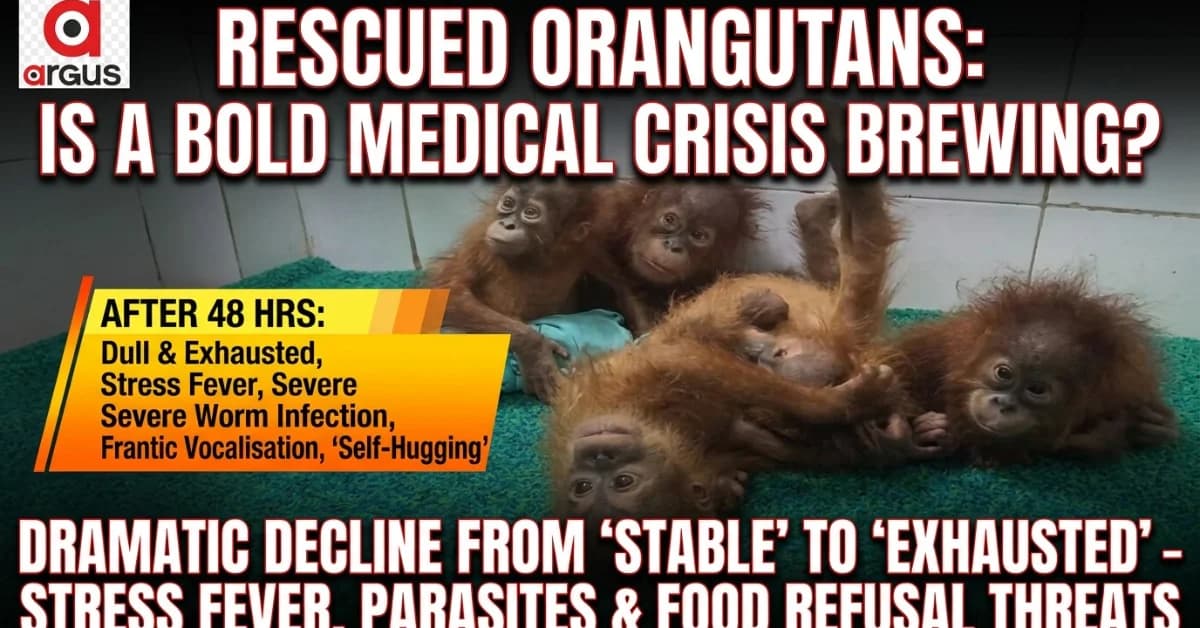
✨The five infant orangutans are now inside a tightly controlled quarantine environment at Nandankanan, under round-the-clock observation. Their behaviour has become markedly different from what was witnessed at the rescue site: frantic vocalisation, self-hugging, clustering tightly together and signs of extreme exhaustion.
Two of the five now require active veterinary attention.
One has developed a high fever that officials and veterinarians are associating with severe stress, while another is being treated for a serious internal worm infection.
Amidst the worrying signs, here is a comparative chart on what changes observed in the tiny apes after 48 hrs:
|
Metric |
Day of Rescue (Tue, Sept 8) |
Current Status (Zoo Quarantine)
Physical Appearance
Visually alert, climbing casuarina trees; looked stable to onlookers.
Dull, physically exhausted; 2 of 5 require intensive veterinary treatment.
Official Health Assessment
Officials reported 4 infants were "stable and active," 1 needed observation.
Crucial sample collection postponed for 10 days due to extreme weakness.
Behavioral Signals
Showed basic survival motor skills (climbing away from crowds); adrenaline masked exhaustion.
Erratic mood swings, frantic vocalisation, self-hugging, and packing tightly in corners.
Temperature & Vitals
Deemed structurally normal; given basic oral rehydration and fruit formulas.
One infant has a stress-induced high fever; another is fighting a severe worm infection.
Handling Approach
Actively handled by rescue teams amidst a crowd of curious villagers.
Isolated in strict quarantine with 24/7 CCTV and classical music therapy to regulate heart rates.
The Five-Day Question
One of the most important clues in the case is the timeline.
The five infants were reportedly found in the Bichitrapur casuarina plantation only hours before their rescue on Tuesday morning.
That means they were not wandering around the coastal plantation for several days.
They appear to have been dumped shortly before being discovered.
This changes the central question surrounding the case.
It is no longer simply: How did five infant orangutans reach Balasore?
It is also:
What happened to them during the days immediately preceding their abandonment?
A forest official informed that the available timeline points towards an international trafficking operation in which the animals may have been moved through several transit points before reaching Odisha.
And it could be that these five orangutan babies had been on transit mode for around 5 days, before being dropped in Odisha, he revealed.
Trafficking investigations involving exotic wildlife have shown that live animals can be moved through complicated networks involving multiple handlers, transport modes and intermediary locations.
The exact route followed by these five infants, however, remains a matter for investigation.
What is increasingly difficult to ignore is the short interval between their presumed arrival in India and their abandonment.
Their behaviour, physical condition, nutritional state, infections and subsequent medical responses providing multiple clues about what happened before the rescue, he added
The Sedation Question
As per the senior forest official, there is high possibility that the infants were chemically managed during transit.
Traffickers moving live infant wildlife have a powerful incentive to suppress noise and movement. The past cases busted are evident how trafficked wild animals were administered specific sedatives such as ketamine or diazepam.
Is Medical Crisis Brewing?
The telltale signs observed just 48 hrs after rescue from Casurina forest, there appears to be looming of a bigger crisis over the next several days. The first is:
Will they continue to eat?
Veterinary monitoring is now centred not merely on whether the babies accept food and milk, but whether that intake remains stable as the physiological effects of their ordeal unfold.
For infant orangutans, a sudden refusal of milk or food could turn a rescue operation into an acute medical emergency.
The reason is simple: these are not adult animals with large physiological reserves. They are extremely young great apes, already separated from their natural maternal environment and apparently subjected to an unknown period of human handling before being dumped.
The emerging evidence therefore raises a disturbing possibility.
The babies may have survived the journey – but their bodies could now be entering the most dangerous phase of the ordeal.
The Most Dangerous Signal May Be Food
The biggest immediate warning may not be the crying, as per verterinarians, it may be the possibility of food refusal.
At present, the babies are accepting infant formula and fruits (banana).
But veterinary teams are watching this extremely carefully because an infant primate that suddenly stops taking milk can deteriorate rapidly.
Their present feeding behaviour should therefore not automatically be interpreted as proof that they have recovered, caution experts.
They may be feeding because they are physically hungry.
They may also be responding to familiar tastes and the immediate availability of food.
But severe psychological and physiological stress can disrupt normal feeding behaviour.
If that happens, the sequence can become dangerous:
stress → reduced gut function → discomfort → reduced feeding → dehydration and falling glucose → further weakness → greater stress.
That is the cycle veterinarians are trying to prevent.
Why the Next Few Days Matter
The babies' condition may also reflect the aftermath of the journey rather than simply what happened after their rescue.
During prolonged stress, the body releases hormones including cortisol and adrenaline.
These responses are useful in an immediate emergency because they help an animal survive a threat.
But prolonged activation comes at a cost.
Digestion can be disrupted.
Sleep and normal behaviour can be disturbed.
Immune function can be affected.
Energy reserves can fall.
And once the immediate threat disappears, an animal that appeared surprisingly active can suddenly become exhausted.
This provides one possible explanation for the dramatic behavioural difference between the rescue site and the quarantine facility.
The crucial point for investigators is that the change itself needs to be medically documented.
The Fever Is More Than a Number
The fever in one infant is another important warning signal, caution experts.
A fever in an animal under extreme stress can have several possible explanations.
It can accompany infection.
It can occur alongside inflammatory processes.
And severe physiological stress can also influence temperature regulation.
Therefore, describing the fever simply as "psychological" would be premature.
What matters is that the infant now requires active monitoring while veterinarians simultaneously deal with the possibility of infection and the consequences of extreme stress.
That is precisely why the coming days are critical.
The Worm Infection Adds Another Layer
One of the five infants is already being treated for a severe internal worm infection.
That matters because an already compromised infant has fewer reserves to deal with additional stress.
Parasites can affect nutrition and gastrointestinal function.
Treatment itself can also produce changes in appetite or digestion.
If abdominal discomfort develops, the animal may begin associating feeding with discomfort.
For a young ape already operating under severe psychological stress, even a relatively small gastrointestinal disturbance could therefore have disproportionately serious consequences.
The immediate objective is not simply to make the babies eat.
It is to ensure that they continue to eat without developing a cycle of pain, stress and food refusal, experts opined.
Redlines Under Observation
If they continue feeding, maintain hydration and gradually regain behavioural stability, the rescue operation may enter a recovery phase.
If even one infant abruptly stops taking milk and food, the medical equation could change within hours.
That is why the present battle at Nandankanan is not simply about treating an infection or calming frightened animals.
It is about preventing five traumatised infant orangutans from crossing a physiological threshold from which recovery becomes dramatically harder.
The Bottomline
The most disturbing revelation in the case may be hiding in the contrast between Tuesday's climbing infants and Thursday's traumatised babies.
They did not appear to spend days surviving alone in the Bichitrapur plantation.
They were reportedly dumped only hours before their discovery.
That compresses the timeline –and points the investigation backwards, towards the days immediately preceding the rescue.
The babies' current condition cannot by itself prove that they were sedated, drugged or subjected to a particular trafficking method.
But the combination of their apparent recent abandonment, severe behavioural distress, fever, parasitic infection, exhaustion and the need to postpone invasive testing presents investigators with a crucial window.
The five infant orangutans may have arrived in Odisha at the end of a trafficking journey. But their bodies may only now be revealing what that journey did to them.
And for Nandankanan's veterinary team, the immediate race is brutally simple:
Keep
them calm. Keep them hydrated. Keep them feeding. Keep them alive –
long enough to learn what happened to them.
Also Read: EXCLUSIVE | The 2 AM Forest Drop, Bengal Trail & 2015 Eluru Clue: Rescue of Five Baby Orangutans in Baleswar Exposes Interstate Wildlife Smuggling
Related Topics
Explore more stories