



Special Report| Odisha’s Fire-Safety Net Widens, But MKCG Fire Raises a Bigger Question: Why Do Buildings Keep Failing After Inspections?
Key Points
Odisha's tracked unsafe or non-compliant buildings surged from roughly 50-80 in 2016 to 824 in 2026 due to systematic surveillance and continuous audits.
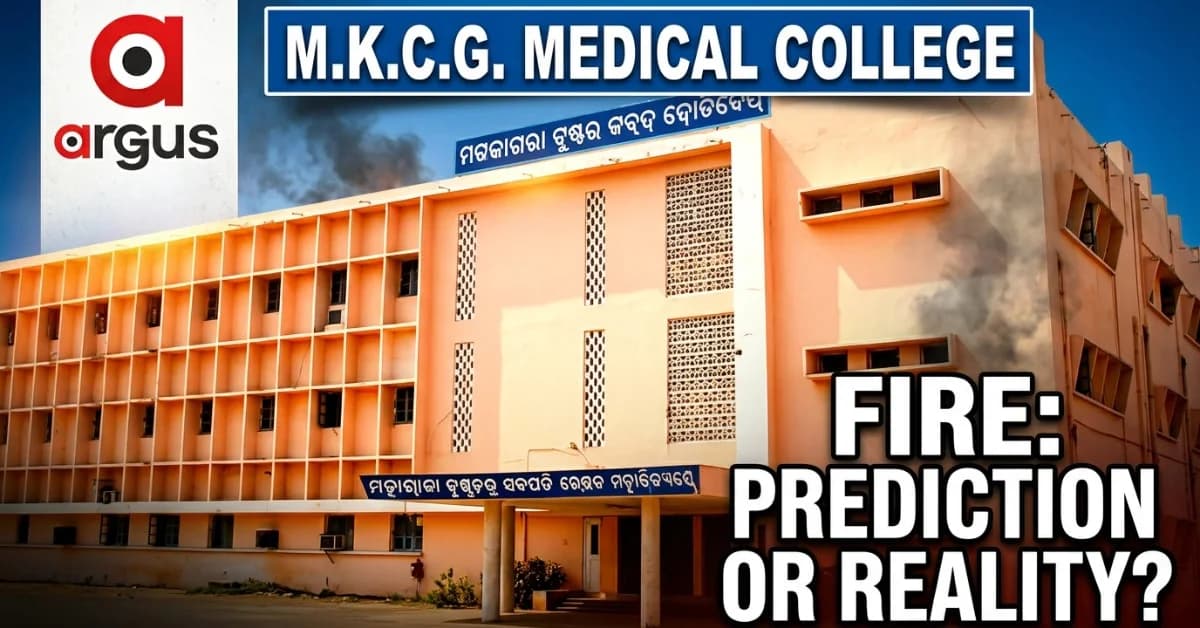
A short-circuit fire at MKCG Medical College's Obstetrics OT sparked panic despite a comprehensive safety assessment by the Fire Services DG earlier in the year.
The ultimate test for the state's new policy framework is moving beyond detection and notices to ensure rigorous, end-to-end corrective maintenance.
Bhubaneswar: Odisha's fire-safety story over the past decade has changed dramatically. The number of buildings being identified as unsafe or non-compliant has risen sharply – not necessarily because buildings suddenly became more dangerous, but because the state's fire-safety surveillance has steadily moved from sporadic inspection to systematic tracking.
That
transformation has accelerated under the BJP government, particularly
with the shift towards continuous
compliance monitoring and mandatory periodic audits.
The numbers tell the story: from an estimated 50–80 unsafe or
non-compliant buildings being tracked in 2016, the figure has climbed
to 824
in 2026.
But
the first day of Odisha Fire and Emergency Services' month-long
fire-safety inspection drive has thrown up a more uncomfortable
question.
What happens when a building has already been inspected, warned and subjected to safety scrutiny – and still suffers another fire?
The answer is staring at the state from MKCG Medical College and Hospital in Berhampur, one of south Odisha's premier government medical institutions.

📱 Get Argus News App
✨On
September 15, a fire broke out on the second floor of the Obstetrics
and Gynaecology Department's Operation Theatre complex, originating
in the anesthetist room. Preliminary findings point to a short
circuit involving an old air-conditioning unit. The incident did not
result in casualties, but smoke spread through the area and patients
in adjoining rooms had to be moved in panic.
The timing makes the
incident particularly significant.
On April 3, 2026, Fire Services DG Sudhanshu Sarangi himself undertook a comprehensive safety assessment of the MKCG campus. Fire officials examined the safety infrastructure across all 22 buildings on the campus and identified gaps, particularly in older structures. The inspection also led to directions for emergency-response training involving hospital staff and security personnel.
Yet, barely five-and-a-half months later, another fire has exposed the limits of inspection when preventive maintenance and compliance do not keep pace.
The numbers are rising – but so is the state's ability to find violations
The historical data shows a clear expansion of the fire department's enforcement net.
Before the 2017 Fire Safety Rules, inspections were largely ad hoc. The estimated number of unsafe or non-compliant buildings being tracked remained extremely low. After the 2017 framework came into force, inspections became more structured, with commercial establishments subjected to a two-year inspection cycle and high-rise residential buildings to a five-year cycle.
The numbers subsequently climbed:
|
Year |
Unsafe/Non-compliant buildings tracked |
|---|---|
|
2016 |
~50–80 |
|
2018 |
~150–200 |
|
2020 |
300+ |
|
2022 |
~450–500 |
|
2024 |
600+ |
|
2026 |
824 |
The latest spike is linked to the 2025 shift towards continuous compliance, under which third-party audits are uploaded twice a year. The current enforcement drive has brought not only commercial establishments and hospitals but also hotels, educational institutions and residential complexes under closer scrutiny.
The 2025 amendment reduced the compliance cycle substantially: commercial establishments moved to bi-annual audits, while high-rise residential buildings moved to annual certification.
That is the real significance of the rising number.
824 does not simply mean Odisha suddenly acquired 824 dangerous buildings. It increasingly means the state is finding, recording and tracking buildings that previously could remain outside sustained scrutiny.
But MKCG exposes the gap between detection and correction
The MKCG episode shows why the state's new tracking mechanism matters.
A fire-safety inspection can identify an old electrical system, deficient equipment or structural vulnerability. But an inspection report cannot itself replace an ageing air-conditioner, repair wiring or guarantee that hospital management has completed every corrective measure.
The available records indicate that MKCG has faced repeated fire-related incidents this year.
In May 2026, a short-circuit fire occurred in the ICU of the TB and Chest Department, forcing an emergency response and evacuation of patients.
On September 4, a separate fire broke out at the Nursing College boys' hostel after a gas-pipe leak in the kitchen.
And on September 15, the latest incident occurred inside the Obstetrics and Gynaecology OT complex.
The pattern is therefore more important than any individual fire.
A hospital dealing with newborns, pregnant women, critically ill patients and people recovering from surgery cannot treat fire safety as a certificate that remains valid until the next inspection. The very patients occupying such facilities may be the least capable of escaping independently.
The BJP government's bigger test is now implementation
Odisha's policy shift is clear: move away from fire safety being a one-time bureaucratic exercise and towards continuous compliance.
The rationale is straightforward. Fire pumps, sprinklers, electrical systems, alarms and other equipment can deteriorate after an inspection. The 2025 system therefore attempts to ensure that building owners remain responsible for maintaining operational safety rather than merely obtaining a certificate.
That makes the current month-long inspection drive more than another enforcement campaign.
Its real test will be whether the department can create a complete chain:
inspection → notice → rectification → verification → continuous tracking.
The rise from roughly 50–80 tracked unsafe/non-compliant buildings in 2016 to 824 in 2026 suggests that the first part of that chain has become considerably stronger.
MKCG shows that the harder battle is the next part.
A building can be inspected. A warning can be issued. A training programme can be ordered. A compliance system can be digitised.
But if an old electrical appliance remains in service and becomes the source of the next fire, the state is left confronting the most important question of all:
Is Odisha becoming better at finding unsafe buildings – or better at making them safe?
The
answer to that question will determine whether the BJP government's
fire-safety tracking becomes a genuine public-safety reform and
violators taken to task or a routine check up only.
Also Read:From 300-km Cancer Journey to Treatment at Village Doorstep: Odisha’s Cancer Care Van Bet to shoot down high Drop-out Rates in State| Special Report
Related Topics
Explore more stories