



Special Report| From Jagannath to Market: How PM Modi’s Memento Auction is Propelling Odisha’s Artisans into National Spotlight Boosting Cultural Economy
Key Points
Bhubaneswar: A gift presented to Prime Minister Narendra Modi may begin its journey as a ceremonial gesture. But once it enters the PM Mementos e-auction, it acquires a very different life – one that can take an obscure craft, a regional symbol or a traditional artistic form from a drawing room in Odisha to the screens of buyers across India.
That is what makes the latest PM Mementos e-auction more than an auction.
For Odisha, it is a showcase of how culture can become an economic asset- and how political symbolism can travel with it.
The eighth edition of the PM Mementos e-Auction has put 1,498 mementos up for public bidding, with the collection reflecting India's artistic traditions, traditional craftsmanship, cultural practices, spiritual traditions and sporting achievements.

📱 Get Argus News App
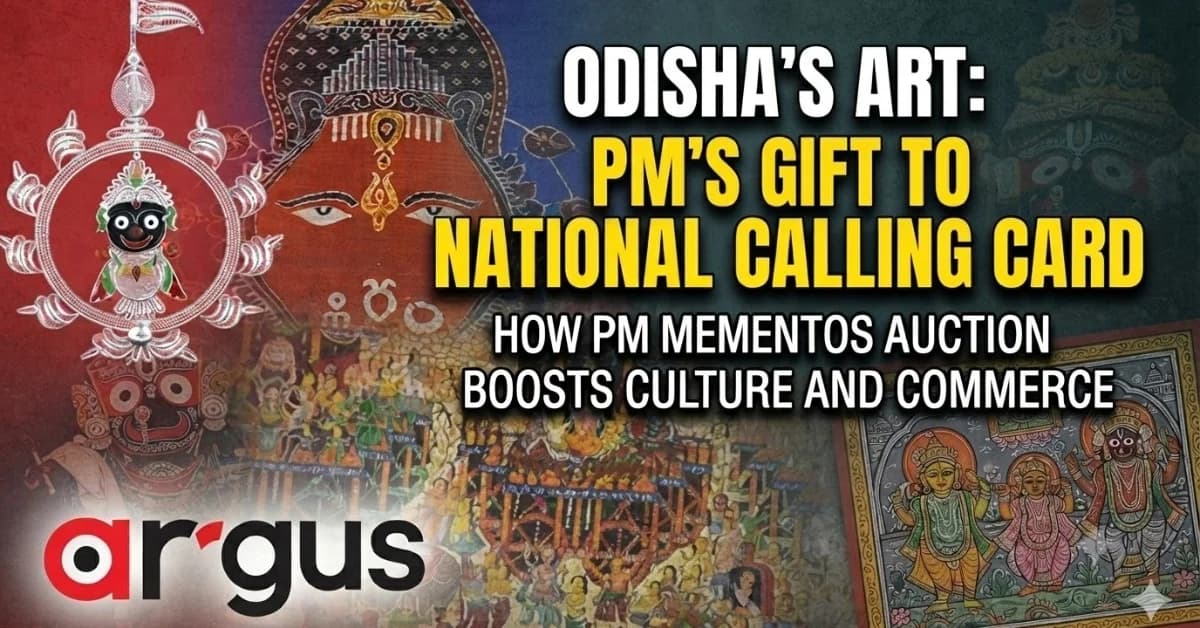
✨Odisha is among the States with a significant representation. One of the 50 identified 'Hero Objects' is Jagannath Parivar on a Chariot, carrying a base price of Rs6 lakh.
That single object tells a much larger Odisha story.
From PM’s gift to Odisha’s cultural calling card
The political significance lies in the route the object takes.
A cultural artefact presented to the Prime Minister is first a symbol of respect. Its inclusion in the national PM Mementos collection then turns it into part of India's cultural showcase. When it is subsequently displayed and auctioned before a national audience, the object acquires another layer – market visibility.
This is particularly significant for Odisha, where cultural products are often deeply rooted in specific places and communities.
Pattachitra from Raghurajpur, silver filigree from Cuttack, appliqué work from Pipili, Sambalpuri textiles and other traditional forms are not merely decorative products. They are linked to clusters of artisans, inherited skills, local economies and, in several cases, specific tourist destinations.
Odisha's presence in the PM Mementos ecosystem therefore has the potential to perform a kind of national cultural advertising that a conventional government publicity campaign cannot easily replicate.
The 2025 edition, for example, featured 21 Odisha artefacts, including Pattachitra works, a silver peacock representing Odisha's filigree tradition and a Tussar silk painting of Navagunjara.
The political layer: culture travels where politics travels
There is also a political dimension.
PM Mementos is an initiative directly associated with Narendra Modi's tenure as Prime Minister.
The auction began in 2019 and has since evolved into a recurring public showcase of gifts received by him from across India.
The latest edition is being presented by the Union Culture Ministry as a celebration of India's cultural diversity, while the auction proceeds are earmarked for the Namami Gange Programme.
For Odisha, this creates an interesting intersection between regional cultural identity and national political symbolism.
The Jagannath tradition, for instance, is unmistakably associated with Odisha.
But when a representation of Jagannath Parivar becomes one of the nationally highlighted objects in a PM-linked exhibition and auction, Odisha's cultural vocabulary enters a much larger national space.
This does not make the artefact political in itself.
Rather, it shows how political office can become a platform through which cultural identities acquire national visibility.
That is an important distinction.
The BJP-led Union government can use such cultural showcases to reinforce a broader narrative of India's civilisational and regional diversity, while Odisha benefits from the national exposure of its own cultural symbols. The political communication and the cultural economy therefore overlap without being identical.
And then comes the artisan
The most important question, however, is what happens after the spotlight moves away from Delhi.
A Pattachitra painting does not emerge from a government office. A silver filigree piece does not come out of an auction catalogue. A handloom product does not become a cultural symbol without the artisan behind it.
The economic chain is much longer:
National visibility → curiosity about the craft → product discovery → consumer demand → more orders → artisan income → stronger craft ecosystem.
If national exposure encourages even a fraction of viewers to search for the craft, visit its place of origin or purchase similar products, the impact can travel much beyond the particular memento being auctioned.
This is where the story moves from culture to commerce.
Raghurajpur, for instance, is already known for Pattachitra and palm-leaf engraving, while Pipili is associated with appliqué work. Such craft villages function not merely as production centres but also as cultural destinations.
The Odisha multiplier: craft can sell the destination
There is potentially another multiplier.
People do not always travel simply to see a monument. Increasingly, cultural tourism can mean seeing where something is made, who makes it and how it is made.
A tourist attracted by Pattachitra may want to see Raghurajpur.
Someone fascinated by appliqué may want to see Pipili.
Interest in silver filigree can create curiosity about Cuttack.
Interest in Sambalpuri textiles can lead visitors towards western Odisha.
The object therefore becomes more than a product.
It can become a destination marker.
That creates a possible tourism chain:
Craft → artisan village → tourist curiosity → local spending → transport/food/hospitality → wider rural economy.
This is not an automatic consequence of an auction. It requires the State to connect cultural promotion with tourism circuits, artisan marketplaces, digital commerce, product authentication, visitor infrastructure and sustained promotion.
But the opportunity is clearly visible.
Odisha's real challenge: visibility must become a market
This is where the celebration of Odisha's culture must meet economics.
A national showcase can create attention. But attention is not income until somebody buys the product.
And a product does not create a sustainable artisan economy unless the artisan receives a meaningful share of the value.
Therefore, the larger policy opportunity for Odisha is to convert national cultural visibility into:
stronger direct-to-consumer markets;
national e-commerce access for artisan products;
craft-village tourism circuits;
better product packaging and branding;
GI-based authentication;
institutional and corporate purchases;
cultural experience centres;
and repeat tourist demand.
The PM Mementos auction can provide the visibility spark. The State's tourism, handicraft, handloom and MSME ecosystem has to convert that spark into sustained economic activity.
From souvenir to soft power
There is another reason the development matters.
A cultural object presented to a Prime Minister can travel much farther than an ordinary commercial product.
Modi has also used Odisha's cultural artefacts as gifts during international engagements. Recent examples reported in the media include Pattachitra, Konark Wheel replicas and silver filigree products presented to foreign leaders.
That creates a second route for Odisha's cultural economy:
Odisha → Prime Minister → national audience → international audience → cultural curiosity → market opportunity.
In that sense, the artisan's workshop in Odisha and India's diplomatic table abroad can become part of the same cultural supply chain.
The larger political economy of a Jagannath artefact
And that may be the most interesting part of this entire auction.
A Jagannath artefact can simultaneously be a religious symbol, an Odisha identity marker, an artistic product, a political-cultural symbol and a potential tourism trigger.
The same object can mean different things to different audiences.
For Odisha's artisan, it represents livelihood.
For the tourist, it can represent the attraction of a destination.
For the buyer, it can become a collectible.
For the State, it can become a cultural export.
And in national politics, it can fit into the larger narrative of India's regional cultures being presented as components of a common national heritage.
That is why the PM Mementos auction deserves to be read beyond the hammer price.
The real auction is for attention.
And if Odisha can convert that attention into orders for artisans, visitors to craft villages and demand for products outside the State, the value of the memento will be measured not merely in the price paid in Delhi – but in the economic activity it helps generate back home.
Related Topics
Explore more stories