



Special Report| 'Antyodaya' Blueprint: Decoding BJP Government’s Strategic Gambit in Odisha’s Mass Housing Re-engineering
Key Points
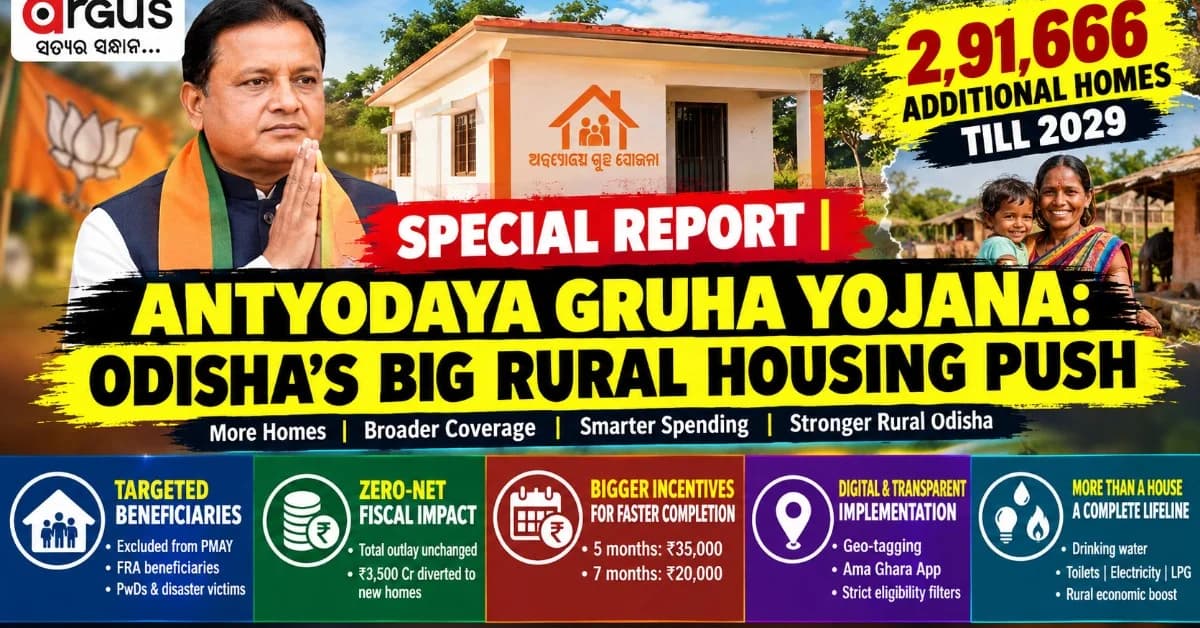
Fiscal Re-engineering: The Odisha Cabinet diverted ₹3,500 crore from repair funds into new construction, expanding unit sanctions to 2.91 lakh homes while maintaining budget neutrality at ₹7,550 crore.
Behavioral Performance Bonuses: Cash incentives for fast-track construction were nearly doubled—offering up to ₹35,000 for completing a home within 5 months to boost local rural economies.
Closing PMAY Coverage Gaps: The scheme systematically targets households left out of central SECC lists, including FRA beneficiaries, PwD-headed households, and climate disaster victims
Bhubaneswar: On October 15, 2026, the Bharatiya Janata Party (BJP) administration in Odisha, led by Chief Minister Mohan Charan Majhi, executed a critical structural pivot in its flagship welfare architecture. By sanctioning 2,91,666 additional permanent homes under the Antyodaya Gruha Yojana and extending the program’s operational deadline until 2029, the state government moved beyond standard administrative expansion.
This decision highlights a calculated strategy to rewrite the rules of fiscal asset creation and resolve a persistent political and structural challenge: the demographic left out of federal welfare nets.
1. The Core Philosophy: Political Anchoring and the Gaps-in-Coverage Strategy
At the center of this legislative move is the concept of Antyodaya—the philosophy of prioritizing the last person in the socio-economic queue, as outlined by party ideologue Pandit Deendayal Upadhyaya. Since gaining power in Odisha, the BJP administration has focused on converting this ideological framework into targeted, institutional actions.

📱 Get Argus News App
✨The primary structural goal of the scheme is to act as a comprehensive safety net for those excluded from the central government's Pradhan Mantri Awaas Yojana (PMAY). While PMAY relies on rigid historical datasets like the Socio-Economic and Caste Census (SECC), the local realities of rural Odisha involve fluid, climate-induced poverty that these lists often miss.
Target Demographic: Rural Kutcha/Houseless Households
├─► Excluded from PMAY (SECC Data Gaps)
├─► Forest Rights Act (FRA) Beneficiaries
├─► Households with Disabled Earners (PwD)
└─► Victims of Climate Disasters / Project Displacement
By identifying and absorbing these excluded groups – including Forest Rights Act (FRA) beneficiaries, households with disabled primary earners, and families displaced by natural disasters or state industrial projects – the Majhi administration is systematically addressing a key source of local economic vulnerability.
Strategically, this allows the state government to deliver on its promise of absolute rural shelter security while retaining distinct ownership over the welfare program.
2. Financial Re-engineering: Achieving Zero-Net Fiscal Impact
The most notable financial feature of this policy update is its budget neutrality. In an era where scaling public welfare often leads to fiscal deficits, the Odisha Cabinet maintained the scheme's total project outlay at a fixed Rs7,550 crore.
TOTAL OUTLAY: ₹7,550 Crore (Unchanged)
├ OLD MODEL: [ New Construction Funds ] + [ ₹3,500 Crore Repair Outlay ]
│
|- NEW MODEL: [ New Construction Funds ] + [ ₹3,500 Crore Diverted to New Units ]
│
└─► Result: +2,91,666 New Homes
To accommodate nearly 2.92 lakh additional homes without requesting new capital, the state reallocated ₹3,500 crore originally set aside for home repairs directly into new construction. This move shifts policy focus from temporary property preservation to permanent asset creation.
From an economic perspective, repairing a mud structure provides temporary security but leaves the asset vulnerable to Odisha's regular monsoon and cyclone cycles. In contrast, building a brand-new concrete (pucca) house creates a resilient asset that removes families from the poverty cycle, lowers future disaster relief expenditures, and increases the state's permanent infrastructure valuation.
3. Supply-Side Economics: Behavior-Modifying Performance Incentives
Public housing projects in India often face significant delays, where inflation eats into unit costs and leaves structures half-built for years. To counter this bureaucratic inertia, the BJP administration introduced a revised, tiered system of early-completion cash incentives via Direct Benefit Transfer (DBT).
|
Completion Window |
Previous Incentive Structure |
Newly Approved Incentive Structure |
Strategic Impact |
|
Within 5 Months |
₹20,000 (For a strict 4-month timeline) |
₹35,000 |
Mitigates labor shortages; rewards fast-track building. |
|
Within 7 Months |
₹10,000 (For a strict 6-month timeline) |
₹20,000 |
Provides a realistic target for challenging terrains. |
By expanding the completion windows slightly while nearly doubling the financial rewards, the policy uses behavioral economics to motivate beneficiaries.
A cash bonus of ₹35,000 paid directly into a rural worker's bank account acts as an effective economic stimulus. This cash injection encourages families to source local bricks, sand, and masonry quickly, turning the housing program into a decentralized driver of rural employment and material demand.
4. Tactical Eligibility and the Rural Data Pipeline
The final component of the strategy lies in its updated eligibility rules and strict field execution timeline. The Panchayati Raj and Drinking Water Department has been tasked with executing a fast-track field survey to prevent registration delays.
Step 1:
* Field Survey InitiatedGround-level data collection begins for potential beneficiaries.
Step 2: Exclusion Filters Applied
* Criteria for Rejection:
* Government employment status
*Monthly income exceeding ₹15,000
* Ownership of a motorized vehicle
Step 3:
* Fractional Benefit Filter
* Checks past financial assistance (capped at < ₹48,500)
Step 4:
* Geo-Tagging Verification
* Digital physical-location validation completed using: Rural Housing Portal Ama Ghara App
Step 5:
* Final Sanction & DBT Release Funds approved and transferred directly to the beneficiary's bank account.
The updated framework specifically includes families that previously received Rs 48,500 or less under older, fragmented housing initiatives. This fractional benefit filter prevents vulnerable households from being disqualified due to minor historical payouts that were insufficient to complete a permanent home.
To ensure transparency and prevent corruption, the survey integrates with the state's end-to-end e-governance framework, using the Rural Housing Odisha Portal and the Ama Ghara Mobile App for mandatory geo-tagging. This digital oversight ensures that every new sanction corresponds to a verified, substandard structure, keeping the expansion focused on the intended recipients.
5. The Macro View: Integration and Economic Multipliers
The strategic expansion of the Antyodaya Gruha Yojana does not operate in isolation; it functions alongside other major welfare initiatives. By building a permanent house, the state creates a foundational hub for multiple other services.
Every approved home under the scheme is systematically linked with secondary programs to deliver:
· Piped drinking water via mega pipe water projects.
· Individual household toilets funded through clean sanitation initiatives.
· Domestic electricity connections and clean cooking gas linkages.
This approach turns a basic housing grant into a coordinated social investment. For the rural economy, constructing hundreds of thousands of concrete units acts as a steady fiscal stabilizer. It creates sustained demand for core manufacturing sectors like cement, steel, and brick kilns, while providing consistent work for local unskilled and semi-skilled laborers via MGNREGS integration.
A Model for Resilient Governance
The expansion of the Antyodaya Gruha Yojana to 2029 represents a shift in how the state addresses persistent poverty. Through targeted exclusion filtering, budget re-engineering, and clear performance incentives, the BJP-led government has designed a scalable blueprint for rural infrastructure development.
By transforming maintenance
budgets into permanent, disaster-resilient assets, Odisha is setting a
practical example of how to balance long-term economic planning with immediate
social welfare.
Also Read: Special report| Panchayat Polls 2027: How SEC is Rewriting the 2022 Voting Playbook
Related Topics
Explore more stories