



Special Report| 3rd Interim Report: Decks Cleared for New Lingaraj Temple Darshan System by Mahashivratri 2027
Key Points
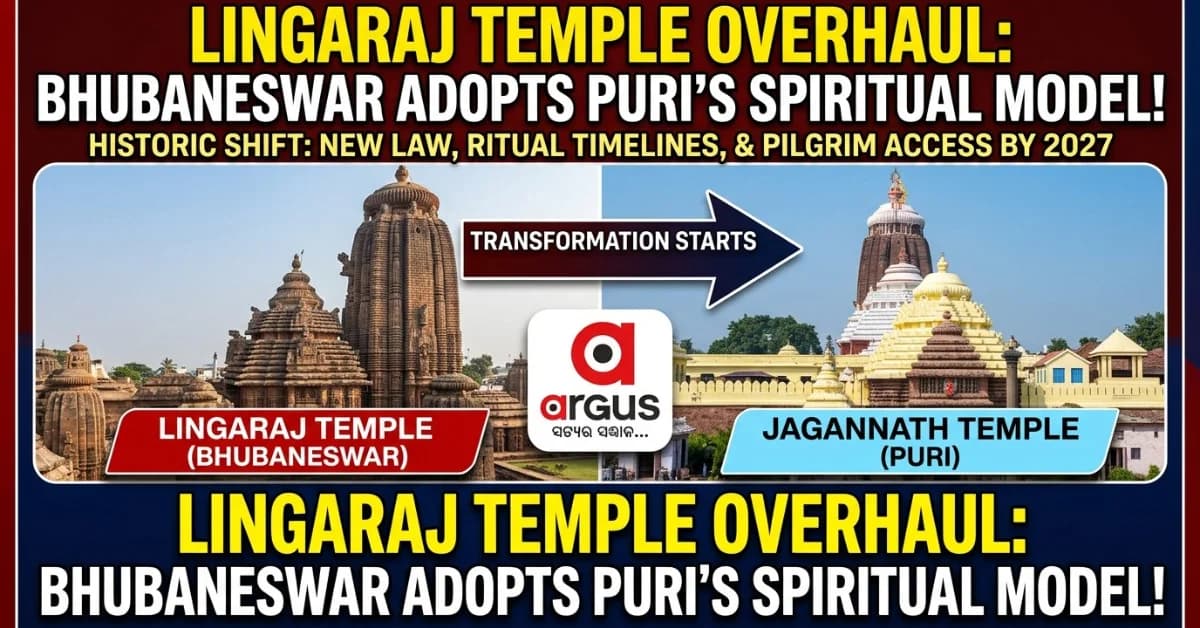
Historic Puri-Style Overhaul: Odisha State Government sets a strict June 2027 deadline to implement a Puri Jagannath Temple-style queue darshan system and legal framework at the 11th-century Lingaraj Temple.
3rd Interim Report Submitted: The two-member Sattwalipi Committee submitted its final report on October 16, 2026, outlining ASI-led repairs and environmental controls for the sacred Garbhagruha (Sanctum Sanctorum).
Comprehensive Reforms & Law: Reforms include transitioning to a standalone Lingaraj Temple Act, strictly codifying servitor duties via the unalterable Sattwalipi, upgrading kitchen infrastructure, and reclaiming encroached temple lands.
Bhubaneswar: In a historic development that will forever alter the spiritual pilgrimage to Ekamra Khetra, the Odisha State Government has officially set a strict timeline for the complete overhaul of the 11th-century Lord Lingaraj Temple.
Following the submission of the highly anticipated 3rd Interim Report of the Record of Rights (Sattwalipi) Committee to the Minister of Law, Works, and Excise, Shri Prithviraj Harichandan, on October 16, 2026, the path has been cleared the implementation of the revolutionary "Jagannath Temple-style" queue darshan system and legal framework becoming fully operationalized by June 2027, with major structural repairs and pilgrim access pathways accelerating ahead of the upcoming Maha Shivaratri festival.
This monumental declaration promises an end to decades of erratic scheduling, distressing ritual standoffs, and chaotic crowd bottlenecks.
Devotees of Mahaprabhu Lingaraj will soon experience a highly disciplined, dignified, and visually seamless spiritual journey, matching the world-class administrative standards utilized at the holy dham of Puri.

📱 Get Argus News App
✨The framework, meticulously drafted by a high-power two-member committee – headed by retired Orissa High Court Judge Justice Dr. Durga Prasanna Choudhury and decorated Sanskrit scholar Professor Prafulla Kumar Mishra – seeks to permanently protect both the living rituals and the structural sanctity of the ancient Shaivite shrine.
The Transformation: Lingaraj Temple vs. Puri Jagannath Temple Framework
To help devotees understand the sweeping changes, the upcoming administrative and architectural framework is explicitly modeled after the time-tested systems of Puri. The structural comparison highlights how the new system will seamlessly align the two most revered shrines of Odisha:
|
Operational Feature |
Puri Jagannath Temple System |
New Lingaraj Temple Reform Plan (Target: June 2027) |
Primary Governance & Law
Autonomous administration governed under the specialized Shree Jagannath Temple Act, 1955.
Transitioning completely away from the generic Odisha Hindu Religious Endowment Act, 1951 to a custom, standalone Lingaraj Temple Act.
Day-to-Day Executive Power
Managed directly by a senior, state-appointed Full-Time Bureaucratic Administrator alongside a specialized temple board.
Creation of a centralized Shree Lingaraj Temple Managing Committee led by an on-site Administrator with full magisterial execution powers.
Devotee Darshan Mechanism
Employs technologically advanced, multi-lane, steel-barricaded queue management ramps designed by structural experts.
Replacing chaotic entry with permanent disciplined queue barricades, designated waiting plazas, and a rigid, uninterrupted pedestrian flow.
Sanctum Sanctorum Flow
Devotees view the holy Trinity from the expansive Jagamohan hall, safely regulated away from the physical platforms of the wooden idols.
Regulating a strict, continuous one-way pedestrian loop directly through the narrow stone Garbhagruha to prevent interior crowd crushing.
Ritual Accountability
Supervised by the Chhatisa Nijog apex body; disruptions or delays in daily Nitis carry severe economic and functional penalties.
Legally binding all servitor clans to a strict timeline via the newly codified, unalterable Sattwalipi (Record of Rights).
Complex Sanctity Regulations
Rigid enforcement of traditional dress codes, total ban on smartphone cameras, and absolute zero-tolerance for tobacco or plastics.
Universal roll-out of matching code of conduct policies, prohibiting non-traditional items, paan, and polythene within heritage walls.
Deep-Dive Analysis of the 3 Interim Reports
The upcoming sweeping reforms are not sudden reactions, but the final execution phase of a systematic, investigative process conducted by the Choudhury-Mishra Committee. Over the past two years, the panel evaluated thousands of pages of historical texts, imperial logs, and engineering reports to build a foolproof roadmap.
The 1st Interim Report: Establishing the Legal Iron Dome
Submitted in January 2026, the committee’s first volume diagnosed the root cause of the temple's structural and operational failures. For generations, whenever internal conflicts erupted between different servitor groups – such as the massive dispute that left the deity fasting (upavaas) without food offerings for over 45 hours – the state government lacked the swift legal mechanisms to intervene immediately.
· Legislative Liberation: The report fiercely argued that the Odisha Hindu Religious Endowment Act, 1951 was mathematically and legally incapable of handling the highly specific, complex needs of an ancient Shaivite center. The cornerstone recommendation was the drafting of the Lingaraj Temple Act, creating a legal barrier that prevents internal labor disputes among priests from ever bringing the temple's primary functions to a halt.
· Historical Nijog Mapping: The report initiated the complex process of reviewing old documents across all primary Nijogs (servitor associations), cataloging their hereditary duties to ensure that no group could arbitrarily claim ownership over another group's ritual domain.
The 2nd Interim Report: The 16-Point Operational Blueprint
Delivered in April 2026, the second interim report shifted focus from broad legal principles to actionable, on-the-ground infrastructure changes. It provided a comprehensive 16-point action layout that targets the physical comfort of visiting pilgrims and the socio-economic welfare of the traditional caretakers:
· Rigid Ritual Standardization: The report established a binding, chronological timeline for daily Niti-Kanti (worship services). If a specific ritual is scheduled for sunrise, the assigned Sevayat is legally obligated to perform it on time, removing the unpredictable delays that have historically inconvenienced travelers.
· Radical Kitchen Infrastructure Upgrades: The ancient temple kitchen (Roshashala) will be completely renovated. While maintaining strict adherence to traditional firewood cooking methods, the environment will be upgraded with modern drainage, improved ventilation, and structured raw material storage to ensure the hygienic preparation of holy Prasada.
· Reclaiming Encroached Heritage Land: Recognizing that the temple owns nearly 1,500 acres of historic land across the state—much of which has been illegally occupied over the decades—the report mandated the creation of a specialized legal wing tasked with evicting unauthorized occupants and redirecting those land revenues straight into the temple’s development fund.
· Servitor Empowerment: To guarantee long-term operational success, the report advocated for comprehensive welfare schemes, including medical insurance and educational funds for the children of servitors, alongside modern crowd-management training for younger Sevayats.
The 3rd Interim Report: Safeguarding the Sacred Garbhagruha
The final piece of the puzzle, presented directly to Minister Harichandan on October 16, 2026, addresses the physical preservation of the ancient Kalinga architecture. The centuries-old stone structures have faced subtle environmental decay from humidity, human breath, and chemical wear from ritual oils, milk, and vermilion.
· Structural Stabilization of the Sanctum Sanctorum: In direct coordination with the Archaeological Survey of India (ASI), the report outlines immediate engineering protocols to repair, chemical-clean, and structurally reinforce the interior walls of the Garbhagruha (sanctum sanctorum).
· Environmental & Atmospheric Control: The report demands the immediate removal of all harsh, heat-emitting electrical bulbs inside the inner shrine. They will be replaced with specialized, low-lux, heatless heritage lighting systems. Furthermore, subtle ventilation systems will be integrated to clear trapped moisture, preserving the sacred, ancient stone carvings for future generations.
· Codification of the Ancient Sattwalipi: The report provides the final, unalterable text of the Record of Rights. By legally defining every ritual action, it ensures that the traditional heritage remains completely secure, while modern civil administrators handle crowd logistics, clean water access, and security.
What this Means for Devotees
When the final phase of the Ekamra
Parikrama Project and the structural queue systems lock into place by June
2027, a visit to Lord Lingaraj will be fundamentally transformed. Devotees
will no longer face chaotic bottlenecks or uncoordinated entry paths. Instead,
you will be welcomed by beautifully lit stone walkways, transparent digital
queue tracking, pristine surroundings, and a guaranteed schedule of daily
rituals – allowing everyone to focus entirely on the spiritual bliss of
offering prayers to the divine Harihara form of Shiva and Vishnu.
Also Read:Puri Jagannath Temple Goes Digital Before Rath Yatra: Why ‘Samarpan’ Places Srimandir Among India’s Elite Tech-Enabled Shrines | Special Report
Related Topics
Explore more stories