



New Age Tech / Semiconductors: Odisha’s Opportunity in India’s New Industrial Frontier
Key Points
From chip design and fabrication to testing and packaging, India is seeking a place in the global semiconductor value chain. Odisha has an opportunity to emerge as a new-age technology hub.
Bhubaneswar, Sep 28: Odisha’s industrial story, long associated with mining, metals, power and large-scale manufacturing, could be entering a new phase with the state seeking a foothold in the emerging semiconductor and advanced electronics ecosystem.
The development of technology infrastructure around the Bhubaneswar-Cuttack region, including the proposed semiconductor-related facilities at Naraj and the emerging Odisha Silicon Valley ecosystem, offers an opportunity to diversify the state’s industrial base and attract technology-intensive investments.
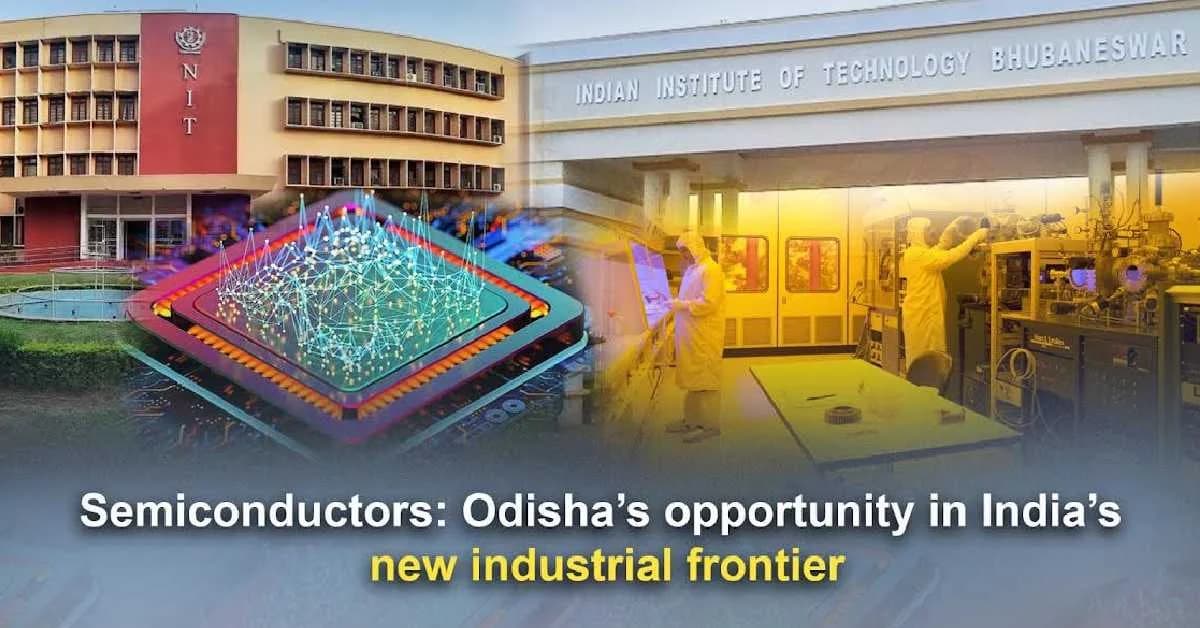
Odisha’s pool of technical talent could be another major advantage. Institutions such as IIT Bhubaneswar, NIT Rourkela, IIIT Bhubaneswar and VSSUT produce engineers who can potentially contribute to chip design, VLSI, embedded systems, artificial intelligence and advanced electronics. Recent semiconductor-related initiatives involving NIT Rourkela also underline the potential for Odisha to participate in the research and innovation side of the industry.
For the state, therefore, the semiconductor opportunity is not merely about attracting factories. It is about building an ecosystem linking industry, academia, research institutions, startups and skilled manpower.

📱 Get Argus News App
✨The opportunity comes against the backdrop of India’s larger semiconductor ambition. In the technology-driven world of the 21st century, the tiny semiconductor chip has become the invisible heart of modern civilisation. From smartphones and automobiles to defence systems, medical equipment, telecommunications and advanced computing, almost every major sector depends on these devices.
If oil shaped much of the geopolitical and economic equations of the 20th century, semiconductors are increasingly becoming a strategic resource in today’s digital and AI-driven economy.
The government’s Semiconductor Mission and Semicon India programme seek to build a domestic semiconductor ecosystem, covering chip design, fabrication, assembly, testing and packaging. India already has considerable strength in chip design, with several global companies operating major research and development centres here. The challenge is to convert that design capability into greater domestic intellectual property and manufacturing capacity.
The Design Linked Incentive scheme seeks to encourage startups and MSMEs to develop semiconductor designs and intellectual property. A stronger domestic value chain would reduce dependence on overseas manufacturing while creating opportunities for high-skilled employment.
But the road ahead is difficult. Semiconductor manufacturing is among the world’s most complex and capital-intensive industries, with technology evolving rapidly. Continuous investment in research and development, policy stability and close cooperation between government, industry and academia will be essential.
Infrastructure is equally critical. Semiconductor plants require uninterrupted power, highly purified water, advanced logistics and stringent quality control. Environmental sustainability will also matter, particularly through renewable energy and water-recycling systems.
The next phase of the semiconductor race will extend beyond conventional silicon chips into areas such as silicon carbide, gallium nitride, silicon photonics, quantum computing and AI-specific processors. The growth of electric vehicles, smart grids, robotics, advanced communications and AI infrastructure will further increase demand.
For Odisha, this presents an opportunity to add a high-technology dimension to its industrial profile. But semiconductor ecosystems cannot be built overnight. The real challenge will be to convert the state’s infrastructure, institutions and young technical talent into a sustainable technology ecosystem.
For a state known for its mineral wealth, the semiconductor
opportunity could mark a significant shift—from supplying the raw materials of
industrialisation to participating in the technologies that will shape its next
generation.
Related Topics
Explore more stories