



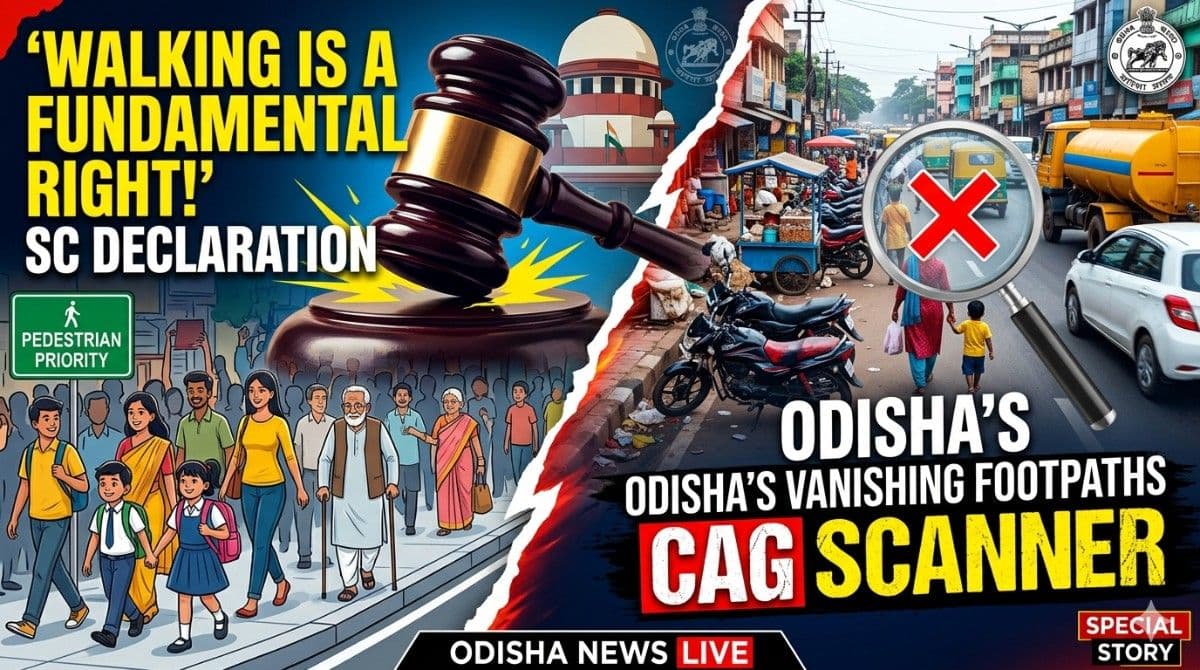
SC Declares Walking Fundamental Right As Odisha Under CAG Scanner For Vanishing Pedestrian Spaces| Special Story
Key Points
The Supreme Court declares walking a primary fundamental right under Articles 19(1)(d) and 21, overriding motorized vehicle privileges.
State road policies face immediate pressure as a citizen-centric CAG audit targets structural gaps and missing pedestrian infrastructure in Bhubaneswar and Cuttack.
Pedestrians can now directly sue municipal corporations and urban bodies for compensation if footpaths are lost to illegal parking and encroachment.
Bhubaneswar: In a landmark ruling that is set to fundamentally alter urban planning and traffic enforcement across the country, including Odisha, the Supreme Court of India has declared walking a fundamental right under the Constitution, prioritizing pedestrians over motorized vehicles.
The historic Supreme Court ruling declaring walking a fundamental right has handed a powerful legal weapon to millions of pedestrians across Odisha. The judgment arrives just as a sweeping institutional audit exposes how the state’s aggressive push for motorized road expansion has systematically wiped out safe walking spaces.
The apex court's ruling in Maniyar Iliyaz @ Shaik Riyaz & AnR. v. P. Ayyappan & Ors. establishes that a citizen’s right to walk on a demarcated footpath holds absolute priority over motorized vehicles. It places a binding legal obligation on municipal bodies to maintain unencumbered pavements.
For Odisha, this shifts the battleground from a mere civic inconvenience to a severe constitutional violation.

📱 Get Argus News App
✨The Catalyst: A Fatal Lack of Infrastructure
The Supreme Court’s intervention stems from a poignant tragedy: a father walking his five-year-old son to a neighborhood school at 9:00 AM. Because there was neither a functioning footpath nor a pedestrian crossing, a speeding tanker struck the boy from behind, crushing him.
The bench observed that modern municipal administrations have been so "busy creating roads that are suitable for motorized vehicles" that wheels have eclipsed the civic imagination, treating walkers as a "nuisance" rather than the primary stakeholders of public space.
The Legal Angle: What SC Said
Dismantling the legal bias toward motorists, the Supreme Court established a new constitutional paradigm:
- Constitutional Backing: The right to walk is now recognized as integral to the right to movement under Article 19(1)(d) and the right to life under Article 21.
- Historical Precedence: The Court noted that humans walked long before wheels were invented. Therefore, the fundamental right to walk on a demarcated footpath takes absolute priority over motorized transport.
- Beyond Accident Claims: The Court ruled that pedestrian safety cannot merely be dealt with through routine police FIRs and insurance claims. It requires an enforceable statutory framework.
Engineering the Pedestrian Out of the Picture
While the Supreme Court dismantled the legal bias toward motorists, ongoing urban audits in Odisha show that the state’s engineering policies have long coded pedestrians out of its streets.
Under the current Odisha State Road Policy, statutory guidelines strictly mandate parameters for widening roads – requiring minimum widths of 12 meters for the Works Department, 7.5 meters for Rural Development, and 5 meters for Urban Local Bodies (ULBs). However, these blueprints treat pedestrian infrastructure as a residual afterthought. Rather than allocating non-negotiable, continuous, and barricaded rights-of-way for walkers, the walking space is routinely relegated to an optional, unpaved shoulder.
Where footpaths do exist on paper, they are swiftly consumed by urban chaos.
The Cuttack Model
In a stark example from Cuttack, a 5.2-km smart corridor from Madhupatana Square to Badambadi Chowk was built costing Rs 4 crore, featuring dedicated walkways designed to be 1.2 meters wide and raised by 6 inches for safety. Yet, field data reveals that illegal two-wheeler parking, delivery bikes, and commercial shopfront extensions have occupied virtually 100% of this space during peak hours, forcing school children and daily commuters directly into the path of high-speed traffic.
The CAG Steps In: Auditing Odisha's Urban Mobility
This systematic failure to protect the non-motorized commuter has caught the attention of federal watchdogs. In a major development, the Comptroller and Auditor General (CAG) of India last month has initiated a comprehensive Citizen-Centric Compliance Audit on Urban Mobility targeting the twin cities of Bhubaneswar and Cuttack.
Driven alongside the Housing and Urban Development Department of Odisha, the CAG audit is actively mapping:
- The actual presence versus absence of continuous, uninterrupted pedestrian pathways relative to total blacktopped road lengths.
- Critical policy implementation gaps in enforcing non-motorized transport (NMT) zones.
- The failure of local administrations to curb illegal parking from swallowing public walkways.
How SC Judgment Empowered Pedestrians
The Supreme Court's judgment provides a direct solution to the exact governance failures the CAG is currently auditing. The court explicitly designated Urban Development Authorities (such as BDA and CDA) and Municipal Corporations (such as BMC and CMC) as duty bearers.
"If a road exists, there must then be a duty to ensure that a footpath is demarcated and maintained for the walkers," the Court ruled.
Crucially, the apex court declared that if a municipal body allows illegal parking to encroach upon walking spaces, forcing people into harm's way, citizens are entitled to invoke constitutional and legal remedies for restitution and compensation directly against the local authorities. This remedy stands completely independent of the Motor Vehicles Act.
With the
Supreme Court directing central ministries and the Law Commission to structure
a comprehensive statutory framework to enforce pedestrian rights nationwide,
Odisha's civic bodies can no longer build roads solely for cars. The ongoing
CAG audit will provide the data, but the Supreme Court has already provided the
teeth: the pavements belong to the people, and the state is legally bound to
clear them.
Also Read: Special Story / Delhi HC Blow to ‘NEET Mafia’ Conspiracy: How Telegram Was Weaponised to Create a Fake Paper-Leak Narrative
Related Topics
Explore more stories