



Political Analysis / Redrawing Social Justice: How Reservation Reform Could Reshape Odisha Politics
·6 months ago·3 min read
Key Points
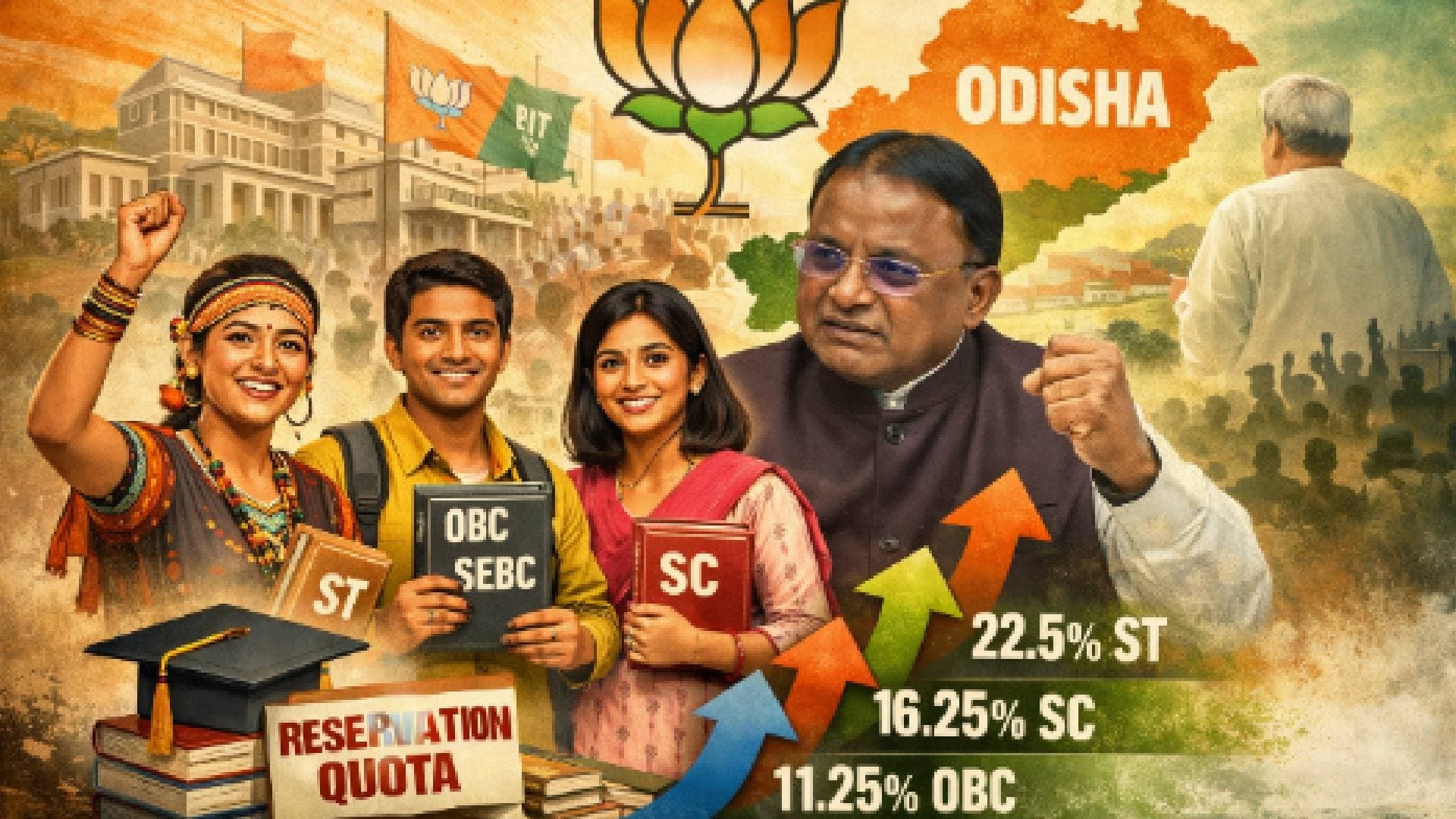
BJP government in Odisha increased ST quota from 12% to 22.5%, SC from 8% to 16.25%, and introduced 11.25% reservation for SEBCs, aligning affirmative action with demographic realities.
Bhubaneswar, Apr 6: The decision of the Bharatiya Janata Party government in Odisha to expand reservation in higher education is not merely an administrative reform -- it is a deeply calibrated political move with long-term electoral implications.
At one level, the policy addresses a long-pending structural imbalance. By increasing quotas for Scheduled Tribes (from 12 per cent to 22.5 per cent) and Scheduled Castes (from 8 per cent to 16.25 per cent), and introducing 11.25 per cent reservation for SEBCs, the government has attempted to align affirmative action with demographic realities. Given that STs alone constitute over 22 per cent of Odisha’s population, the earlier quota framework had increasingly appeared inadequate. This recalibration, therefore, allows the government led by Mohan Charan Majhi to project the move as one rooted in social justice rather than political expediency.
However, the timing and scale of the decision suggest a far more strategic underpinning. Odisha’s social composition—where SCs, STs, and OBCs together account for nearly 90 per cent of the population -- makes these communities the decisive electoral bloc. By extending tangible benefits in the education sector, the BJP is attempting to consolidate a broad social coalition that has historically been fragmented and, in many cases, aligned with the Biju Janata Dal.
The inclusion of SEBCs (OBCs) into the reservation framework is particularly significant. Unlike SCs and STs, OBCs in Odisha have not always been politically mobilised as a unified voting bloc. By formally recognising them within the higher education quota system, the BJP is not only addressing a policy gap but also making a bid to politically integrate this diverse and numerically substantial group into its support base.
At one level, the policy addresses a long-pending structural imbalance. By increasing quotas for Scheduled Tribes (from 12 per cent to 22.5 per cent) and Scheduled Castes (from 8 per cent to 16.25 per cent), and introducing 11.25 per cent reservation for SEBCs, the government has attempted to align affirmative action with demographic realities. Given that STs alone constitute over 22 per cent of Odisha’s population, the earlier quota framework had increasingly appeared inadequate. This recalibration, therefore, allows the government led by Mohan Charan Majhi to project the move as one rooted in social justice rather than political expediency.
However, the timing and scale of the decision suggest a far more strategic underpinning. Odisha’s social composition—where SCs, STs, and OBCs together account for nearly 90 per cent of the population -- makes these communities the decisive electoral bloc. By extending tangible benefits in the education sector, the BJP is attempting to consolidate a broad social coalition that has historically been fragmented and, in many cases, aligned with the Biju Janata Dal.
The inclusion of SEBCs (OBCs) into the reservation framework is particularly significant. Unlike SCs and STs, OBCs in Odisha have not always been politically mobilised as a unified voting bloc. By formally recognising them within the higher education quota system, the BJP is not only addressing a policy gap but also making a bid to politically integrate this diverse and numerically substantial group into its support base.

📱 Get Argus News App
✨📰 60 Word News🎬 Argus Podcast📺 Live TV and Breaking News🔔 Free Notification Alerts
Download Free:
The move also reflects a shift in the BJP’s Odisha strategy -- from a largely ideological campaign to one grounded in welfare-driven social engineering. Since assuming power in June 2024, the party has been keen to establish governance credentials distinct from its predecessor. This reservation policy provides a powerful narrative: one that combines inclusivity, representation, and opportunity, particularly in aspirational sectors like engineering, medicine, and management.
Yet, the policy cannot be viewed in isolation from the electoral calendar. With the 2027 panchayat and urban local body elections on the horizon, the BJP faces the formidable grassroots network of the BJD, which continues to dominate local governance structures, including all Zilla Parishads and a majority of urban local bodies. Breaking this entrenched dominance requires more than rhetoric -- it demands policies that create direct, perceivable benefits for large sections of the population.
In this context, expanding reservation in higher education serves a dual purpose. It enhances access to professional education for historically marginalised communities while simultaneously embedding a sense of political reciprocity. Beneficiaries of such policies often translate into loyal electoral constituencies, especially when the benefits are both visible and aspirational.
For the BJD, this presents a nuanced challenge. While it has historically enjoyed strong support among SCs, STs, and rural voters, the BJP’s aggressive outreach through targeted policy interventions could gradually erode this base. The contest, therefore, is no longer just about governance versus legacy, but about who better represents the aspirations of Odisha’s socially and economically backward classes.
In essence, the expansion of reservation in higher education is as much about classrooms as it is about constituencies. It signals the BJP’s intent to reshape Odisha’s political landscape by aligning social justice with electoral strategy -- an approach that could redefine power equations in the state in the years to come.
Yet, the policy cannot be viewed in isolation from the electoral calendar. With the 2027 panchayat and urban local body elections on the horizon, the BJP faces the formidable grassroots network of the BJD, which continues to dominate local governance structures, including all Zilla Parishads and a majority of urban local bodies. Breaking this entrenched dominance requires more than rhetoric -- it demands policies that create direct, perceivable benefits for large sections of the population.
In this context, expanding reservation in higher education serves a dual purpose. It enhances access to professional education for historically marginalised communities while simultaneously embedding a sense of political reciprocity. Beneficiaries of such policies often translate into loyal electoral constituencies, especially when the benefits are both visible and aspirational.
For the BJD, this presents a nuanced challenge. While it has historically enjoyed strong support among SCs, STs, and rural voters, the BJP’s aggressive outreach through targeted policy interventions could gradually erode this base. The contest, therefore, is no longer just about governance versus legacy, but about who better represents the aspirations of Odisha’s socially and economically backward classes.
In essence, the expansion of reservation in higher education is as much about classrooms as it is about constituencies. It signals the BJP’s intent to reshape Odisha’s political landscape by aligning social justice with electoral strategy -- an approach that could redefine power equations in the state in the years to come.
Related Topics
Explore more stories