



Record Paddy Procurement at ₹3,100 MSP: Odisha Eclipses Telangana in Paddy Farmers benefitted; Will AgriStack ID Derail?| Exclusive
Key Points
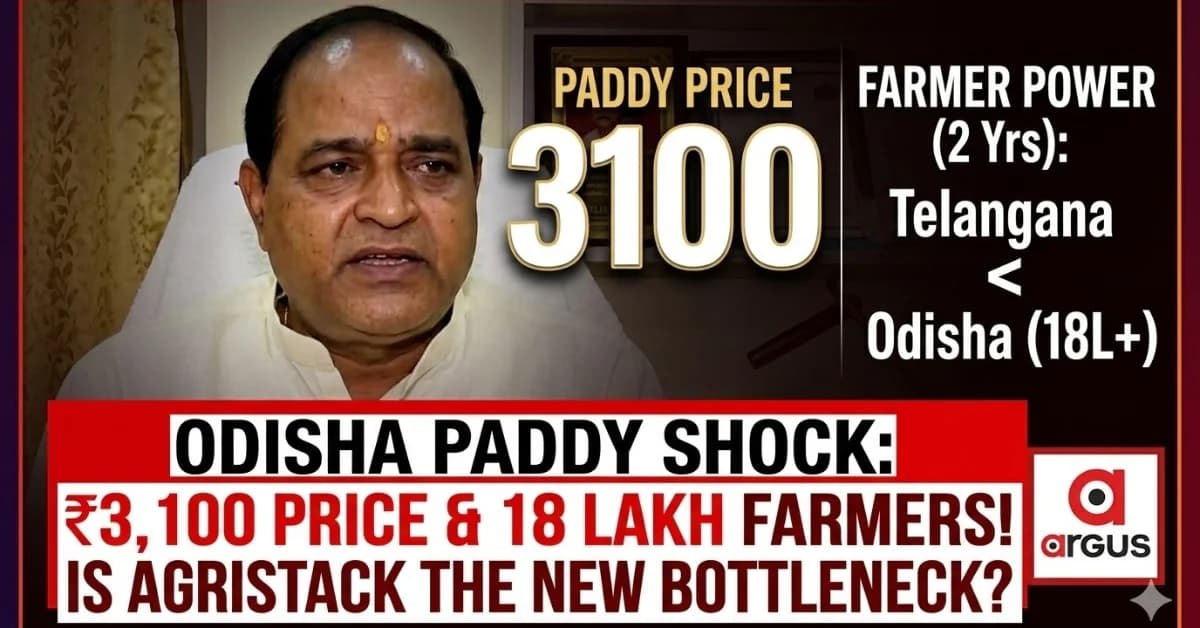
Bhubaneswar: The Odisha BJP govt’s decision to raise the effective paddy procurement price to Rs3,100 per quintal, comprising the Centre’s Rs2,369 MSP and the State’s Rs731 input assistance, appears to have significantly widened farmer participation in the government procurement system, with more than 18 lakh farmers benefiting for the second consecutive procurement year.
The latest procurement figures show that around 18.03 lakh farmers sold paddy through the government procurement system in 2025-26, taking the number above the 18-lakh mark for the second straight year.
This marks a substantial rise from 15.32 lakh farmers in 2023-24 and establishes the post-Rs3,100 procurement regime as a major factor behind the expansion in farmer participation.
Odisha’s farmer participation rises sharply

📱 Get Argus News App
✨The longer-term procurement data tells the story more clearly.
|
Procurement year |
Odisha farmers benefiting |
|
2022-23 |
17.10 lakh |
|
2023-24 |
15.32 lakh
2024-25
18.21 lakh
2025-26
18.03 lakh
Thus, after falling to 15.32 lakh in 2023-24, farmer participation crossed the 18-lakh threshold in 2024-25 and remained above it in 2025-26.
The latest departmental assessment places the total number of farmers benefiting from the combined 2025-26 Kharif and Rabi procurement cycle at approximately 18.03 lakh, while paddy procurement is estimated at more than 79 lakh metric tonnes.
But Odisha is not the national leader
While Odisha has registered a major jump, the comparative national data shows that it is still well behind Chhattisgarh.
In 2024-25, Chhattisgarh recorded around 25.50 lakh farmers benefiting from paddy procurement against Odisha’s 18.21 lakh. In 2025-26, Chhattisgarh again remained ahead with about 25.24 lakh farmers, compared with Odisha’s latest 18.03 lakh.
However, Odisha has made an important gain in the national pecking order.
It has overtaken
Telangana in farmer participation during the last two procurement years.
Telangana had around 16.18 lakh beneficiaries in 2024-25 and about 11.67
lakh in 2025-26 in the table available up to February, when Odisha
crossed over 13.28 lakh (The table is given below).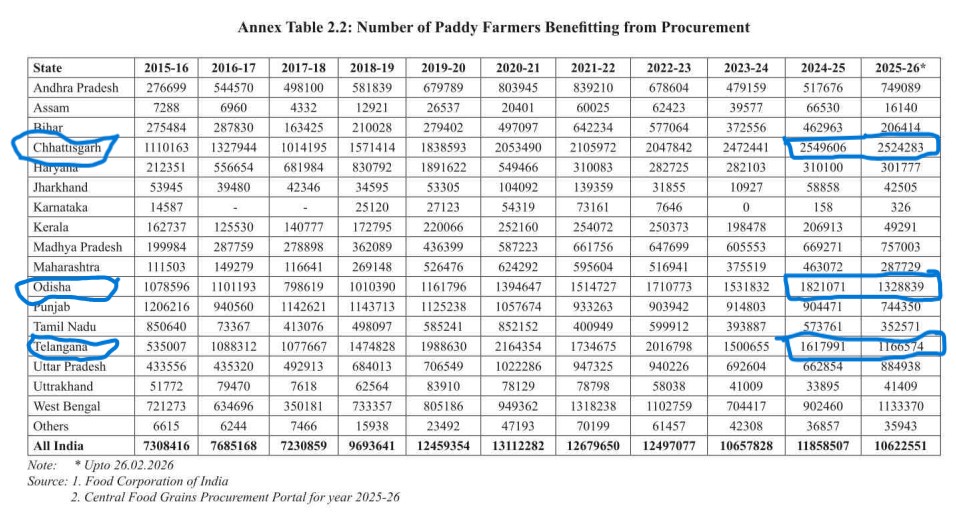 The
comparison indicates that Odisha’s procurement architecture, backed by the
enhanced effective price of Rs3,100 per quintal, has substantially expanded its
reach among paddy growers.
The
comparison indicates that Odisha’s procurement architecture, backed by the
enhanced effective price of Rs3,100 per quintal, has substantially expanded its
reach among paddy growers.
Why the ₹3,100 price matters
The significance of the Rs3,100 procurement price goes beyond the headline MSP.
The Centre’s MSP for common paddy for the procurement season is Rs2,369 per quintal, while Odisha’s additional input assistance takes the effective government procurement price to Rs3,100.
For a paddy farmer, therefore, government procurement offers a substantially higher assured return than merely selling in an open market where prices can fluctuate around harvest.
That guaranteed price has the potential to influence the farmer’s decision on where, when and to whom to sell paddy, particularly in a State where paddy remains the dominant Kharif crop.
The rising beneficiary numbers over the past two years offer an important empirical indicator: more farmers are entering or remaining within the formal procurement network.
The AgriStack question: Could It now become the bottleneck?
This is where the 2026-27 Kharif procurement cycle faces its biggest administrative test.
The State has introduced AgriStack integration into the procurement process this year. The move has triggered political opposition, with the BJD alleging that mandatory digital identification could exclude sharecroppers, small farmers and other cultivators.
But Food Supplies and Consumer Welfare Minister Krushna Chandra Patra has clarified that an AgriStack ID is not mandatory for registration.
As of August 9, 8,654 cultivators registered, out of which 8,605 received formal Farmer Codes, and 5,134 have unique AgriStack IDs linked.
That distinction is critical.
Registration is not the same as token generation
The government's procurement architecture this year effectively has three stages:
Registration → AgriStack mapping/token generation → Paddy sale
The registration window opened on August 6 and will remain open till August 31. Farmers can register with Aadhaar, bank passbook, land records/RoR and a linked mobile number.
The AgriStack ID becomes relevant at the token-generation stage before procurement begins in November.
In other words, the government has created a gap of roughly two months between registration and actual procurement to complete the digital mapping.
The department says an AgriStack ID can be generated from the farmer’s RoR and that the process is expected to take around 48 hours after submission of the required land records.
This is the government's principal answer to the concern that AgriStack could derail procurement.
Sharecroppers are the real test
The more important question is not whether a land-owning farmer can generate an AgriStack ID.
It is whether sharecroppers and cultivators whose names are not directly reflected in land records can seamlessly enter the procurement chain.
The State's stated position is that sharecroppers will not be excluded. They can register by submitting a consent letter from the landowner along with their other documents.
The government has also simplified the process by allowing tenant farmers to register without requiring the landowner to physically accompany them to the PACS centre.
That could become decisive in determining whether the 18-lakh-plus farmer participation level is sustained in 2026-27.
The actual status: AgriStack is not blocking registration yet
The present status, therefore, is more nuanced than the political debate suggests.
As of August 9, AgriStack has not emerged as a barrier to registration. Nearly 3471 newly registered farmers in the first few days did so without an existing AgriStack ID, according to the latest official data available.
But the bigger test is still ahead.
The government itself has acknowledged that digital integration is facing friction, particularly because of mismatches between physical land records and digital databases.
Therefore, the real question is not whether farmers can register without an AgriStack ID.
It is whether the administration can ensure that every eligible farmer registered by August 31 gets the required digital mapping before procurement tokens are generated in November.
That is the point at which an administrative technology problem could potentially translate into a procurement problem.
When the procurement network has reached a new scale, the AgriStack rollout seems a consequential administrative test for the Govt.
If the government successfully completes the digital mapping without excluding sharecroppers and small cultivators, the new system could strengthen traceability, crop verification and direct payments. The State says AgriStack integration is also being used alongside satellite-based verification and digital crop surveys to improve the authenticity of procurement data.
But if land-record mismatches, ID generation delays or token-related problems persist into November, the very digital reform designed to clean up procurement could become the weakest link in a system that has just achieved record farmer participation.
The
immediate verdict, therefore, is clear: AgriStack has not derailed
registration. Whether it can avoid disrupting actual procurement will be known
only when token generation and paddy arrivals begin in November.
Also Read: Odisha Food Pro 2026: What ₹43,437-Crore Headline Number Tells Another Bigger Story| Exclusive Details Inside
Related Topics
Explore more stories