



PM Modi Nuakhai Message: How ‘Spirit of Togetherness’ Reflects Western Odisha’s Cherished Bhetghat Traditions
Key Points
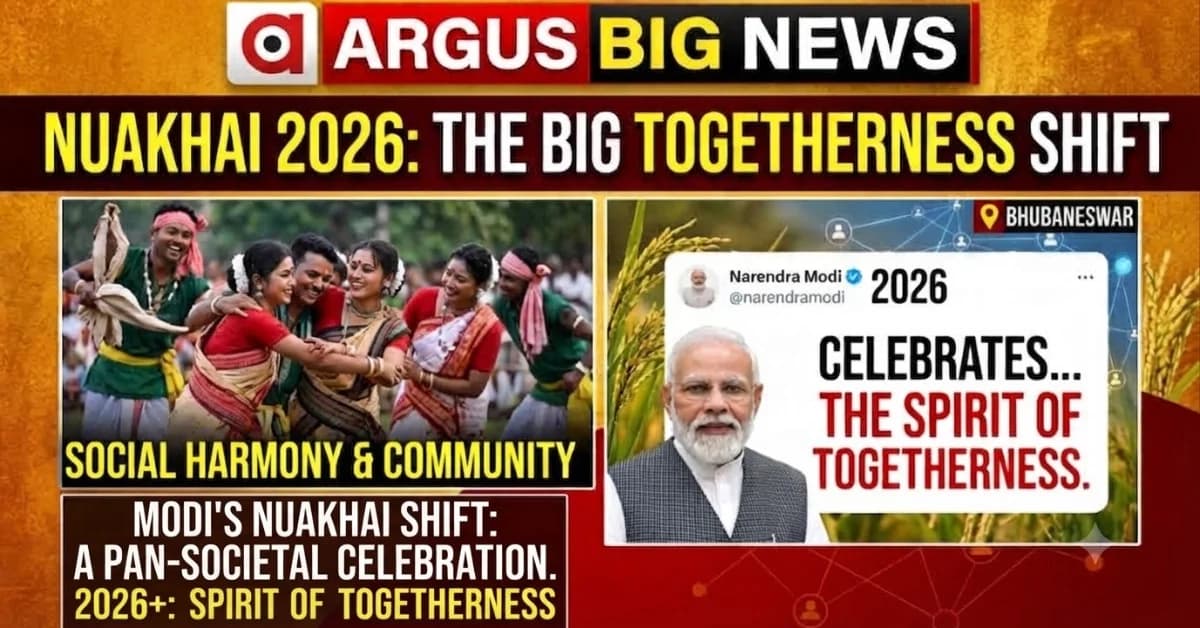
PM Modi's 2026 Nuakhai message expands beyond traditional agricultural focus to emphasize the "spirit of togetherness" and social harmony.
The celebration of Nuakhai Bhetghat serves as an annual social reset, encouraging reconciliation and the setting aside of past grievances.
Cultural traditions like Dalkhai dance and Dulduli music act as collective mediums bridging generations and uniting the community.
Bhubaneswar: Prime Minister Narendra Modi’s 2026 Nuakhai Juhar greeting appears to mark a subtle but significant shift in the way India’s national leadership is articulating Western Odisha’s premier festival.
In
his annual message, Modi moved beyond the familiar celebration of
farmers, harvest and prosperity to foreground the “spirit
of togetherness”
and the strengthening of “bonds
of harmony.
That language closely mirrors the social meaning of Nuakhai
Bhetghat – the
community tradition through which families, neighbours and
generations come together, exchange greetings, seek blessings and put
past bitterness behind them.
Nuakhai Juhar!
— Narendra Modi (@narendramodi) September 15, 2026
Warm greetings on Nuakhai, a festival that celebrates our farmers, the harvest and the spirit of togetherness.
May this special occasion strengthen bonds of harmony and bring happiness and prosperity in our society.
ନୂଆଁଖାଇ ଜୁହାର୍ !
ଆମ କୃଷକ, ଫସଲ ଏବଂ ଏକତାର…
The shift becomes clearer when Modi’s Nuakhai messages are placed side by side.

📱 Get Argus News App
✨From
Farmers And Harvest To The “Spirit Of Togetherness
| Year | Core emphasis of PM Modi’s Nuakhai message |
|---|---|
| 2026 | Farmers, harvest, spirit of togetherness, bonds of harmony, happiness and prosperity |
| 2025 | Gratitude to farmers; good health, prosperity and happiness in every home |
| 2024 | Hardworking farmers, their contribution to society, joy and good health |
| 2023 | Farmers’ hard work, happiness and wellbeing |
| 2022 | Farmers feeding the nation, progress, happiness and health |
| 2021 | Industrious farmers, nation building, health and wellbeing |
| 2020 | Farmers’ hard work, feeding the nation, prosperity and health |
| 2019 | Ancient festival, prosperity, especially among hardworking farmers |
| 2017 | Happiness and prosperity for everyone |
| 2016 | Prosperity in the lives of farmers |
The
pattern is revealing. The earlier messages repeatedly centred on the
farmer,
agricultural labour, prosperity, health and national contribution.
The 2026 formulation retains farmers and harvest but adds a
distinctly social dimension: togetherness
and harmony.
That
emphasis matters because Nuakhai does not end with the ritual
consumption of the new crop. Its deeper social expression unfolds
through Bhetghat,
the get-together or reunion in which the festival becomes a
collective experience.
Bhetghat: Where Nuakhai’s Social Contract Comes Alive
The morning of Nuakhai is deeply connected with ritual, family and the offering of the new harvest. But the hours that follow take the celebration into the wider community.
Bhetghat brings people together in common spaces and creates an occasion for personal contact across families and social groups. Its most powerful message is therefore not simply celebration, but reconciliation.
The traditional exchange of Nuakhai Juhar between younger people and elders reinforces respect across generations. The embrace between peers represents affection and social bonding. More importantly, the occasion carries an unwritten expectation that old disputes, bitterness and grievances should be set aside.
In that sense, Bhetghat is an annual social reset.
A person cannot meaningfully offer Juhar or embrace another while continuing to carry the burden of an old grievance. The ritual therefore converts the lofty ideas of harmony and togetherness into an ordinary, face-to-face human practice.
This is where Modi’s 2026 wording finds its strongest cultural resonance.
Dalkhai: When The Spirit Of Harmony Finds A Collective Rhythm
The clearest cultural expression of this togetherness emerges when Bhetghat moves from greetings and food to music and dance.
Among the folk traditions associated with Western Odisha, Dalkhai occupies a special place. Traditionally performed by women in vibrant Sambalpuri attire, the dance uses coordinated movement and rhythm to create a collective visual form. The forward-and-backward movement has also been associated with the swaying of paddy crops in the wind.
But its significance during Bhetghat goes beyond performance.
The boundary between performer and spectator can dissolve as elders, children and members of the wider community join the celebration. What begins as a folk performance becomes a shared cultural space.
That is precisely where the “spirit of togetherness” ceases to be a phrase and becomes visible.
The same principle runs through Western Odisha’s Sambalpuri folk-song tradition. Songs performed during community celebrations carry stories of rural life, relationships, the soil, nature and the farmer. Older compositions such as Rasarkeli, Jaiphula and Maelajadha can coexist with newer compositions, allowing different generations to participate in the same cultural vocabulary.
The music therefore performs another kind of social bridging: grandparents and younger generations can inhabit the same cultural moment.
The Beat That Makes A Community Move Together
Then comes the soundscape of Bhetghat.
The Dulduli tradition brings together instruments such as the Dhol, Nishan, Tasha/Tasa, Tamki and Mahuri. The collective percussion creates the rhythmic backdrop to the celebration.
Its importance is cultural rather than merely musical.
A common rhythm requires people to listen to something beyond themselves. The individual dancer may move differently, but everyone remains connected to the same beat. That makes the music a fitting metaphor for the social philosophy embedded in Bhetghat: difference does not have to disappear for togetherness to exist.
This is also why Nuakhai’s idea of prosperity extends beyond agricultural output or household wealth. The festival creates a moment of psychological release after the demanding agricultural cycle and turns the community towards collective celebration.
Why The 2026 Message Resonates Differently
For years, national greetings around Nuakhai have understandably highlighted the people who produce food – the farmers whose labour sustains society.
But PM Modi’s 2026 message adds another layer.
By invoking togetherness and harmony, it touches the part of Nuakhai that cannot be measured in tonnes of paddy or agricultural output. It acknowledges the social infrastructure of the festival: the Bhetghat, the Juhar, the embrace, the shared food, the folk song and the common rhythm.
That is perhaps the most enduring lesson of Nuakhai.
The harvest may fill the granary, but Bhetghat fills the social space between people.
And when Dalkhai rises to its familiar rhythm, the message becomes almost physical: different ages, families and backgrounds moving to one collective beat.
That
makes the Prime Minister’s 2026 phrase “spirit
of togetherness”
more than a festive greeting. It echoes one of Western Odisha’s
oldest social instincts – that prosperity is incomplete without
harmony, and a celebration is incomplete unless the community
celebrates together.
Also Read: Culture / Western Odisha Celebrates Nuakhai with Devotion and Unity
Related Topics
Explore more stories