



Odisha’s Silent Cancer Warning: Why Odisha’s Veteran MP Bhartruhari Mahtab Raised Colorectal Cancer in Lok Sabha| Special Report
Key Points
Bhubaneswar: Veteran BJP MP and Cuttack Lok Sabha member Bhartruhari Mahtab has sounded an alarm over the growing threat of colorectal cancer, placing the issue before Parliament through a Special Mention under Rule 377 very recently.
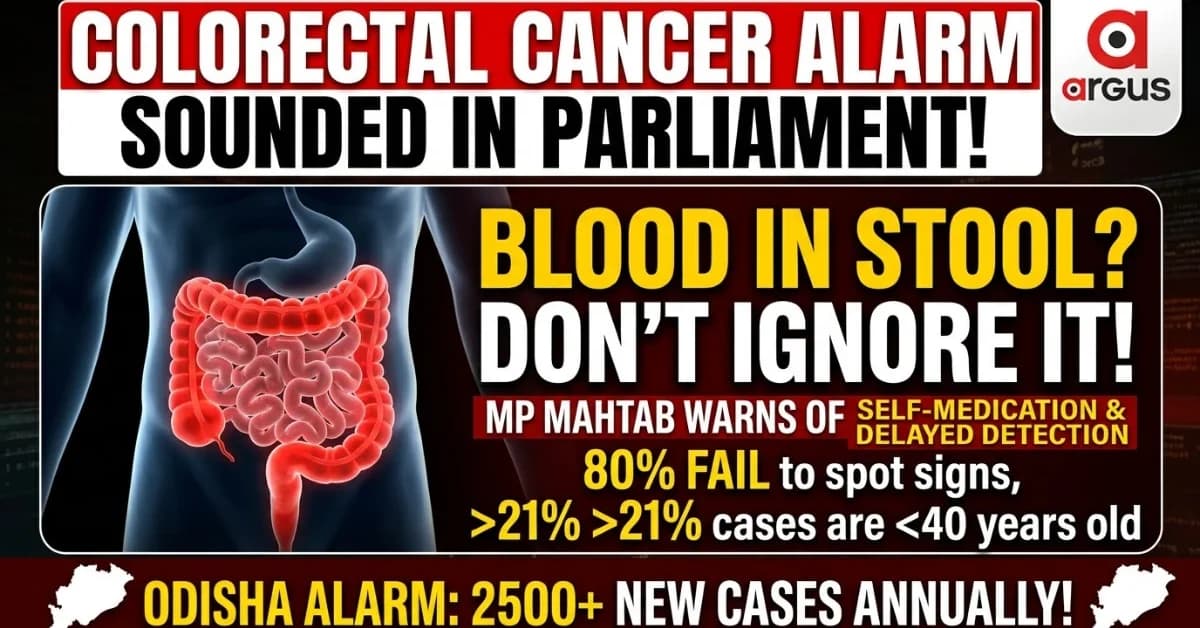
Mahtab raised the issue because a nationwide survey cited in his parliamentary intervention found that more than 80% of respondents failed to recognise blood in the stool as a serious warning sign, while nearly 90% preferred self-medication or home remedies instead of consulting a doctor. He also flagged the tendency, particularly among younger people, to dismiss persistent bloating, bowel irregularities and diarrhoea as stress or dietary problems.
Odisha: Around 2,100-2,500 New Cases A Year
The warning assumes significance for Odisha, where colorectal cancer is emerging as an important gastrointestinal cancer burden.

📱 Get Argus News App
✨The available state-level estimates put the annual incidence of colorectal cancer at around 2,100 to 2,500 new cases, while the estimated number of people living in Odisha with a colorectal cancer diagnosis within a five-year period is around 4,500-5,200.
The data also point to a distinctive pattern in the state and eastern India, with rectal cancer accounting for a disproportionately high share of colorectal cancer presentations. Tertiary-care surgical audits cited in the source indicate that rectal cancer can constitute nearly 65% or more of lower gastrointestinal cancer presentations in regional clinical pools.
However, the Odisha numbers need to be read as estimates rather than a comprehensive population-based registry count, as state-wide cancer surveillance remains limited and much of the state-level burden is modelled from available ICMR and institutional data.
India: Colorectal Cancer Now Among the Major Cancer Burdens
Nationally, colorectal cancer has become the fourth most common cancer in India, with around 83,577 new cases estimated annually. Of these, approximately 48,536 are among men and 35,041 among women. The estimated five-year prevalence stands at around 1.55-1.60 lakh people.
What is particularly worrying is the changing age profile. Although colorectal cancer has traditionally been associated with older people, Indian clinical audits suggest that 21%-40% of colorectal cancer patients are now below 40 years of age. The source also notes that more than 70% of Indian cases present at advanced Stage III or IV, making delayed detection a critical concern.
There is another striking feature in the Indian pattern: rectal cancer cases outnumber colon cancer cases. The national colon-to-rectal cancer ratio is estimated at around 0.7:1, meaning that for every seven colon cancer patients, there are roughly 10 rectal cancer patients.
What Exactly Is Colorectal Cancer?
Colorectal cancer is cancer of the large intestine – either the colon or the rectum. The disease generally begins when abnormal cells develop in the inner lining of the bowel. In many cases, it starts as a polyp, a small growth that is initially non-cancerous but can gradually undergo cancerous changes over several years.
That long progression from polyp to cancer also makes early detection particularly important. Tests such as colonoscopy and stool-based tests such as the Fecal Immunochemical Test (FIT) can help detect abnormalities or hidden blood, while a biopsy is used to confirm cancer when suspicious tissue is found.
What Are the Early Warning Signs?
The biggest danger, as highlighted by Mahtab, is that the early signs are often subtle and easily normalised.
Watch out for:
- Blood in the stool or rectal bleeding, whether bright red or dark.
- Persistent changes in bowel habits, including constipation, diarrhoea or alternating bowel patterns.
- A feeling that the bowel does not empty completely.
- Persistent bloating, gas, cramps or abdominal discomfort.
- A sustained change in stool shape, including unusually narrow or pencil-thin stools.
- Unexplained weight loss and persistent fatigue.
- An unexplained fall in haemoglobin or anaemia, which can sometimes indicate hidden bleeding.
One of the most dangerous mistakes is to automatically attribute rectal bleeding to piles or fissures and continue self-treatment without medical evaluation. Similarly, persistent bloating or recurring constipation and loose motions should not simply be dismissed as "gas", stress or dietary disturbance.
What Causes Colorectal Cancer?
There is no single cause. The disease results from genetic changes in bowel cells, with the risk influenced by a combination of diet, lifestyle, genetics and underlying medical conditions.
Major risk factors include diets high in processed and red meat and low in fibre, physical inactivity and obesity, tobacco use and heavy alcohol consumption. Age and family history also matter, while inherited conditions such as Lynch syndrome and chronic inflammatory bowel diseases such as ulcerative colitis and Crohn’s disease can significantly increase risk.
The changing lifestyle of India's younger population is therefore an important concern. Increasing consumption of processed food, sedentary habits and tobacco/alcohol use are among the factors being associated with the changing colorectal cancer profile.
The Bottom Line: Don't Wait for Pain
The central message emerging from Mahtab's intervention is simple: colorectal cancer does not always announce itself with severe pain. By the time significant pain or other obvious symptoms appear, the disease may already have progressed.
If you notice blood in the stool, persistent changes in bowel habits, unexplained anaemia, recurring bloating, abdominal discomfort, unexplained weight loss or any other unusual bowel symptom, do not self-medicate or assume it is merely piles or indigestion. Consult a doctor promptly.
Early
detection can substantially improve treatment options – but only when the warning signs are recognised
and acted upon in time.
Also Read: How Odisha's Rising C-Section Delivery Trend Could Fuel an Urban Diabetes Crisis Among Mothers and Newborns | Special Report
Related Topics
Explore more stories