



Odisha’s Sanitation Paradox: GARIMA Nears 6 Years, Yet Septic Tank Deaths Persist| Special Report
Key Points
Bhubaneswar: Nearly a fortnight before Odisha hosts the 2nd National GARIMA Conclave, with the Union ministries of Social Justice and Empowerment and Housing & Urban Affairs jointly sponsoring the national-level event, the State government has launched an enforcement-cum-awareness drive against unregistered private sanitation operations and hazardous manual cleaning.
The campaign, titled “Aainagata Safai, Surakshita Safai” (Legal Cleaning, Safe Cleaning), is being conducted from August 7 to August 21, ahead of the August 22 conclave in Bhubaneswar.
It seeks to crack down on unauthorised cesspool operators, prevent citizens and institutions from directly engaging labourers for hazardous septic tank and sewer cleaning, and push all such work through registered service providers or the national sanitation helpline 14420.
Yet, the irony is stark: with Odisha’s GARIMA scheme completing nearly six years, the State continues to record deaths linked to hazardous cleaning of septic tanks and sewers.

📱 Get Argus News App
✨Ground Reality vs Official Record: The Data Gap
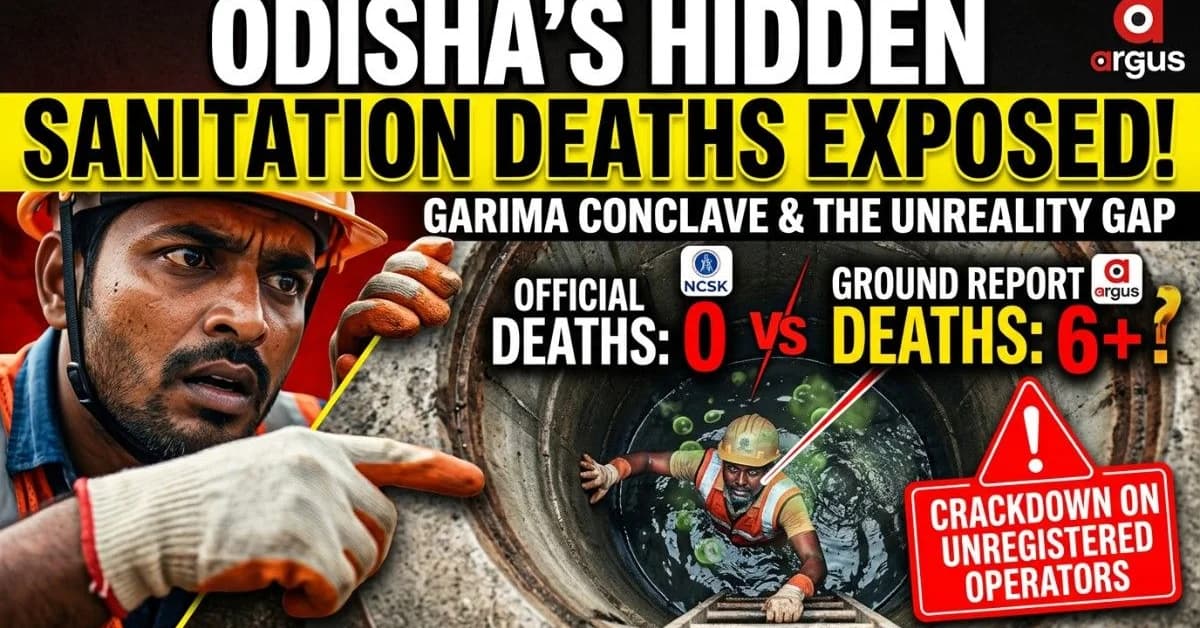
The biggest challenge confronting Odisha’s sanitation-safety architecture is not merely the existence of fatalities, but the wide gap between deaths reported on the ground and those captured in official sanitation-death databases.
The official National Commission for Safai Karamcharis (NCSK) tracking system records deaths specifically classified as “accidental hazards while cleaning sewers and septic tanks.”
By that yardstick, Odisha recorded only two deaths in 2021, with none officially recorded from 2022 through June 2026. The two fatalities occurred on April 15, 2021, at CDA Sector-10 in Cuttack, where workers Bishnu Naik and T. Prabhakar reportedly suffocated inside a sewage tank.
But the picture emerging from ground-level reports is markedly different.
According to the documented incident data provided, Odisha saw four sanitation-related fatalities in 2021 – two workers died inside a residential septic tank in Bhubaneswar in March, followed by the two Cuttack deaths in April.
The reported toll then stood at zero during 2022-24, before four workers died in a septic-container incident in Nabarangpur in June 2025. The situation became even more alarming in 2026, when six persons, including a father-son duo, died after inhaling toxic gases inside an under-construction septic tank in Kalahandi on May 26.
Odisha’s sanitation death data: Official vs ground reports
|
Year |
Official NCSK record |
Ground-level reported deaths |
|
2021 |
2 |
4 |
|
2022 |
0 |
0 |
|
2023 |
0 |
0 |
|
2024 |
0 |
0 |
|
2025 |
0 |
4 |
|
2026* |
0 |
6 |
*January-June 2026 for the official registry.
The discrepancy is rooted in the very nature of the work. Private, informal and unregistered cleaning operations often happen outside municipal supervision. Fatalities can subsequently be recorded by police as accidental asphyxiation, drowning or construction-site mishaps rather than as sanitation-worker deaths, keeping them outside specialised national sanitation databases.
GARIMA Has Built a Safety Net But NAMASTE Shows the Remaining Vulnerability
Odisha launched GARIMA on September 11, 2020, as a statewide social-security and dignity framework for core sanitation workers. At its inception, the scheme envisaged coverage of around 20,000 core sanitation workers and their families.
The programme has since identified and validated more than 10,000 workers across 115 Urban Local Bodies, while 9,364 core sanitation workers are currently mapped within the GARIMA ecosystem and receiving welfare and safety-related provisions.
The central National Action for Mechanised Sanitation Ecosystem (NAMASTE), launched in 2023-24, brings another layer of worker identification and mechanisation.
Odisha has 1,294 validated Sewer and Septic Tank Workers (SSWs) under NAMASTE. The workers are eligible for PPE, occupational safety training, emergency response equipment, machinery-related capital support and health insurance. The fresh national survey, meanwhile, reported zero manual scavengers in Odisha.
This creates an important distinction: zero officially identified manual scavengers does not necessarily mean zero hazardous manual cleaning.
GARIMA covers a broader universe of core sanitation workers, while the NAMASTE database specifically validates sewer and septic tank workers. The 1,294 NAMASTE workers are therefore a sub-category within the larger GARIMA framework.
The Real Gap: The Informal Private Cleaning Economy
The persistence of fatalities despite institutional schemes points to a vulnerability outside the formal municipal sanitation system – the informal private market for septic-tank and sewer cleaning.
This is precisely where the current “Aainagata Safai, Surakshita Safai” campaign assumes significance.
The Odisha government is seeking to plug the gap by making hazardous cleaning a civic-regulated activity, rather than allowing households, apartments, hotels, hospitals or other institutions to directly hire individuals for dangerous cleaning jobs.
Under the campaign, ULBs are cracking down on illegal and unregistered cesspool vehicles, while citizens are being directed to use registered Private Service Provider Organisations or the 14420 helpline. At the operational level, Emergency Response Sanitation Units (ERSUs) are being equipped with gas detectors, air blowers and protective equipment to ensure that workers do not enter hazardous environments without safety safeguards.
The underlying policy challenge, therefore, is no longer simply identifying sanitation workers. It is identifying every sanitation job, every service provider and every hazardous cleaning operation before a worker enters a septic tank.
Why the August 22 Conclave Matters
The timing of the enforcement drive is significant.
The campaign ends on August 21, immediately before the 2nd National GARIMA Conclave 2026, scheduled for August 22 at Lok Seva Bhavan in Bhubaneswar. The conclave brings Odisha’s GARIMA framework onto a national platform with participation from the Union Ministry of Social Justice and Empowerment and the Ministry of Housing & Urban Affairs.
The national gathering is expected to focus on mechanisation, safety standards and the elimination of fatalities in sanitation work. The stated objective is essentially a “Mission Zero” approach – ending deaths during sanitation work.
For Odisha, however, the credibility of that mission will ultimately depend not on the number of workers officially registered, but on whether the State can close the gap between official databases and what happens in privately hired septic-tank cleaning operations.
Because the uncomfortable question remains: if GARIMA has been in operation since 2020 and NAMASTE has now identified 1,294 sewer and septic-tank workers, why are people still entering toxic septic tanks, and dying there?
The answer
may lie less in the absence of schemes and more in the unregistered
sanitation economy operating beyond the reach of those schemes. The August
7-21 crackdown is therefore more than an awareness campaign. It is a test of
whether Odisha can finally bring that invisible sanitation workforce into the
formal safety net before another death exposes the gap.
Related Topics
Explore more stories