



Odisha’s Internet Subscribers Cross 3 Crore, Covering 63% of Population; Digital India’s Bigger Success Lies in Last-Mile CSC, ASK Revolution| Exclusive
Key Points
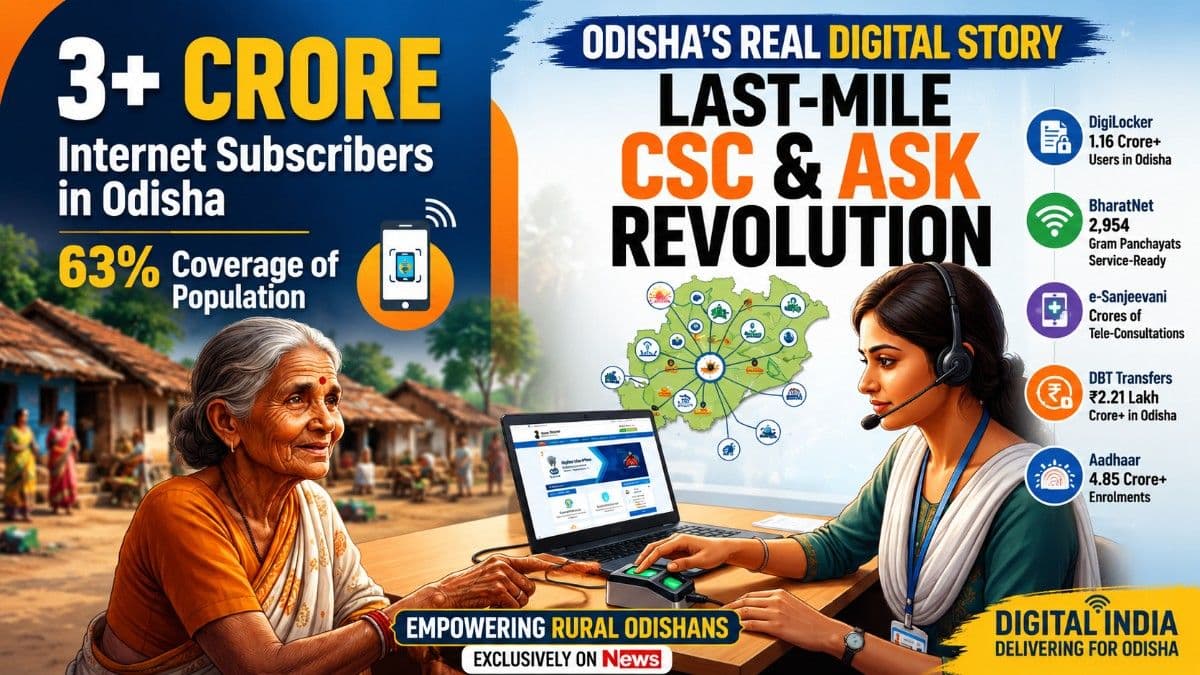
While Odisha has emerged as the digital frontrunner among eastern states with over three crore internet subscribers, the real transformation is unfolding in villages through more than 31,700 Common Service Centres (CSCs) and Ama Seva Kendras (ASKs), making Digital India a grassroots governance success.
Bhubaneswar: Odisha has quietly scripted one of the most significant chapters in Prime Minister Narendra Modi's Digital India mission.
The state has crossed the landmark of three crore internet subscribers, a milestone that translates into an internet penetration of nearly 63% when measured against Odisha's projected 2026 population of around 4.76 crore.
The achievement becomes even more striking when viewed against Odisha's demographic reality. More than eight out of every ten Odias live in rural areas, making digital expansion far more challenging than in highly urbanised states.
Yet, Odisha has emerged ahead of neighbouring Jharkhand (49%) and Chhattisgarh (53.5%), while closely trailing West Bengal (64%) and remaining behind Andhra Pradesh (74%), whose penetration is aided by larger urban centres.

📱 Get Argus News App
✨Odisha's 63% penetration therefore represents not merely rising smartphone ownership but the success of a rural-first digital infrastructure strategy that has dramatically narrowed the digital divide.
The Bigger Story: Last-Mile Digital Governance
If three crore internet subscribers represent the visible face of Digital India, the real story lies beneath the surface – in Odisha's expansive network of Common Service Centres (CSCs) and Ama Seva Kendras (ASKs).
Across the state, more than 20,229 CSCs and 11,535 ASKs have become the backbone of last-mile governance, taking digital public services to villages where smartphones alone cannot bridge the gap.
These centres have effectively converted internet connectivity into citizen services by enabling rural residents to access certificates, welfare schemes, Aadhaar services, banking, telemedicine and hundreds of central and state government services without travelling to district headquarters.
Unlike conventional infrastructure indicators such as kilometres of fibre optic cable, CSCs and ASKs measure digitisation from the citizen's perspective. Every centre represents a physical access point where technology is translated into governance through trained Village Level Entrepreneurs (VLEs), making digital services accessible even to those with limited digital literacy.
Why CSCs and ASKs Matter
The significance of this network extends far beyond internet connectivity.
For decades, rural citizens often travelled long distances, spent money on transport and lost a day's wages merely to obtain government certificates or submit welfare applications. CSCs and ASKs have virtually eliminated this "distance tax" by bringing government services to Gram Panchayat level.
Equally important, they address India's biggest digital challenge – digital literacy. Rather than expecting every citizen to independently navigate online portals, trained operators assist villagers in filling online forms, accessing DigiLocker documents, linking Aadhaar, applying for pensions, making digital payments and availing healthcare through e-Sanjeevani.
This assisted-digital model has significantly strengthened transparency by reducing dependence on middlemen while ensuring faster delivery of welfare benefits through Direct Benefit Transfer (DBT).
Per Capita Access Reveals a Different Digital Story
Absolute numbers naturally favour populous districts such as Ganjam, Balasore and Cuttack. However, when digital centres are measured against population, a different picture emerges.
Smaller districts have emerged as the real leaders in digital accessibility.
Boudh tops Odisha with 1.10 digital centres per 1,000 people, followed by Deogarh (1.06) and Gajapati (1.03). Even though these districts have fewer centres in absolute numbers, their sparse populations mean citizens enjoy greater access to physical digital infrastructure.
Among larger districts, Balangir (0.97) and Balasore (0.96) also perform strongly, indicating deliberate policy emphasis on western and tribal Odisha.
Conversely, urban districts such as Khordha (0.62) and Cuttack (0.70) record lower centre density because residents there increasingly access services directly through smartphones and broadband connections rather than assisted digital centres.
Rural Odisha Drives the Digital Revolution
The distribution of CSCs demonstrates that Odisha's digital strategy has been overwhelmingly rural.
Of the 20,229 CSCs, nearly 17,622 – or over 87% - operate in rural areas, exceeding the state's rural population share of around 83%. This alignment reflects a conscious policy choice to build infrastructure where digital exclusion was historically the greatest.
District-level data further reinforces this trend.
In Mayurbhanj, nearly 92% of CSCs are located in rural areas, supporting one of Odisha's largest tribal populations. Balangir, Kalahandi, Nuapada and Gajapati similarly maintain more than 90% rural distribution, ensuring digital governance reaches remote habitations.
Even Ganjam, Odisha's most populous district, retains nearly 84% of its CSCs in rural pockets despite having a major urban centre in Berhampur.
Only Khordha, home to Bhubaneswar, presents a different profile, with a much higher urban (40.6%) concentration reflecting the capital city's demographic structure.
Digital Strides Beyond Connectivity
Odisha's digital transformation extends well beyond internet subscriptions.
The state has over 4.85 crore Aadhaar enrolments, while nearly 1.16 crore residents have registered on DigiLocker, enabling paperless access to official documents. BharatNet has made 2,954 Gram Panchayats service-ready, and 3,726 mobile towers have been commissioned under the government's connectivity expansion projects.
Digital governance is equally visible in healthcare, where e-Sanjeevani has enabled 2.6 million of teleconsultations, reducing pressure on hospitals and extending specialist medical advice to remote regions. The state's digital ecosystem is further strengthened through UPI-based financial inclusion, DBT-enabled welfare delivery and the integration of government services on UMANG.
Together,
these indicators reveal that Odisha's Digital India story is no longer merely
about expanding internet connectivity. The state has built a hybrid digital
ecosystem where broadband infrastructure, assisted service centres and
cloud-based citizen platforms complement one another. Crossing the three-crore
internet subscriber mark may be the headline achievement, but the real
success lies in ensuring that digital governance reaches the last village and
the last citizen.
Also Read: 5G is Booming, Yet 1,091 Odisha Villages Remain Offline: Parliament Data Reveals the State's Two-Speed Digital Revolution | Exclusive
Related Topics
Explore more stories