



Viksit Odisha / Odisha’s 2036–2047 Vision Signals A Decisive Shift To Development Politics
Key Points
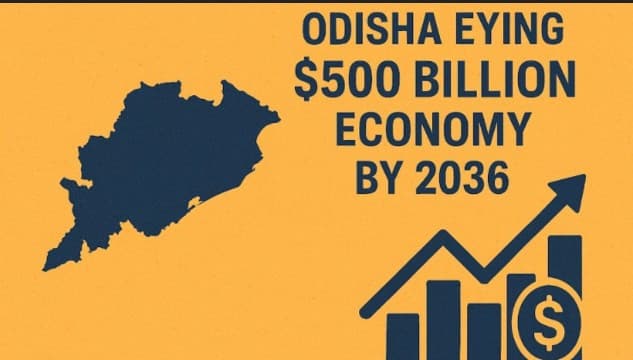
- Odisha aims for a $500 billion economy by 2036 and $1.5 trillion by 2047.
- Targets include per capita income of Rs32 lakh and poverty cut to 5%.
- Industry expansion with 100 MTPA steel capacity by 2030.
- Governance focus on law, order, and human capital development.
Bhubaneswar, Feb 19: Odisha’s development discourse took a sharply defined turn on Tuesday as the Bharatiya Janata Party government placed long-term economic transformation — not short-term populism — at the centre of its political narrative. The ambition to build a prosperous (“Samrudha”) Odisha by 2036 and a fully developed state by 2047 is more than a slogan; it is an attempt to anchor governance in measurable economic outcomes.
The framework, articulated by Governor Hari Babu Kambhampati in his nearly two-hour Assembly address, aligns Odisha’s trajectory with Prime Minister Narendra Modi’s “Viksit Bharat” vision — but with state-specific targets that are unusually bold in scale.

📱 Get Argus News App
✨A projected $500-billion economy by 2036 and a $1.5-trillion economy by 2047 would represent a structural leap rarely attempted in state planning documents. More significant than the headline numbers is the emphasis on execution: faster growth through investment, technology-led reforms and administrative efficiency. The target of raising Odisha’s GDP share from three to five per cent signals an intent to reposition the state from a resource supplier to a growth engine.
The social indicators embedded in the vision are equally telling. A jump in per capita income from Rs 1.8 lakh to Rs 32 lakh, multidimensional poverty cut to five per cent, 70 per cent female workforce participation, and the elimination of anaemia and malnutrition suggest that the government is framing development as human capital expansion, not merely industrial output. If achieved, these metrics would redefine Odisha’s socio-economic profile within a generation.
The Governor’s data points on industry strengthen the credibility of that pitch. With 24 PSUs profitable and dividends touching Rs 8,358 crore, and with Odisha already accounting for 23 per cent of India’s steel capacity, the state is positioning itself as a cornerstone of national manufacturing. The 100 MTPA steel target by 2030 is not just industrial ambition — it is a signal that Odisha wants to sit at the centre of India’s growth story rather than orbit it.
Equally important is the governance messaging around law and order. The decline in Left Wing Extremism and faster convictions in crimes against women and children are being presented as prerequisites for development. Investment flows where stability exists; the government appears keenly aware that economic credibility depends as much on security as on infrastructure.
The Opposition walkout by the Biju Janata Dal and the Indian National Congress highlighted the political contest over narrative. Yet the address makes clear that the ruling establishment intends to fight future elections on the plank of growth metrics, industrial expansion and governance delivery. In a political culture long dominated by welfare arithmetic, that represents a deliberate recalibration.
Whether the targets are fully realised will depend on execution over the next two decades. But the articulation of such a roadmap itself marks a shift: Odisha is no longer speaking the language of incremental progress. It is speaking the language of scale.
Related Topics
Explore more stories