



Water Conservation / Odisha Revives Groundwater with ‘Jal Sanchay, Jan Bhagidari’
Key Points
- Odisha harnesses monsoon rains to revive groundwater.
- Jajpur installs rooftop systems under CHHATA Scheme.
- Cuttack blends engineering and community for aquifer recharge.
- Digapahandi urban recharge shows measurable success.
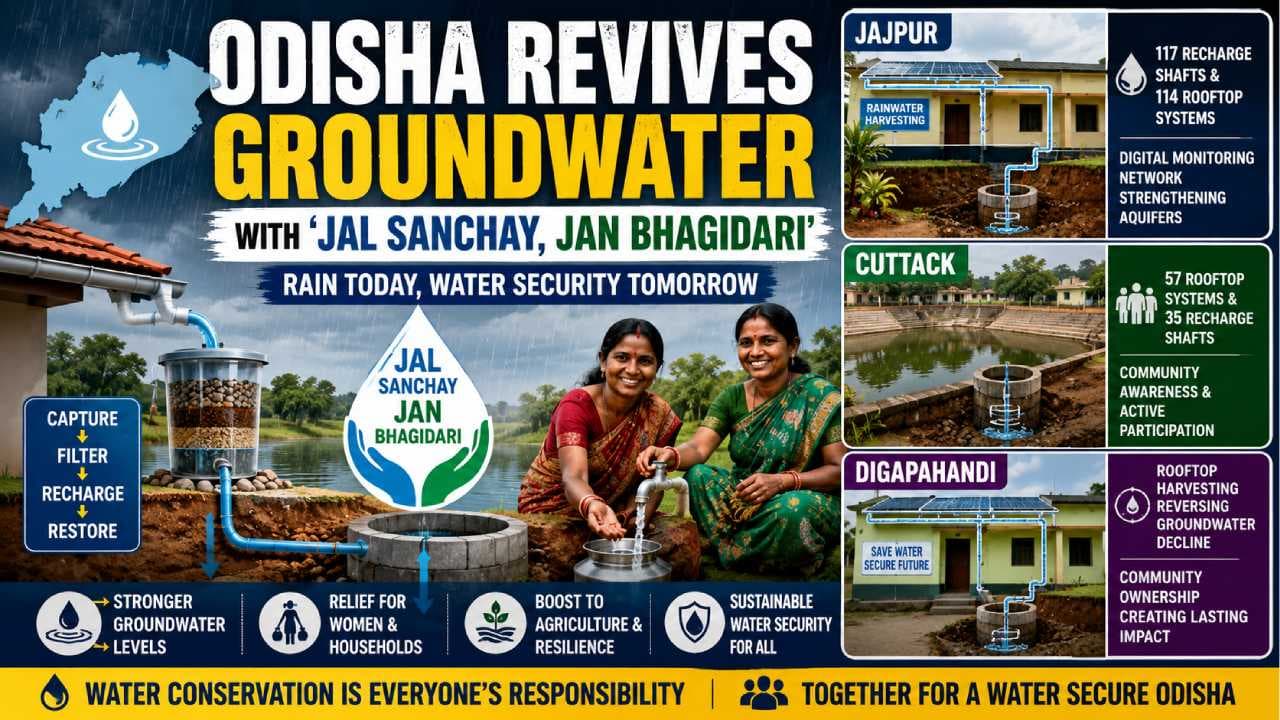
Bhubaneswar, Jun 11: As monsoon rains sweep across Odisha, the state is witnessing a quiet but transformative groundwater revival. From rooftop rainwater harvesting in Jajpur schools to recharge wells in Ganjam and pond-based interventions in Cuttack, the initiative ‘Jal Sanchay, Jan Bhagidari’ is turning seasonal rainfall into a lasting source of water security, officials said on Thursday.
Harnessing Rainwater
Guided by the vision of Prime Minister Narendra Modi and the “Whole of Government, Whole of Society” approach, Odisha is capturing rainwater where it falls and channeling it into aquifers. Rooftop runoff from schools, colleges, and government offices are being filtered and directed into recharge wells, while surplus pond and tank water is allowed to percolate deep underground. These measures are restoring groundwater levels, improving drinking water security, and reducing household burdens, particularly for women.
Jajpur: Scaling Up Recharge

📱 Get Argus News App
✨Between 2022-23 and 2025-26, Jajpur district constructed 117 recharge shafts under the ARUA Scheme and installed 114 rooftop systems under the CHHATA Scheme. A monitoring network of 47 digital water level recorders and 72 observation wells has shown healthier aquifer behavior. Improved groundwater availability has supported agriculture and strengthened resilience against water stress.
Cuttack: Engineering Meets Community
Cuttack district combined technical interventions with community engagement. Fifty-seven rooftop harvesting systems and 35 recharge shafts were established, while awareness campaigns, street plays, and workshops mobilized self-help groups and local institutions. Automated monitoring stations and observation wells confirmed a stable groundwater regime, with extraction levels maintained at around 47 per cent.
Digapahandi: Urban Recharge Success
In Ganjam’s Digapahandi urban area, rooftop harvesting
systems installed in schools and offices have reversed groundwater decline.
Observation wells near recharge structures recorded improved post-monsoon
recovery and reduced seasonal fluctuations. Public outreach ensured active
participation by residents, youth, and women’s groups, fostering ownership of
local water resources.
Also Read: Ayodhya Sarovar in Sambalpur Set for Rs440‑Crore Redevelopment
A People’s Movement
Odisha’s model demonstrates that sustainable groundwater management is most effective when infrastructure is combined with community ownership. By implementing the CHHATA and ARUA schemes, the state has created a replicable framework for water conservation. Each monsoon shower is now treated as an opportunity to replenish aquifers and secure the future.
Related Topics
Explore more stories