



Odisha Lokayukta Travails: Anti-Corruption Watchdog Lies Headless But Minister Suresh Pujari Assures New Chief Soon!
Key Points
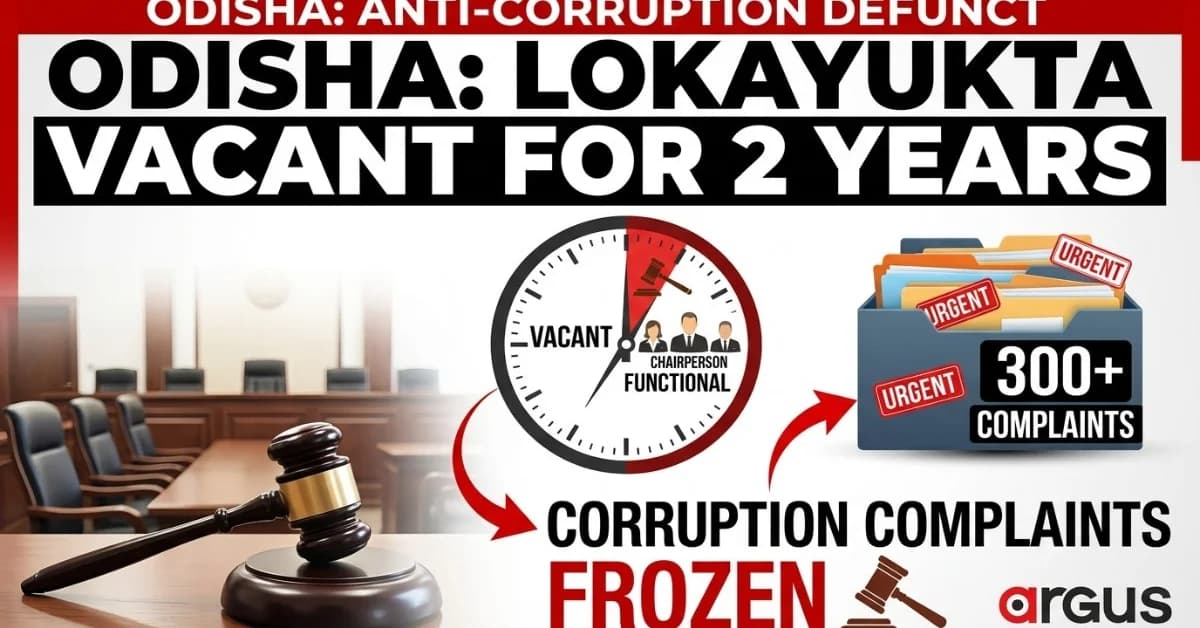
Bhubaneswar: Odisha is set to get a new Lokayukta soon, Revenue and Disaster Management Minister Suresh Pujari has said, but the assurance comes against the backdrop of a striking institutional failure: the State's statutory anti-corruption watchdog has remained virtually defunct for nearly two years, with its entire bench falling vacant by August 2024.
Pujari said the selection process has already begun and will be completed “very soon”. Addressing the 2year delay question, taking a dig at the previous BJD government, Pujari said, “What wasn't done in 24 years, we're doing it in two years. What we'll do in five years, the opposition won't even imagine.”.
The larger question remains here: why has an institution created specifically to investigate corruption allegations been left without a functioning bench for such a prolonged period?
A watchdog without a watchdog

📱 Get Argus News App
✨The Odisha Lokayukta was formally constituted in 2019, after Odisha enacted its Lokayukta law in 2014, with Presidential assent following in 2015. It took 4 years to appoint Justice Ajit Singh, former Chief Justice of the Gauhati High Court, as its first chairperson.
The appointment was not forthcoming. It came following this. After the Supreme Court directed the state to stop delays, the Odisha LokAyukta was officially constituted on February 28, 2019
The institution functioned through its first five-year cycle. But the succession process began to unravel in 2024.
Justice Ajit Singh retired in March 2024. Two other members subsequently completed their terms, while Dr Rajendra Prasad Sharma was appointed by the then Govt as acting chairperson. By August 2024, his retirement left the panel with zero serving members.
The consequence was not merely administrative.
Under the Odisha Lokayukta Act, a division bench requires at least two members, including a judicial member, to hear and dispose of complaints. With no members left, the statutory mechanism for hearing corruption complaints effectively collapsed.
The backlog nobody can ignore
The most worrying dimension is what happened to complaints during this institutional vacuum.
According to the RTI-based data cited in court proceedings, the Lokayukta registered 444 cases in early 2024 and disposed of 149 before the members retired. Subsequent complaints filed through late 2024, 2025 and into 2026 have remained frozen because there was no functioning bench to process them.
This creates an unusual accountability vacuum.
A corruption complaint cannot meaningfully proceed without a functioning statutory bench. At the same time, a public servant against whom allegations have been made also remains without institutional closure – whether that means investigation, adjudication or exoneration.
In other words, the vacancy hurts both accountability and institutional certainty.
The curious question of an acting chairperson
The Lokayukta's travails also raise a legal and administrative question: could the government have done something earlier?
Section 9 of the Odisha Lokayukta Act provides for an acting chairperson when the office of the chairperson falls vacant. The Governor can authorise the senior-most member to act as chairperson until a permanent appointment is made.
But there is an important catch.
An acting chairperson cannot substitute for an entire bench. Since the Act requires a minimum of two members, including at least one judicial member, merely having an acting head would not have restored the Lokayukta's full adjudicatory capacity if the other seats were vacant.
That makes the real failure less about the absence of one chairperson and more about the failure to ensure timely succession to the entire panel.
The law actually anticipated this problem
Perhaps the sharpest institutional question is why the vacancy was allowed to happen despite a statutory safeguard.
Section 5(6) of the Odisha Lokayukta Act requires steps for appointment of a permanent successor to be initiated at least three months before the expiry of the sitting chairperson's term.
The prolonged vacancy therefore isn't simply a matter of an appointment taking time.
It raises the question of whether the succession mechanism envisaged by the law was activated in time and, if not, why.
The Orissa High Court has already taken a serious view of the delay, with its division bench repeatedly questioning the administration over what was described as administrative apathy and pointing to the statutory requirement concerning timely replacement.
The selection process
The appointment is not solely in the hands of the Revenue Minister or the State Cabinet.
The selection committee comprises the Chief Minister, Speaker of the Assembly and Leader of the Opposition, with decisions taken through the prescribed majority mechanism.
Pujari has said the first meeting of the statutory selection committee has already taken place and that administrative and financial processes connected with the appointment have moved forward.
So, the latest assurance is that Odisha is finally approaching the end of the vacancy.
But that immediately raises another question: will appointing a new panel be enough to repair the damage caused by the prolonged institutional paralysis?
The real test begins after the appointment
The incoming Lokayukta will inherit more than an empty office.
It will inherit a backlog of complaints, an investigative machinery that has had little scope to function without a bench, and an institutional credibility deficit created by the prolonged vacancy. The Lokayukta has an Inquiry Wing and prosecution infrastructure, but without a functioning bench, the machinery cannot perform its core statutory role effectively.
The new body will therefore face a twin challenge: restart the institution and clear the accumulated pipeline of complaints.
How long should an anti-corruption watchdog remain without a functioning bench in a State that claims to be strengthening governance?
The answer will depend not on the announcement of a new Lokayukta, but on how quickly the new institution becomes capable of actually hearing, investigating and disposing of the complaints waiting at its door.
Related Topics
Explore more stories