



Odisha Lokayukta Selection Fast-Tracked: How Former CJI G.B. Pattanaik’s Entry Sets Full Appointment Process in Motion
Key Points
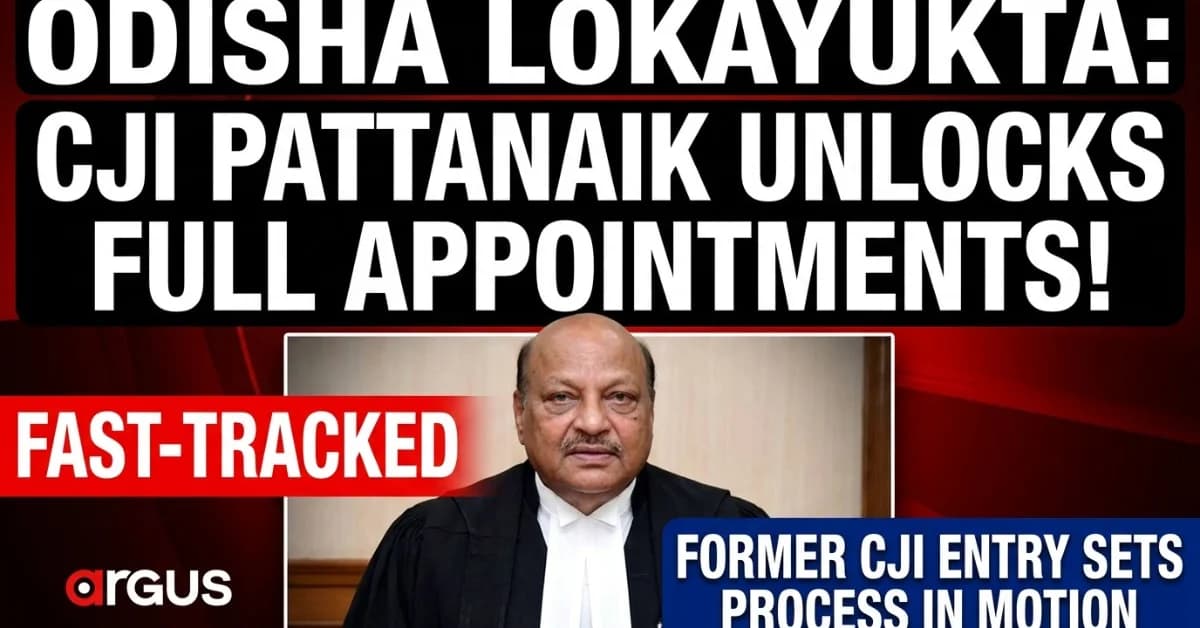
Bhubaneswar: The long-stalled process of reconstituting the full Odisha Lokayukta has suddenly moved into a faster lane with the selection of former Chief Justice of India Justice Gopal Ballav Pattanaik as the eminent jurist on the statutory Selection Committee.
Justice Pattanaik’s nomination has effectively completed the five-member mechanism required to select the Lokayukta Chairperson and members, clearing a key institutional hurdle that had held up the process. With the Selection Committee now fully constituted, the focus shifts to finalising candidates, taking a decision by majority and sending the selected names to the Governor for appointment.
The government is also moving simultaneously on another front. An amendment to the Odisha Lokayukta law is proposed to be placed before the Assembly to ensure that future vacancies, disagreements or non-cooperation by a member of the selection mechanism do not again freeze the appointment process.
The combined move signals a clear attempt to fast-track the complete revival of the anti-corruption institution.

📱 Get Argus News App
✨How the process was fast-tracked
The breakthrough came after the state's top political and judicial stakeholders reached a consensus on the choice of an eminent jurist.
The core selection mechanism comprises Chief Minister Mohan Charan Majhi, Assembly Speaker Surama Padhy, Leader of Opposition Naveen Patnaik and the Chief Justice of the Orissa High Court nominated Justice G.B. Pattanaik as member of the selection committee.
Following the consensus, the General Administration and Public Grievance Department issued the formal notification nominating the former CJI to the Selection Committee. His induction means the statutory five-member committee is now complete and can move towards the final phase of selecting the Lokayukta Chairperson and other members.
The next step is expected to be the consideration of the names shortlisted through the preliminary search mechanism. The full Selection Committee will examine the candidates and finalise the appointments.
Once the names are approved by the committee, the decision can be taken by majority and the recommendations forwarded to the Governor of Odisha for appointment.
This means Justice Pattanaik's selection is not merely an addition of one member. It is the move that has unlocked the full statutory machinery for constituting the Lokayukta.
Amendment bill to prevent another freeze
The government is also attempting to ensure that the present impasse does not become a recurring feature of the Lokayukta appointment process.
A proposed amendment to the Odisha Lokayukta Act is expected to be brought before the ongoing Monsoon Session of the Assembly. The objective is to make the selection process less vulnerable to political deadlock or the absence or non-cooperation of a particular member.
The proposed legal change is significant because it seeks to build continuity into the appointment mechanism. Once the amendment is in place, the selection process would be better insulated from situations in which one vacancy or one member's non-participation brings the entire institutional process to a standstill.
With the amendment process and the reconstituted Selection Committee moving together, the state government is effectively working on a two-track strategy –complete the current appointments quickly while also preventing future delays.
Why the choice of G.B. Pattanaik matters
The selection of Justice Gopal Ballav Pattanaik brings one of Odisha's most accomplished legal figures into the centre of the Lokayukta appointment process.
Popularly known as Justice G.B. Pattanaik, the Cuttack-born jurist rose through every major tier of India's judicial system before becoming the 32nd Chief Justice of India in November 2002.
Born on December 19, 1937, Justice Pattanaik's journey began in Odisha. He completed his early education in Cuttack, studied science at the historic Ravenshaw College and later obtained a B.Sc. degree from Ewing Christian College of Allahabad University. He subsequently pursued law at Madhusudan Law College in Cuttack.
Interestingly, law was not his first childhood ambition. He had initially aspired to become a doctor before eventually choosing the legal profession – a decision that would take him from the Orissa High Court to the highest judicial office in the country.
From the Bar to the highest judicial office
Justice Pattanaik enrolled as an advocate on February 28, 1962. During his years at the Bar, he handled civil, criminal, constitutional and corporate matters, building an extensive legal practice at the Orissa High Court and appearing in important cases before the Supreme Court.
His association with the Odisha government as a law officer began in 1971, when he was appointed Standing Counsel. He later became Additional Government Advocate in 1974 and subsequently served as Government Advocate.
The judicial elevation came on June 1, 1983, when he was appointed a permanent judge of the Orissa High Court.
His career then moved rapidly through the higher judiciary. On May 19, 1995, he was appointed Chief Justice of the Patna High Court. Within months, on September 11 that year, he was elevated to the Supreme Court of India.
Seven years later, on November 8, 2002, he took oath as the 32nd Chief Justice of India, administered by then President A.P.J. Abdul Kalam. He retired from office on December 19, 2002.
A jurist with a constitutional legacy
During his tenure in the Supreme Court, Justice Pattanaik was associated with several important legal matters, including the landmark constitutional proceedings in Danial Latifi v. Union of India, which dealt with the Muslim Women (Protection of Rights on Divorce) Act, 1986, and questions surrounding maintenance rights.
After retirement, he continued to be associated with public and institutional assignments. He headed and participated in several committees and also served as chairman of the selection committee for the Saraswati Samman literary award.
He has been recognised for his contribution to law and public life, including with the Utkal Ratna Award.
Justice Pattanaik has also documented his life journey in his Odia memoir, Mone Achhi Jetiki, published in 2021. His journey has also been chronicled in English in The Gown and The Gavel: Life Journey of a Former Chief Justice of India.
The countdown to a fully functional Lokayukta
The selection of Justice G.B. Pattanaik has now changed the pace of the Lokayukta process. The mechanism that was incomplete is now fully constituted, the shortlist process is already in motion, and the government is preparing a legislative safeguard to prevent future deadlocks.
The final Selection Committee will now have to choose the Lokayukta Chairperson and the remaining members of the anti-corruption body. Once selected, the names will go to the Governor for appointment and the full institution can begin functioning.
The urgency has also been sharpened by judicial scrutiny over delays in completing the appointments and the pending corruption-related matters requiring institutional attention.
For Odisha, therefore, the nomination of a former Chief Justice of India is the key step that has transformed the Lokayukta process from an incomplete exercise into a fast-moving selection operation.
The coming weeks will determine how quickly that momentum translates into the formal constitution and activation of the full Odisha Lokayukta.
Related Topics
Explore more stories