



Flood Fury / Odisha Floods Ease, Relief and Rescue Continue as Government Maintains Vigil
Key Points
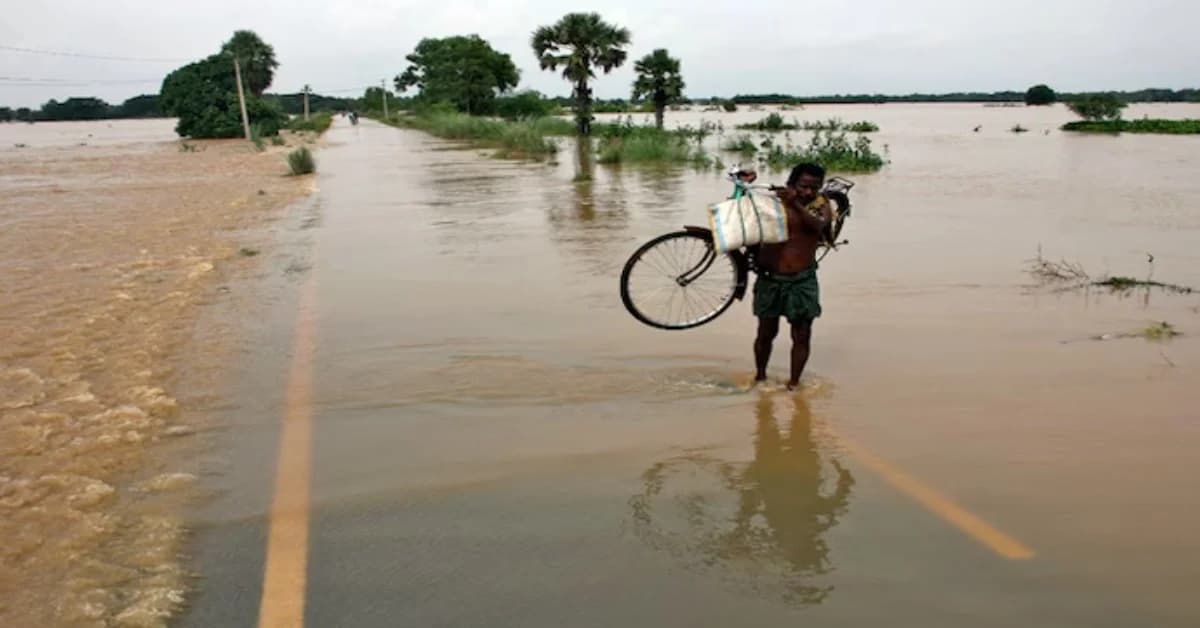
Floods in Odisha are easing as river levels fall and rainfall reduces. Relief camps shelter thousands, response teams remain active, and authorities continue 24×7 monitoring to ensure safety and timely support.
Bhubaneswar, Sep 3: The flood situation in Odisha is showing steady improvement, with river levels across most major rivers on a falling trend and rainfall activity reducing significantly.
Authorities have confirmed that the overall situation remains under control, though certain districts continue to face challenges.
The State Government, in coordination with district administrations, is maintaining round‑the‑clock monitoring while relief, response, and restoration measures are ongoing in affected areas.
Also read: Rain Eases in Odisha, But Subarnarekha Fury Drowns Northern Baleshwar

📱 Get Argus News App
✨According to the latest reports, Jajpur, Mayurbhanj, and Baleshwar remain impacted. In Jajpur, Dasarathpur block is still affected, with 19 gram panchayats and 62 villages under floodwaters.
Relief efforts are active, with 22 camps accommodating 7,745 beneficiaries. In Mayurbhanj, 21 blocks, 53 gram panchayats, and 97 villages are affected, along with two wards of Baripada Municipality.
A total of 29 relief camps are operational, covering 10,501 people. Authorities have reported 104 damaged houses, and nine polythene rolls have been distributed to assist families.
In Baleshwar, five blocks — Bhogarai, Baliapal, Basta, Remuna, and Jaleshwar — remain affected, covering 41 gram panchayats and 214 villages. Relief operations there include 72 camps serving 35,740 beneficiaries.
Response teams remain deployed across the districts. On Thursday, 47 teams were in action, comprising 21 ODRAF units, 4 NDRF teams, and 22 Fire & Emergency Services squads.
Jajpur has three ODRAF teams on the ground, Mayurbhanj has six ODRAF and 13 Fire & Emergency Services teams, while Baleshwar has 12 ODRAF, 4 NDRF, and 9 Fire & Emergency Services units engaged in rescue and relief operations.
River levels across the state are largely falling, signaling gradual improvement. The Subarnarekha River is the only one still flowing above danger level.
At Rajghat, the river stood at 10.84 meters at noon, above the danger mark of 10.36 meters, but is showing a declining trend.
Other rivers — including the Mahanadi at Naraj, IB at Sundaragada, Brahmani at Panposh, Baitarani at Anandpur and Akhuapada, Burhabalanga at NH‑5, Vansadhara at Gunupur, and Jalaka at Mathani — are also receding.
The Hirakud reservoir level was recorded at 627.29 feet, with an inflow of 1,41,962 cusecs and an outflow of 78,429 cusecs through four open gates.
The India Meteorological Department (IMD) has forecast that the well‑marked low‑pressure area over northeast Madhya Pradesh will move west‑northwestwards across south Uttar Pradesh and adjoining north Madhya Pradesh within 24 hours.
Thunderstorms with lightning and gusty winds of 30-40 kmph are likely at isolated places in Baleshwar, Bhadrak, Jajpur, Kendrapada, Jagatsinghapur, Kataka, Kendujhar, and Mayurbhanj. These districts have been placed under Yellow Warning, with people advised to take shelter during thunderstorms to avoid lightning strikes.
District administrations have been instructed to remain alert to localized flooding, waterlogging in low‑lying areas, closure of underpasses, potential damage to roads and vulnerable structures, and harm to horticulture and standing crops. Relief measures, including supply of cattle feed, are being extended to affected districts.
The Special Relief Commissioner’s Office confirmed that the State Emergency Operation Centre continues to monitor the situation 24×7 in coordination with all District Emergency Operation Centres.
With rainfall activity easing and river levels falling,
officials say the situation is gradually stabilizing, though preparedness
remains high to ensure timely support to affected communities.
Related Topics
Explore more stories