



Odisha DGP Selection Gets Curioser: How CBI Report, UPSC Deadlock & SC Intervention Changed The Race| Exclusive
Key Points
Bhubaneswar: The race for Odisha’s next Director General of Police has suddenly moved from an administrative selection exercise to a legal battle, with the Supreme Court stepping in after senior advocate P Chidambaram alleged that the Odisha government was attempting to alter the pool of eligible candidates after the Union Public Service Commission’s August 7 meeting failed to produce a shortlist.
Mentioning a PIL before a CJI Surya Kant-led bench on Tuesday, Chidambaram alleged that the State had withdrawn the list sent to the UPSC and was attempting to promote an ADGP and bring the officer into the selection pool. The Supreme Court agreed to hear the matter and made it clear that the UPSC is duty-bound to approach the court in case of non-compliance with its directions.
The development is significant because the Supreme Court had reiterated in February 2026 that the prescribed procedure for DGP appointments cannot be bypassed merely because the number of eligible officers is limited. Under the framework, the UPSC prepares the panel and the State appoints the DGP from among those empanelled.
Why Did The August 7 UPSC Meeting Remain Inconclusive?

📱 Get Argus News App
✨The August 7 meeting was expected to be the decisive moment in Odisha’s DGP succession, with the UPSC empanelment committee scheduled to prune the State’s larger pool of officers to three names.
But the selection ran into an unusual problem.
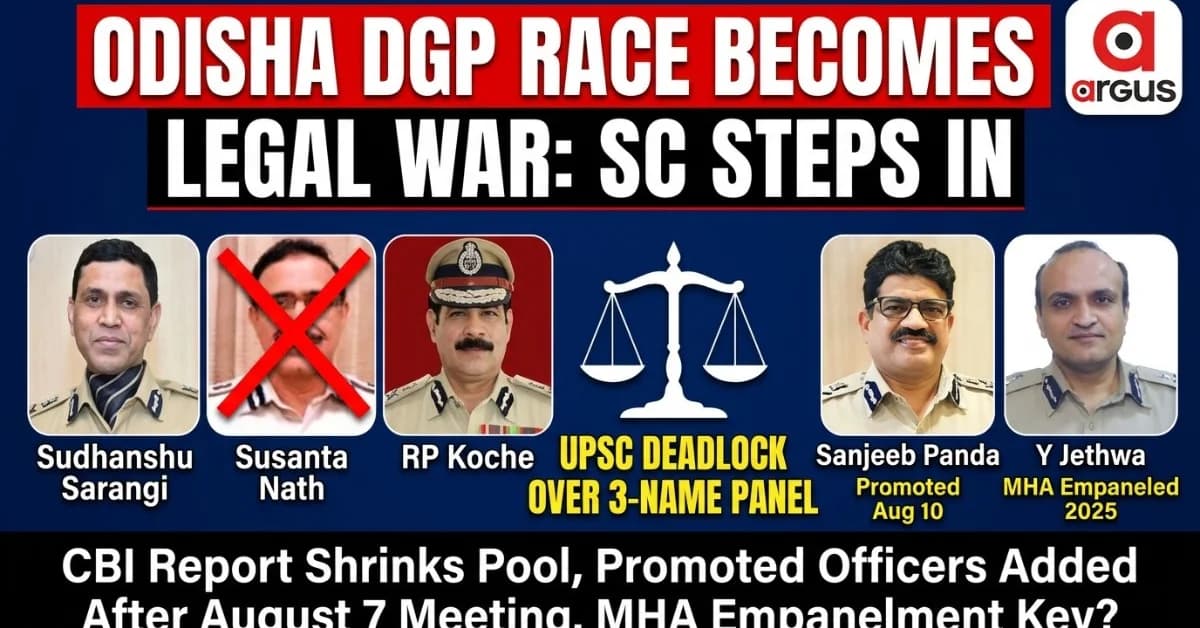
The State’s original pool contained three DG-rank officers at the top – Sudhanshu Sarangi, Susanta Nath and R.P. Koche – along with a larger group of ADG-rank officers.
The subsequent CBI vetting process, however, became a crucial factor in determining who could effectively remain in contention.
According to top official sources, the CBI’s adverse report concerning Susanta Nath altered the equation. Once Nath was effectively knocked out of the clean DG-rank pool, Odisha was left with only two DG-rank officers who could form the core of the final selection.
That created the central problem: how could the UPSC select three names when the State effectively had only two uncontroversial DG-rank candidates?
The August 7 meeting therefore remained inconclusive, with the selection process entering a procedural grey zone. The Supreme Court has since made clear that the prescribed eligibility framework cannot simply be diluted because the pool is small.
The Integrity Certificate Withdrawal: What Chidambaram Said – And What Happened Behind It?
This is perhaps the most intriguing part of the episode.
Before the Supreme Court, P Chidambaram alleged that the State had withdrawn the list after the UPSC meeting. His submission was blunt: “Odisha withdrew the list. They are now making another list to send.” He further alleged that the State was trying to promote an ADGP and “smuggle him into the list and get him considered.”
But the administrative sequence points to a more complicated explanation.
The issue was not simply that Odisha withdrew its list and decided to create a new one. The CBI’s adverse feedback had already changed the composition of the pool before the UPSC could complete its exercise.
In effect, the CBI report shrank the three-DG equation to two viable DG-rank officers.
The UPSC, acting on the vetting material before it, was therefore confronted with a candidate pool that did not neatly fit the requirement of producing three names.
That is what makes the withdrawal of the State’s list significant. It came after the integrity/vetting issue had altered the original arithmetic of the selection.
The State’s subsequent move to elevate two ADGPs to DG rank on August 10 has therefore become the central point of legal scrutiny.
CBI Report Threw A Spanner Into Odisha’s DGP Selection
The roots of the present crisis go back to the Odisha SI recruitment examination paper-leak case. Here is the timeline given.
- September 2025: The Odisha Sub-Inspector (SI) recruitment examination is abruptly cancelled just days before its scheduled date following a massive paper-leak detection.
- November 12, 2025: The CBI officially takes over the criminal investigation from the State Crime Branch.
- December 30, 2025 – January 2, 2026: Within its mandatory 90-day window, the CBI files its primary, extensive chargesheet before the Special CJM Court in Bhubaneswar. The document exposes systemic vulnerabilities in the printing press, name-dropping technical leaks, but places severe scrutiny on the oversight of the Odisha Police Recruitment Board (OPRB).
The Adverse Report
- April – May 2026: Anticipating the August retirement of the incumbent DGP Y.B. Khurania, the Odisha state government transmits its pool of potential candidates to the UPSC. The pool includes 1993-batch DG Susanta Kumar Nath, who sat above the 1994-batch contenders in structural seniority.
- June – July 2026: During the mandatory vetting and documentation clearance process, the CBI officially transmits its adverse feedback report to the UPSC. The report details Nath's supervisory lapses as the structural head of the OPRB when the leak occurred. This adverse reporting technically invalidates his promotion prospects for the top post, reshaping the selection pool from the top down.
That changed the equation at the top.
Before the CBI report, the three senior DG-rank names – Sarangi, Nath and Koche – offered the UPSC a straightforward three-name pool. Once Nath became problematic from the integrity/vetting standpoint, the equation effectively became Sarangi + Koche = only two viable DG-rank choices.
That, in turn, collided with the UPSC's requirement to produce a three-member panel.
And that is where the DGP selection stopped being a routine seniority exercise.
August 10: Why Did Odisha Elevate Two ADGPs To DG Rank?
On August 10, barely three days after the inconclusive UPSC meeting, Odisha promoted two 1994-batch IPS officers – Y.K. Jethwa and Sanjeeb Panda – to the DG rank.
The timing immediately attracted attention.
Chidambaram specifically referred to the move before the Supreme Court, alleging that the State was attempting to promote an ADGP and then include him in the DGP selection pool.
The State's administrative rationale, however, can be viewed through a different lens.
Once the CBI report had effectively removed Nath from the equation, Odisha had only two DG-rank officers available for a three-name UPSC panel. Elevating ADGPs to DG rank therefore created additional officers who could potentially fill the vacancy in the eligible pool.
In other words, the August 10 promotions came after the August 7 UPSC deadlock and appear directly connected to the problem created by the reduced DG-rank pool.
But this is precisely where the legal question arises: can a State alter the rank composition of its officers after the UPSC selection exercise has already begun, and can such a newly promoted officer be brought into the DGP selection process?
The Supreme Court's intervention has made that question central to the appointment.
What Changed After The Supreme Court Case? What Will UPSC Do?
The biggest change is that the DGP selection is no longer merely about seniority within Odisha. Central empanelment could now become an important factor.
Among the DG-rank officers, Sudhanshu Sarangi and R.P. Koche have been empanelled by the Ministry of Home Affairs for DG-level posts at the Centre. Susanta Nath, despite being promoted to DG rank and serving as DG (Prisons), was not similarly empanelled by the MHA for a DG-level central post.
There is another important piece in the puzzle: Y.K. Jethwa, one of the two officers promoted to DG rank on August 10, had already been empanelled by the MHA for DG-level posts at the Centre.
That could prove significant.
If the UPSC, following the Supreme Court's intervention, takes the position that only officers holding the DG rank should be considered for the State DGP panel, the Central empanelment of Jethwa could provide the bridge between the original seniority-based pool and the newly created DG-rank pool.
The possible arithmetic could therefore become:
Sudhanshu Sarangi + R.P. Koche + Y.K. Jethwa
The crucial point is that Jethwa's central DG empanelment predates his August 10 elevation in Odisha. Therefore, the State could argue that his promotion was not an artificial creation of eligibility, but a formalisation at the State level of an officer who had already been found suitable for DG-level responsibilities by the Centre.
Whether the UPSC accepts that logic – and whether the Supreme Court permits such a post-August 7 change to influence the selection – is now the big question.
Bottomline: The Centre's DG List May Hold The Key
The Supreme Court's intervention has brought the Odisha DGP selection under a much sharper institutional lens.
The CJI-led bench has reiterated that the prescribed Prakash Singh framework cannot be bypassed merely because the State has a limited pool of eligible officers.
And this is where Odisha's Central empanelment picture becomes important.
If the State effectively has only two DG-rank officers who remain in the clear after the CBI vetting episode, the MHA's prior empanelment of Y.K. Jethwa for DG-level posts could become a decisive piece of the UPSC's three-name puzzle.
The immediate question, therefore, is no longer merely who will become Odisha DGP?
It is who will UPSC consider eligible to be among the three – and can an officer promoted to DG rank after the first UPSC meeting enter that equation?
The answer
could determine whether the Odisha DGP race remains a contest between seniority
and service record or becomes a test case on how strictly the Prakash Singh
framework must be followed when the State's eligible DG pool itself changes
mid-process.
Also Read: Odisha DGP Race Gets Twist: How Sanjeeb Panda’s DG Elevation Changed the Top 3 Equation| Exclusive
Related Topics
Explore more stories