



NIT Rourkela Leads Breakthrough In Power System Cybersecurity
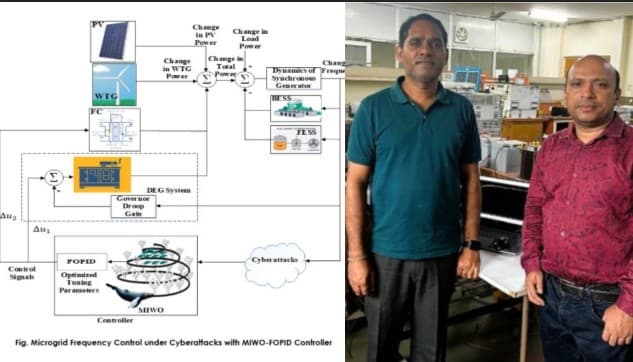
Key Points
MIWO-FOPID controller ensures microgrid stability under cyberattacks.
Algorithm tested in both simulations and real-world hardware setups.
Published in IEEE journal, marking global recognition of the innovation.
Rourkela, Aug 25: In a groundbreaking development, researchers from the National Institute of Technology (NIT) Rourkela, in collaboration with multiple institutions, have pioneered a whale-inspired algorithm to fortify microgrids against cyberattacks. The innovation marks a significant leap in securing localized power systems that are increasingly vital to the global energy transition.
Led by Prof. Pravat Kumar Ray, Head of the Department of Electrical Engineering at NIT Rourkela, the team developed the Modified Improved Whale Optimisation (MIWO) algorithm, drawing inspiration from the bubble-net hunting strategy of humpback whales. This natural phenomenon was translated into a sophisticated control mechanism capable of resisting time delays, false data injection, malware, and random cyber intrusions.

📱 Get Argus News App
✨Microgrids, which integrate renewable sources like solar and wind with energy storage and traditional generators, rely heavily on digital communication. This dependency makes them vulnerable to cyber threats that can destabilize power systems. To counter this, the researchers introduced the MIWO-based Fractional Order PID (FOPID) controller, which ensures robust secondary frequency regulation even during adversarial conditions.
Also Read: NIT Rourkela Hosts INDISCON 2025, Showcasing Smart And Sustainable Tech For Society
“Modern microgrids are exposed to a range of cyber threats due to their reliance on communication networks,” said Prof. Ray. “Our algorithm incorporates adaptive strategies and multi-phase exploitation mechanisms to enhance accuracy, convergence, and resilience.”
The MIWO-FOPID controller was rigorously tested through both computer simulations and real-world hardware experiments, demonstrating its ability to maintain system stability under various attack scenarios. These include time-delay attacks, false data injection (FDI), energy storage system (ESS) status manipulation, and malware intrusions.
Key advantages of the algorithm include:
Enhanced safety and reliability of modern power systems.
Stable microgrid operation under cyber threats, reducing service disruptions.
Seamless integration of renewable energy sources with dependable performance.
The research findings were published in the prestigious journal IEEE Transactions on Consumer Electronics, co-authored by Prof. Ray, Mr. Ramesh Chandra Khamari (NIT Rourkela), Dr. Manoj Kumar Senapati (Government College of Engineering, Keonjhar), and Dr. Sanjeevikumar Padmanaban (University of South-Eastern Norway).
This innovation not only supports India’s renewable energy ambitions but also provides a scalable framework for global energy stakeholders to enhance cybersecurity in smart grids and critical infrastructure.