



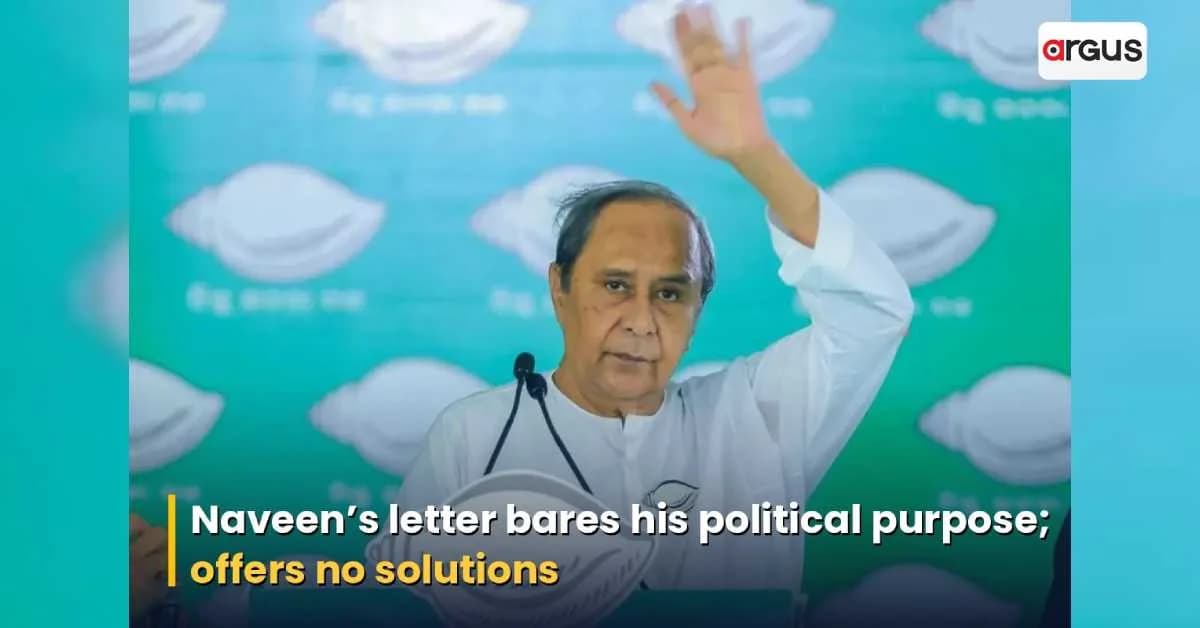
Kotia Dispute / Naveen’s letter bares his political purpose; offers no solutions
Key Points
Bhubaneswar, Oct 30: Andhra Pradesh's notification of panchayat polls in three Kotia villages gave Odisha's opposition an opening. Both states claim 21 of the 28 villages of the Kotia gram panchayat, and the dispute is decades old. Within days, Naveen Patnaik, BJD president and Leader of Opposition, wrote to Chief Minister Mohan Majhi. The speed of the letter says something about its purpose. A leader seeking a solution would first ask what is legally possible. A leader seeking political ground acts while the headline is fresh.
Patnaik's letter was reported as an attack on the government's silence. It accused the BJP of abandoning its pre-election "go back Andhra" slogan and mocked the “double-engine” claim. It also asked whether the BJP's alliance with the TDP was affecting Odisha's handling of the dispute. That is a political insinuation, not a policy proposal.
What the letter did not contain matters as much. There was no call for an all-party meeting, no offer of a joint delegation to the Centre, no legal strategy, no suggestion of any kind. For a dispute the opposition leader himself calls an "inseparable part" of Odisha's identity, this is a striking omission. If the aim was to protect Kotia, the letter offered the government nothing to act on. If the aim was to put the government on the defensive, it was well built.
The central weakness of the letter is who wrote it. Patnaik governed Odisha for more than two decades. Kotia was not a new problem in 2024. Andhra set up polling booths and held direct panchayat elections in some Kotia villages in 2021, disregarding Odisha's objections. That happened under his government. The BJP's line, as stated by minister Suresh Pujari, is that the issue escalated through the negligence of the previous BJD government. The critique is that a man who spent 24 years in office without resolving the matter is now demanding results from a government a little over two years old, in a tone suggesting the problem began the day he left.

📱 Get Argus News App
✨The critics go further. Naveen's government is also said to have had a cordial working relationship with Jagan Mohan Reddy's administration in Andhra, yet Kotia was never made a matter of negotiation or sustained legal push. The argument is not that the BJP has solved the problem, but that the BJD has little standing to treat it as a fresh betrayal.
Majhi's reply, dated 27 October, is more carefully built than a routine rejoinder.
Paragraph 1 acknowledges receipt and names the issue, keeping the tone formal and the heat low.
Paragraph 2 is the core. It states that Kotia has been part of Odisha since the separate province was formed in 1936 and commits to safeguarding Odisha's interests. Then comes the key sentence: the letter "appears to approach this sensitive issue from a political standpoint rather than advance constructive and legally tenable solutions." The word "legally" matters. It signals that the matter will be resolved before courts and constitutional bodies, not through public letter-writing.
Paragraph 3 moves from rebuttal to record. It lists what the government says it has done: a Committee under the Revenue and Disaster Management Minister overseeing integrated development of the Kotia Gram Panchayat areas, and repeated visits by ministers and senior officials to review local needs. The message is that the government is acting on the ground, not merely issuing statements.
Paragraph 4 appeals for restraint and respect for the judicial process, which is both a reassurance to the public and a pointed rebuke to anyone who inflames a sensitive border matter.
Paragraph 5 turns the tables. Majhi asked Patnaik for "constructive suggestions" to resolve the dispute. This single line transfers the burden of proof. If Patnaik has ideas, he must now put them on the table. If he does not, his letter's claim to be driven by concern for Kotia loses force.
The two letters reflect two styles. One is written to be quoted and circulated, built around a charge. The other is written to be filed, built around a record and a procedure. The CM's letter does not deny that the issue is serious; it denies that it should be treated as an opposition weapon. By inviting suggestions rather than answering charge for charge, it positions the government as the party seeking a solution.
The wider pattern is familiar. Border disputes are rich political terrain because they combine identity, emotion and an external adversary. For an opposition out of power, such an issue is attractive precisely because the costs of rhetoric are low and the demands of resolution are high. The BJD's tone on Kotia suggests it prefers the first.
Patnaik now has a choice. He can reply with concrete proposals: support for the legal track, a joint all-party approach, a demand for specific steps. That would show a genuine interest in the villagers and the territory. Or he can respond with another round of accusations, which would reinforce the reading that Kotia is, for the BJD, an instrument rather than a cause.
Supporters of Patnaik and the BJD would reject much of this.
They would say an opposition leader is entitled to ask hard questions when a
neighbouring state moves toward polls in contested villages, and that the
letter was a legitimate demand for the government's stand. They would note that
the BJP campaigned on a "go back Andhra" slogan, which makes the
question fair game. They would argue that the BJP now controls both Bhubaneswar
and, through its TDP ally, has influence in Amaravati, so it holds more levers
than any opposition party. They would also point out that the Majhi reply is
itself political: it leans on the 24-year record because that is convenient,
and it asks the opposition for solutions that a government in power is better
placed to deliver.
Also Read: CM Mohan Majhi Writes to Naveen Patnaik, Reaffirms Odisha's Claim Over Kotia Villages
Finally, there is the historical record to consider: Odisha moved the Supreme Court over this dispute after Andhra's 2021 polls, so the legal track began under the BJD government, and the villages' status has resisted resolution under governments of different parties for decades.
Now that the matter is sub judice and beyond the direct administrative control of the two state governments, political parties in Odisha must tread cautiously and demonstrate greater political maturity. Narrow political interests and partisan agendas must give way to the larger common objective of safeguarding the territorial integrity of the state.
Related Topics
Explore more stories