



LED Street Lighting Scam: Will Former BJD-Era Big Babus, Netas Come Under Vigilance Scanner?| Special Report
Key Points
* Investigators suspect vital components were never installed despite full payments being released under BGBO and SFC-funded projects.
* Probe seeks to establish financial loss and determine whether accountability extends beyond field-level officials to higher decision-makers.
Bhubaneswar: Is Odisha staring at another major corruption scandal of the previous govt?
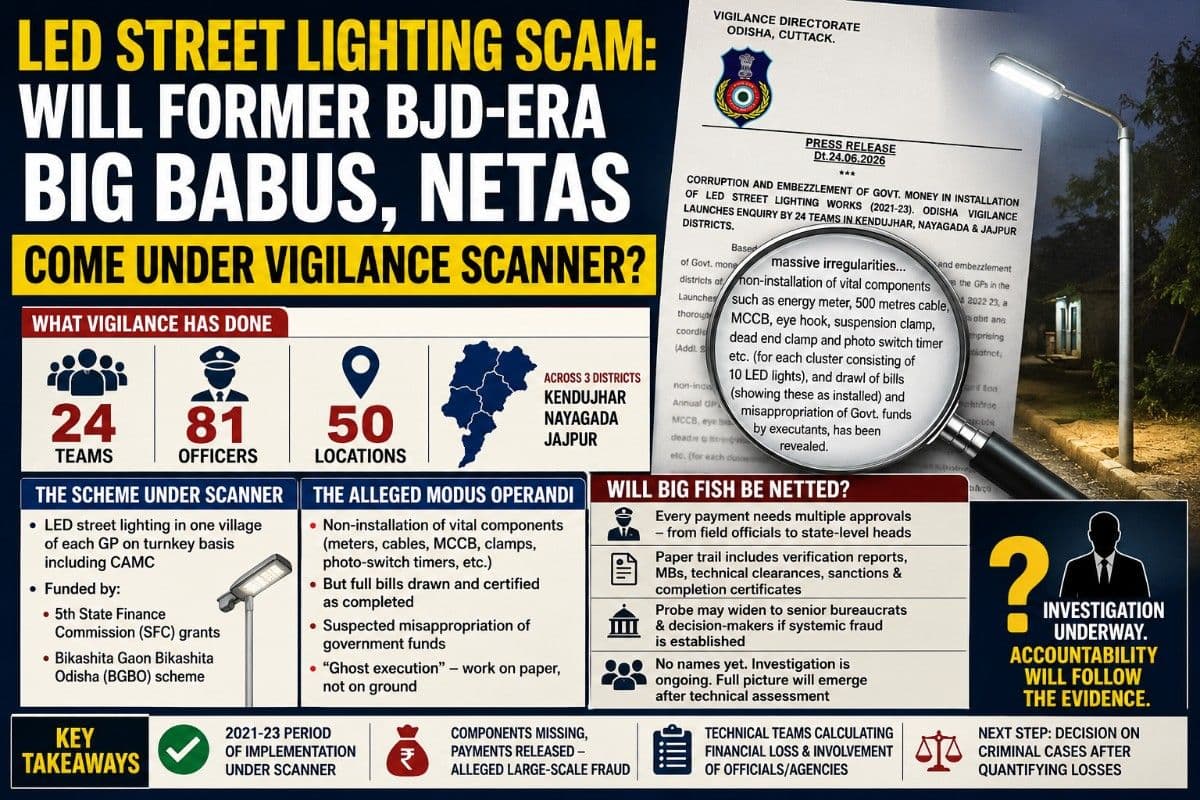
That question is gaining momentum after the Odisha Vigilance Directorate launched one of its largest coordinated field enquiries in recent years, deploying 24 teams comprising 81 officers across 50 locations in Kendujhar, Jajpur and Nayagarh districts to investigate alleged large-scale irregularities in a rural LED street lighting programme executed between 2021 and 2023.
What began as a technical verification exercise is rapidly evolving into a probe that could potentially expose a much wider network of officials, contractors and decision-makers linked to the implementation of LED street lighting systems under the previous BJD government's flagship rural development initiatives.
The central question now being debated in administrative and political circles is whether the investigation will remain confined to field-level engineers and contractors –or eventually climb the bureaucratic and political ladder.

📱 Get Argus News App
✨The Scheme Under Scanner
The project involved installation of LED street lighting systems in villages across Gram Panchayats on a turnkey basis, along with Comprehensive Annual Maintenance Contracts (CAMC).
Funding came from two major public sources:
- 5th State Finance Commission (SFC) grants
- Bikashita Gaon Bikashita Odisha (BGBO) scheme
The objective was straightforward: illuminate rural Odisha through modern energy-efficient infrastructure.
However, Vigilance investigators suspect that in numerous locations, substantial portions of the infrastructure existed only on paper.
The Alleged Modus Operandi
According to preliminary technical assessments, several critical components that formed an integral part of the approved design were allegedly never installed despite payments being released.
Among the missing components reportedly detected during inspections are:
- Energy meters
- Extensive stretches of electrical cabling
- Molded Case Circuit Breakers (MCCBs)
- Eye hooks
- Suspension clamps
- Dead-end clamps
- Photo-switch timers
Investigators suspect that complete project bills were drawn and certified despite the absence of these essential materials.
In simple terms, officials are examining whether public money was paid for infrastructure that never physically existed.
If established, the fraud would represent a classic case of "ghost execution" – where records show completion while ground reality tells a different story.
Why Vigilance Is Taking It Seriously
The scale of the operation offers perhaps the strongest indication that Vigilance believes the irregularities may not be isolated incidents.
Instead of conducting routine departmental inspections, the Directorate mobilized:
- 24 specialised teams
- 81 officers
- Simultaneous inspections at 50 locations
Such coordinated action is typically undertaken when investigators fear records could disappear, be altered, or be influenced if advance warning is given.
The immediate objective is to quantify the actual loss to the state exchequer.
The larger objective appears to be identifying who authorized payments for allegedly incomplete works.
The Big Question: Who Signed the Bills?
Every public works project leaves a paper trail.
For payments to be released under a turnkey contract, multiple layers of certification are usually required, including:
- Physical verification reports
- Measurement books
- Technical clearances
- Financial sanctions
- Completion certificates
This is why the investigation is attracting attention far beyond the contractor community.
If crucial components were indeed missing on the ground, investigators are likely to ask:
Who verified the works?
Who certified completion?
Who approved payments?
And who supervised implementation at district and state levels?
Could Senior Bureaucrats Come Under Scanner?
State Vigilance sources point out that projects funded through SFC grants and flagship rural development schemes involve multiple layers of oversight.
At the district level, implementation typically passes through:
- District Rural Development Agencies (DRDAs)
- Executive engineers
- Project directors
- Panchayati Raj officials
At the state level, policy oversight and budget allocation rest with senior officials of the Panchayati Raj and Drinking Water Department.
Should the enquiry uncover evidence of systemic manipulation rather than isolated field-level fraud, the probe could potentially widen to examine administrative accountability at higher levels.
At present, however, Vigilance has not named any senior officer.
Political Corridors Buzzing
The timing of the investigation has added a political dimension.
The alleged irregularities relate to the 2021-23 period when Odisha was governed by the BJD.
While no political leader has been accused by investigators so far, political observers are already speculating whether the probe could eventually revisit decisions taken during the implementation of the BGBO programme.
They note that flagship schemes often carry significant political visibility, making accountability questions particularly sensitive when corruption allegations emerge years later.
Corporate Executing Agencies Yet to Be Named
One of the most closely watched aspects of the enquiry concerns the identity of the private agencies that secured the turnkey contracts.
Vigilance sources have so far not officially disclosed the names of any company under scrutiny.
Investigators are currently examining:
- Tender documents
- Work orders
- Agreement files
- Payment records
- Technical sanction papers
These records are expected to reveal which entities executed the projects and whether contract conditions were followed.
The names of companies are likely to emerge only after investigators complete their field verification and register formal criminal cases, if warranted.
What Happens Next?
The next phase of the enquiry will be crucial.
Technical teams are expected to calculate:
- Actual infrastructure installed
- Infrastructure shown on paper
- Value of missing components
- Financial loss to the government
Once the quantum of alleged misappropriation is established, Vigilance will decide whether criminal cases should be registered.
That stage could transform the enquiry from a technical audit into a full-fledged corruption investigation.
The Bottom Line
For now, the Odisha Vigilance Directorate has not named any politician, senior bureaucrat or corporate entity.
But the nature of the alleged fraud raises uncomfortable questions.
If payments were released for infrastructure that never existed, responsibility may not stop at the last official who signed a measurement book.
The investigation now underway will determine whether this was merely a case of local-level manipulation –or whether the trail ultimately leads to influential figures who supervised one of the previous government's rural development programmes.
As Vigilance
teams continue their statewide scrutiny, Odisha's political and administrative
establishment will be watching closely to see whether the probe catches only
small fish – or eventually reaches the big ones.
Also Read: Why Odisha Has Become a Prime Target for Job Fraud Syndicates| Special Report
Related Topics
Explore more stories