



Is Bhubaneswar Going the Delhi Way? How City's Explosive Vehicular Density, BMC Worsen PM10 Pollution Despite 88% NCAP Funds Spent | Exclusive
Key Points
Bhubaneswar: For decades, Odisha's capital prided itself on its sprawling green canopy, broad planned avenues and relatively cleaner coastal air.
But the latest assessment by the Central Pollution Control Board (CPCB) under the National Clean Air Programme (NCAP) has punctured that perception, exposing a silent yet alarming deterioration in the city's air quality.
Bhubaneswar
is not merely losing its clean air – it is actively driving itself into an
urban pollution trap, raising a worrying question among environmental planners:
Is Bhubaneswar slowly heading the Delhi way?
It seems the days are not far away when road users have to put on mask while travelling!
The numbers tells the tale of looming danger.

📱 Get Argus News App
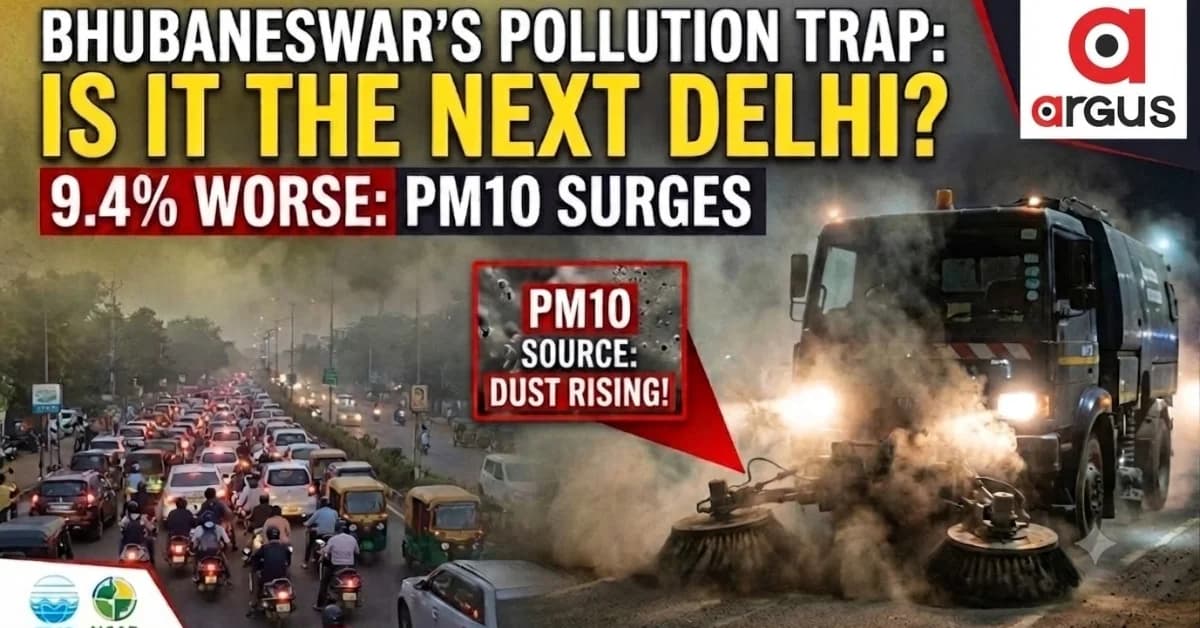
✨Between the NCAP baseline year of 2017-18 and the latest assessment period 2025-26, Bhubaneswar's average PM10 concentration climbed from 85 micrograms per cubic metre (µg/m³) to 93 µg/m³, marking a 9.4 per cent deterioration instead of the mandated reduction.
The decline places Odisha's capital among only 22 cities across India where PM10 pollution has worsened despite years of clean-air interventions.
Far from being an industrial city like Delhi or Angul, Bhubaneswar's deteriorating air quality points to a different culprit altogether – rapid urbanisation, exploding vehicle density, poor dust management and ineffective deployment of pollution-control infrastructure.
Vroooming PM10
Unlike Delhi, whose pollution is driven by a combination of industries, stubble burning and winter meteorology, Bhubaneswar's pollution story is increasingly being scripted on its own roads.
Official transport statistics reveal that registered vehicles in the city surged from nearly 8.8 lakh during 2017-18 to more than 14.2 lakh in 2025-26, representing an extraordinary 61 per cent increase within eight years.
Every month, nearly 12,000 new vehicles are being added to the city's roads, dramatically increasing pressure on an urban road network that was never designed for such explosive motorisation.
The result is an unprecedented rise in vehicular density.
Bhubaneswar now accommodates roughly 7,634 vehicles per square kilometre, compared to 4,731 vehicles per sq km during the NCAP baseline period – an addition of nearly 2,900 vehicles competing for every square kilometre of urban space.
Environmental experts point out that this density matters far more than absolute vehicle numbers.
Nearly 80 per cent of new registrations comprise two-wheelers, whose constant movement along road shoulders repeatedly lifts accumulated roadside dust into the atmosphere. Unlike exhaust emissions, this phenomenon – known as road dust resuspension – is a mechanical process in which tyres continuously grind against asphalt and loose soil, generating coarse particulate matter or PM10. Light commercial vehicles, diesel three-wheelers and expanding logistics traffic further aggravate the problem.
Ironically, even though a large proportion of new vehicles comply with BS-VI emission standards, the city continues to witness worsening PM10 levels because cleaner engines cannot eliminate pollution caused by tyre wear, brake dust and disturbed roadside soil.
Urban planners describe Bhubaneswar's roads as functioning like a giant mechanical blender. Every passing vehicle churns up settled dust, creating a continuous haze that persists even without major industrial emissions.
This explains why Bhubaneswar's PM10 trajectory has moved in the opposite direction of the NCAP objective despite improvements in vehicular emission norms.
Broooming PM10
Ironically, one of the city's flagship anti-pollution measures may itself be contributing to the PM10 problem.
Across major arterial roads, the Bhubaneswar Municipal Corporation (BMC) routinely deploys mechanical road sweepers to remove accumulated dust.
But environmental specialists argue that the technology presently being used resembles giant rotating brooms rather than scientific vacuum sweepers.
These machines employ stiff rotating brushes that scrape dry road surfaces and fling accumulated dust into the air before it can be collected.
On roads already coated with fine soil, construction debris and loose sediment, the brushing action creates intense turbulence, sending large quantities of PM10 and even finer particles back into the breathing zone of commuters.
Instead of eliminating pollution, poorly configured mechanical sweepers risk becoming secondary generators of airborne dust.
Experts recommend that BMC gradually replace conventional brush-based machines with regenerative air sweepers or PM10-certified vacuum sweepers, technologies that physically seal the road surface, loosen embedded dust using controlled airflow and immediately suck it into enclosed filtration chambers.
Unlike traditional mechanical broom sweepers, regenerative air systems recycle air within a closed loop, ensuring virtually no dust escapes back into the atmosphere. High-efficiency vacuum sweepers complement suction with continuous water misting, preventing fine particles from becoming airborne during cleaning operations.
Equally important is how the machines are operated.
Environmental guidelines recommend that mechanised sweeping be carried out between 11 pm and 5 am, when traffic-induced turbulence is minimal. Continuous water spraying, routine filter maintenance and strict vacuum performance monitoring are considered essential for preventing dust leakage.
The irony is difficult to miss. At a time when Bhubaneswar is struggling to reduce particulate pollution, the city's own sanitation operations risk undermining the objectives of the National Clean Air Programme.
88% Funds Spent, Zero Result: Why Bhubaneswar Needs Chandigarh's Clean-Air Playbook
If spending alone guaranteed cleaner air, Bhubaneswar should have been among India's biggest success stories under the National Clean Air Programme.
Instead, the capital presents one of NCAP's most troubling paradoxes.
Official data show Bhubaneswar received Rs50.63 crore under NCAP and utilised Rs44.83 crore, translating into an impressive 88.5 per cent utilisation rate. Yet during the same period, PM10 pollution worsened by 9.4 per cent, increasing from 85 µg/m³ to 93 µg/m³.
The contrast with Chandigarh is striking.
Despite utilising only 66.6 per cent of its allocated NCAP funds, Chandigarh achieved a remarkable 24.6 per cent reduction in PM10 levels – from 114 µg/m³ to 86 µg/m³.
The difference lies not in expenditure but in execution.
Rather than focusing primarily on plantation drives and beautification, Chandigarh invested heavily in scientifically designed vacuum road sweepers, dedicated dust-suppression fleets, continuous water sprinkling, intelligent traffic management systems and strict construction dust control.
Its roads are vacuum-cleaned during late-night hours using enclosed suction systems instead of dry brushing.
Traffic signals are synchronised through Intelligent Traffic Management Systems (ITMS) to minimise idling emissions.
The city is rapidly expanding its electric public transport fleet while maintaining segregated cycling infrastructure to reduce dependence on private vehicles.
Construction and demolition waste is scientifically processed rather than allowed to accumulate along roadsides.
Bhubaneswar's expenditure, by contrast, appears to have emphasised roadside plantation, median beautification and pollution management after dust generation rather than preventing it at the source.
The Bhubaneswar Municipal Corporation's procurement of conventional mechanical sweepers instead of PM10-certified vacuum systems has limited the effectiveness of spending.
For a rapidly expanding planned city, the lesson is unmistakable: spending more does not necessarily produce cleaner air; spending smarter does.
Odisha Lens: Cuttack Slips, Talcher Holds the Line
The deterioration is not confined to Bhubaneswar.
Odisha's second major urban centre, Cuttack, also recorded worsening PM10 levels under the latest NCAP assessment. Average PM10 concentration increased from 93 µg/m³ to 99 µg/m³, representing a 6.5 per cent deterioration. During the same period, registered vehicles expanded from around 5.1 lakh to more than 7.9 lakh, pushing vehicle density from 3,517 vehicles per sq km to 5,448 vehicles per sq km.
The twin cities together have added more than 8.2 lakh registered vehicles since the NCAP baseline year, placing enormous pressure on a shared urban airshed already grappling with rapid construction activity and growing traffic congestion.
Yet one Odisha city tells a different story.
Talcher, despite being one of eastern India's largest coal and thermal power hubs, remained broadly stable. Its average PM10 concentration marginally improved from 113 µg/m³ to 112 µg/m³, making it the only Odisha city that avoided deterioration during the assessment period.
The document attributes this stability to tighter regulatory oversight of industrial point sources through continuous emission monitoring systems, whereas Bhubaneswar's dominant pollution sources – road dust, construction activity and rapidly increasing vehicle density – remain diffuse and comparatively harder to regulate.
That contrast carries a sobering message.
If an industrial city dominated by coal-fired power plants can prevent a significant rise in PM10 through targeted regulation, there is little reason why a planned capital city cannot reverse its own pollution trajectory through better urban management.
For Bhubaneswar, the warning bells are already ringing.
The city is
still far from Delhi's pollution extremes. But unless vehicle growth, road
dust, construction debris and scientific street-cleaning are addressed
together, Odisha's green capital risks surrendering one of its greatest
advantages – clean, breathable air.
Alsdo Read: Bhubaneswar's Air Growing Fouler Than Bengaluru, Mumbai, Hyderabad; Tech City's Big Dream Faces Pollution Challenge | Exclusive Details Inside
Related Topics
Explore more stories