



Irony of Odisha’s ‘Zero Fatality’ Drive: How STA Ignored CAG Warnings on Overspeeding Before Tragic Dhauli Crash| Special Report
Key Points
Odisha's State Transport Authority issued over 60,000 e-challans in just two days during the ongoing "Zero Fatality Week" drive.
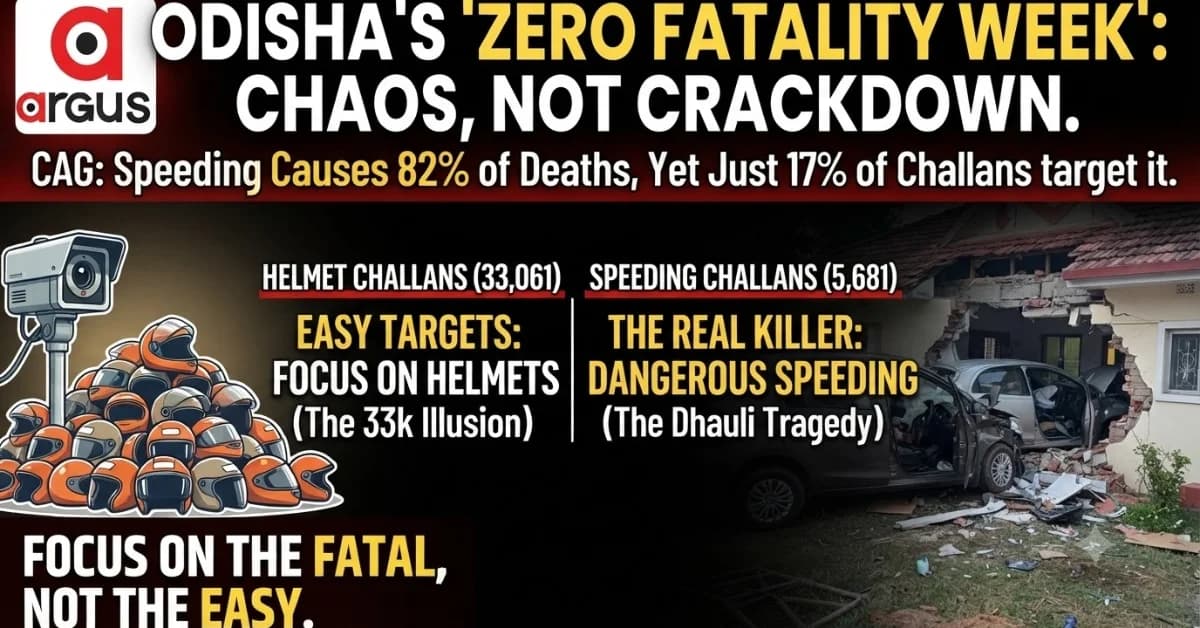
CAG audits reveal that overspeeding accounts for up to 82.20% of fatal road crashes in the state.
Enforcement heavily targets helmet violations (33,061 challans) compared to speeding (5,681 challans), leaving critical safety gaps exposed.
Bhubaneswar: On the very second day of Odisha’s ongoing “Zero Fatality Week” drive, the State Transport Authority (STA) issued 60,242 e-challans – a number that would ordinarily be held up as evidence of an aggressive crackdown on traffic violations.
But behind the impressive enforcement statistics lies a far more uncomfortable reality: overspeeding remains the apex killer on Odisha’s roads, while the state’s enforcement architecture continues to struggle with the very behaviour most directly linked to fatal crashes.
The contrast became particularly stark after a speeding Bolero rammed into a family home in the Dhauli police station area, leaving two people critically injured. The crash has once again brought into focus whether Odisha’s road-safety strategy is targeting the violations that actually kill – or simply those that are easier to detect and penalise.
Official data available shows that Odisha recorded 12,375 road accidents and 6,142 fatalities in 2024. Over-speeding and reckless driving accounted for more than 75% of the preventable deaths, even as the enforcement machinery continued to generate far larger numbers of helmet-related challans.

📱 Get Argus News App
✨The deeper problem, however, is not merely the number of challans. It is the structural gap between what Odisha knows about road fatalities and where its enforcement capacity is actually deployed.
CAG Warning: Overspeeding Accounts for Up to 82.20% of Fatal Crashes
The structural failure to curb speeding is not merely a matter of perception. The Comptroller and Auditor General (CAG) audit in its 2025 report concluded that over-speeding accounted for up to 82.20% of fatal road accidents in Odisha. Yet the state’s ability to enforce speed limits remains constrained by shortages of equipment, technology and personnel.
This raises a fundamental question: if overspeeding is responsible for such a dominant share of fatal crashes, why does the enforcement system continue to generate dramatically more challans for helmet violations than for speeding?
The answer lies partly in the architecture of enforcement itself.
33,061 Helmet Challans, Just 5,681 for Speeding
|
Metric |
Helmetless Riding Enforcement
Speeding Enforcement (The Bolero Scenario)
Volume of Challans
Extremely High (33,000+)
Low (~5,600)
Primary Victim
The individual rider (self-harm).
Innocent third parties (pedestrians, other motorists, houses).
Fatality Catalyst
Increases the severity of an injury during an impact.
Directly causes the loss of vehicle control and the impact itself.
The Dhauli Blindspot
Even if every rider in Dhauli wore a helmet, it would not have stopped a speeding Bolero from ramming into a house.
Directly addresses the root cause of the Dhauli tragedy.
Helmet violations are comparatively easy to identify. A rider without a helmet can be spotted by traffic personnel or conventional surveillance cameras without sophisticated speed-measuring equipment.
Speeding is different.
Detecting it reliably requires radar-equipped Speed Interceptor Vehicles (SIVs), calibrated speed guns or fixed Automated Over-Speed Enforcement Systems (OSES). The inputs indicate that these resources remain limited, forcing speeding enforcement to remain concentrated on selected corridors rather than being pervasive across the road network.
The result is a system where the easiest violation can produce the biggest enforcement number, even though another violation carries a much greater fatality risk.
The 37-Interceptor Problem
One of the most glaring capacity gaps is the shortage of mobile speed interceptors.
Odisha has a road network spanning more than 5,000 km of National and State Highways, but the transport department relies on only 37 radar-equipped interceptor vehicles, according to CAG report.
That creates an obvious enforcement limitation.
A handful of mobile units cannot continuously monitor the thousands of kilometres of highways, district roads, town approaches, bypasses and semi-urban stretches where vehicles can accelerate beyond safe limits.
The Dhauli police station jurisdiction illustrates the vulnerability. Such transitional stretches between urban and rural environments can become speed corridors, yet may not have the same automated enforcement footprint as major highways.
The Camera Blindspot
Odisha has begun moving towards technology-driven enforcement through the Intelligent Enforcement Management System (IEMS).
The system has been launched on four major highway stretches, including Manguli–Sambalpur and Sambalpur–Rourkela, using ANPR cameras to automatically issue e-challans for violations including speeding, wrong-side driving, triple riding and helmet violations.
But it has a crucial limitation: the technology footprint remains narrow compared with the scale of the road network.
Automated enforcement concentrated on selected highways leaves municipal roads, accident-prone curves, rural links and semi-urban corridors without continuous speed monitoring.
That creates predictable blindspots.
Drivers familiar with the enforcement map can slow down where cameras are known to operate and accelerate again after clearing those points.
For road safety, such enforcement is inherently reactive rather than pervasive.
The Speed Governor Loophole
Another structural gap identified in the CAG-related inputs concerns Speed Limiting Devices or speed governors on commercial and transport vehicles.
The rules require heavy commercial vehicles to be fitted with speed governors, but the enforcement system lacks effective continuous digital monitoring to establish whether those devices remain functional after the vehicle clears its initial fitness test.
In other words, the existence of a speed governor on paper does not necessarily translate into a continuously enforced speed ceiling on the road.
This is particularly significant because commercial vehicles and larger SUVs travelling at excessive speed pose risks not only to their occupants but also to pedestrians, other motorists and properties along roads.
The ‘90-Day’ Enforcement Gap
The CAG audit highlighted the breakdown in dynamic database synchronisation between regional transport offices and active enforcement mechanisms. Vehicles flagged for violations could face a significant delay before their records translated into effective restrictions.
Only from September 1, 2026, the STA activated the “Not to be Transacted” lock at toll plazas for vehicles with challans overdue beyond 90 days.
The measure means vehicles with unresolved violations can be prevented from transactions such as sale, RC transfer or fitness-related updates.
The technological intervention is significant, but it also underscores the question of why such a systemic enforcement mechanism took years to become operational despite repeated warnings.
The Forensic Blindspot
The problem is not limited to enforcement before a crash. It extends to what happens after one.
A former top STA official also put glare on the lack of scientific and institutionalised crash analysis as another major loophole.
High-speed crashes are frequently registered under generic descriptions such as rash or negligent driving without systematically reconstructing the variables that could establish the dynamics of the crash – speed, vehicle weight, braking distance and other physical evidence.
That creates a vicious cycle.
If crash investigations do not systematically generate reliable location-specific speed and risk data, authorities have less evidence with which to identify dangerous stretches and introduce appropriate countermeasures.
The result is that the crash happens first, while preventive engineering measures arrive = if at all – later.
Why ‘Zero Fatality’ Numbers Can Mislead
The larger irony is that enforcement statistics can create an appearance of heightened road safety without necessarily attacking the underlying fatality drivers.
The 'ZERO Fatality' Week zooms “low-hanging fruit” effect: violations that require minimal equipment and effort generate high enforcement numbers, while violations requiring specialised infrastructure generate fewer challans.
This does not mean helmet enforcement is unnecessary.
Helmet compliance remains important because helmets reduce the severity of injuries in crashes.
But a helmet challan cannot prevent a speeding vehicle from losing control and crashing into a house.
That distinction becomes painfully clear in the Dhauli case.
The enforcement data showed 33,061 helmetless challans against just 5,681 speeding challans on September 2. Yet the fatality risk associated with uncontrolled vehicle speed is precisely what makes speed enforcement so critical.
From Challan Counting to Risk Reduction
The central challenge for Odisha's transport authorities is therefore to change the definition of enforcement success.
The number of challans issued is an easy metric to count.
But the more meaningful question is whether vehicles are actually being forced to travel at safer speeds on accident-prone roads.
Therefore, road safety experts recommend for a 360-degree road-safety strategy built around risk mitigation rather than enforcement volume.
Accident data should be used to map black spots, residential zones and other high-risk stretches. Permanent speed-control measures and digital speed-calibrating signs should be deployed where necessary.
The AI-based enforcement systems should also move beyond major national highways and expand to State Highways and major district roads, where speeding and reckless driving can remain difficult to detect.
Most importantly, the success metric should shift – from the number of challans issued to the reduction in average vehicle speeds and actual accident rates in high-risk zones.
Because ultimately, a “Zero Fatality Week” cannot be judged by how many challans a department generates.
It
has to be judged by whether fewer families are left grieving – or,
as the Dhauli crash grimly demonstrates, whether citizens can remain
safe even inside their own homes.
Also Read: Odisha Road Safety Overdrive: Record Challans Expose Big Chinks in State Transport Authority’s Enforcement Armour| Special Report
Related Topics
Explore more stories